
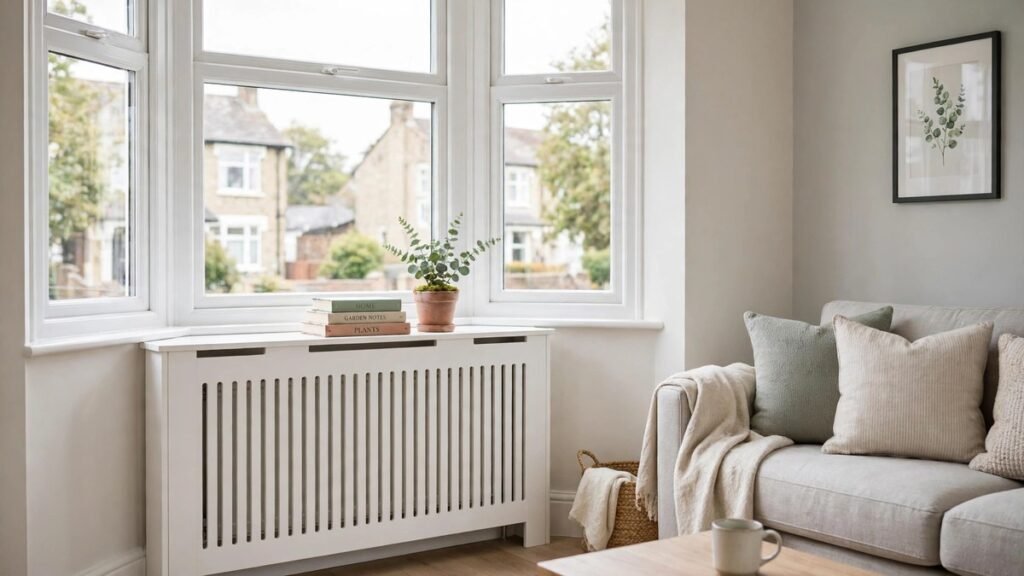
Radiator covers in the UK cost £25 to £450, and they hide an ugly radiator while adding a shelf and a safety barrier. A well-designed cover cuts heat output by only 5 to 10 percent, but a solid, poorly ventilated cover can cut it by 20 to 30 percent or more.
Key Takeaways
- Radiator covers hide ugly radiators, add a shelf, and protect children and pets from hot surfaces.
- A well-designed cover with open slats and good airflow cuts heat output by only 5 to 10 percent, according to Stelrad.
- A solid cover with poor ventilation can cut heat output by 20 to 30 percent or more, according to the Energy Saving Trust.
- Ready-made MDF radiator covers in the UK typically cost £25 to £125, while made-to-measure covers cost £70 to £250 or more.
- Measure the width, height and depth of your radiator, then add 5 cm in width, 3 cm in height and 3 cm in depth for airflow.
- Fit a reflective panel behind radiators on uninsulated outside walls, because the Energy Saving Trust says it can save around £18 a year.
- Never dry clothes on a radiator cover, and keep the top and bottom vents clear so warm air can move.
What Is a Radiator Cover?
A radiator cover is a cabinet that fits over a radiator to hide it, protect people from the hot surface, and give you a flat shelf on top.
Most covers are made from MDF, wood or metal, and the front has slats or a grille so warm air can pass through. Some are freestanding and sit on the floor, some fix to the wall, and some are made to measure for an exact fit. A good cover looks like a piece of furniture, and a bad one looks like a box that traps heat.
Radiator covers are common in UK homes for three reasons. First, many radiators are old, rusty or badly placed, and a cover makes the room look tidy. Second, a cover stops small children and pets from touching a hot radiator. Third, the flat top works as a shelf for books, photos and plants. The trade-off is heat: every cover blocks some heat, so the design matters more than the price.
Do Radiator Covers Block Heat?
Yes, radiator covers block some heat, but a well-designed cover blocks very little, and a badly designed cover blocks a lot.
A radiator warms a room in two ways. About 20 to 30 percent of its heat leaves as radiation, which travels in a straight line from the hot panel into the room, according to Stelrad. The rest leaves by convection, as cool air enters at the bottom, warms up, and rises out of the top. A cover gets in the way of both, because a solid front blocks radiation and a closed top traps rising warm air.
The cover itself does not stop your boiler from working. It stops some of the heat from reaching the room, so the room warms up more slowly and the boiler runs for longer. That is why a cover with big openings and clear airflow costs you far less than a cover that is mostly solid.
How Much Heat Does a Radiator Cover Block?
A well-designed cover with an open or lattice front, a ventilated top and good clearance cuts heat output by around 5 to 10 percent, according to Stelrad.
A moderately restrictive cover with a mesh or grille front typically cuts output by 10 to 20 percent, according to Stelrad. A poorly designed cover with solid front and top panels and tight clearances can cut output by 20 to 30 percent or more, according to the Energy Saving Trust. That is a wide range, and it is the reason two covers that look alike can perform very differently.
A 2016 study by researchers at Liverpool John Moores University, published in the journal Energy and Buildings, tested this directly. The study found that traditional solid wooden casings cut heat output by up to 40 percent, while a better-ventilated magnetic cover design cut output by only around 11 percent. The ventilated design was 13 to 20 percent more efficient than the traditional wooden covers tested.
| Cover design | Heat output lost | Airflow |
|---|---|---|
| Open slats or lattice front, ventilated top | Around 5 to 10 percent | Good |
| Mesh or grille front, some top ventilation | Around 10 to 20 percent | Fair |
| Solid front and solid top, tight fit | 20 to 30 percent or more | Poor |
| Traditional solid wooden casing | Up to 40 percent in lab tests | Poor |
These figures come from Stelrad and the Liverpool John Moores University study, and they show the same lesson: openings matter more than material. A cheap MDF cover with wide slats can beat an expensive solid wood cover that seals the radiator in.
Why Do Covers Reduce Heat Output?
Covers reduce heat output because they break the convection loop that a radiator needs to work well.
Cool air should flow in at the bottom of the radiator, pass over the hot panels, and rise out of the top into the room. A cover with a closed bottom starves the radiator of cool air, and a cover with a closed top traps the warm air inside. The air inside the cover gets hot, the radiator cannot shed heat as fast, and less warmth reaches the room.
A solid front panel adds a second problem, because it blocks the radiant heat that would otherwise travel straight into the room. Metal covers conduct some of that heat through the panel and release it, while thick MDF and wood insulate it and hold it back. That is one reason metal covers often perform better than solid wooden ones, even though wood looks warmer.
Curtains, sofas and furniture cause the same problem. The Building Research Establishment notes that any obstruction around a radiator, whether furniture, curtains or a cover, will reduce its effective output. If your sofa already sits in front of the radiator, adding a cover on top of that makes the problem worse.
What Types of Radiator Covers Are There?
Radiator covers come in four main types: MDF, solid wood, metal, and adjustable or made-to-measure designs.
The material sets the price, the look and how much heat gets through. The front pattern sets the airflow. You need to choose both, because a good material with a bad front still traps heat.
What Are MDF Radiator Covers?
MDF radiator covers are the most common type in the UK, because MDF is cheap, smooth and easy to paint.
MDF stands for medium-density fibreboard, and it is made from wood fibres pressed together with resin. It takes paint well, it does not warp as easily as solid wood, and it comes in ready-made sizes from about £25 to £125. Most ready-made covers on Wayfair UK in November 2026 were MDF, with prices from £24 for a small cover to around £125 for an extra large one.
MDF has two limits. It is heavy, and it does not like water, so it suits living rooms and bedrooms better than damp bathrooms. It also insulates heat, so an MDF cover needs wide slats or a large grille to let warmth out. Look for a powder-coated or sealed finish, which lasts longer and wipes clean.
What Are Solid Wood Radiator Covers?
Solid wood radiator covers are made from oak, pine or another hardwood, and they look better than MDF in period homes.
A solid wood cover suits Victorian and Edwardian rooms, where a painted MDF box can look out of place. Oak covers cost the most, with made-to-measure hardwood covers quoted at £900 to £1,300 for three covers on MyJobQuote in 2026, which works out at about £300 to £430 each. Pine is cheaper and easier to paint, but it can warp and crack in dry heat over time.
Wood also insulates, so the same airflow rule applies. A solid wood cover with a wide open grille performs well, while a solid wood cover with small holes performs badly. If you pay for hardwood, spend the money on the front design as well as the timber.
What Are Metal Radiator Covers?
Metal radiator covers are usually made from steel or aluminium, and they conduct heat better than wood or MDF.
A metal cover warms up and releases heat from its own surface, so it loses less output than a wooden cover of the same design. Metal covers suit modern homes, and they work well in hallways and kitchens where a wipe-clean surface matters. They cost more than basic MDF, and they can feel cold to the touch when the heating is off, which some people dislike.
Metal covers are also thinner, so they take up less room in a narrow hallway. Check that the edges are folded and smooth, because a cheap pressed steel cover can have sharp corners.
What Grille and Slat Styles Are Available?
The front pattern of a radiator cover decides how much air gets through, and there are five common styles.
A vertical slat grille has upright bars with gaps between them, and it suits modern rooms with clean lines. A horizontal slat grille has bars running across, and it works in both modern and traditional rooms. A cross or diamond grille has a lattice pattern, and it suits period homes and traditional decor. A rattan cane grille has a woven texture, and it has become popular in contemporary homes. A perforated metal grille has small holes punched in a sheet, and it suits modern and industrial rooms.
Open patterns let more heat through than tight patterns. As a rule, the more open area in the front, the less heat you lose. A grille that is at least half open space performs far better than a grille with small holes and wide bars. If you love a tight pattern, choose a cover with a ventilated top as well, so warm air can still escape upwards.
| Front style | Best for | Airflow |
|---|---|---|
| Vertical slats | Modern rooms | Good |
| Horizontal slats | Any room | Good |
| Cross or diamond grille | Period and traditional rooms | Good |
| Rattan cane | Contemporary rooms | Fair to good |
| Perforated metal | Modern and industrial rooms | Fair |
| Solid panel with small holes | Looks only, not heat | Poor |
How Much Do Radiator Covers Cost in the UK?
Radiator covers in the UK cost from about £25 for a small ready-made MDF cover to £450 or more for a large made-to-measure hardwood cover.
The price depends on size, material, finish and whether it is ready-made or made to measure. A small cover for a bedroom radiator costs far less than a large cover for a wide living room radiator. The figures below are typical UK prices seen in November 2026, and they exclude fitting unless stated.
| Cover type | Typical UK price | Notes |
|---|---|---|
| Small ready-made MDF cover | £25 to £45 | Flat pack, self assembly |
| Medium ready-made MDF cover | £35 to £80 | Most common size |
| Large or extra large MDF cover | £60 to £125 | Wide living room radiators |
| MDF cover with drawers or shelf | £42 to £100 | Extra storage on top |
| Made-to-measure MDF cover | £70 to £250 each | Built to your exact size |
| Made-to-measure hardwood cover | £300 to £450 each | Oak or other hardwood |
| Metal radiator cover | £60 to £200 | Steel or aluminium |
| Adjustable radiator cover | £50 to £120 | Expands to fit a range of sizes |
What Does a Ready-Made Radiator Cover Cost?
A ready-made MDF radiator cover typically costs £25 to £125 in the UK, depending on size.
Small covers for narrow radiators start at about £25, and medium covers for standard living room radiators cost £35 to £80. Large and extra large covers cost £60 to £125. Covers with drawers, a shelf or a wood-effect top sit in the same range, usually £42 to £100. These prices come from Wayfair UK listings seen in November 2026, and they include delivery in most cases.
Ready-made covers come flat packed, and you assemble them at home with basic tools. They come in standard sizes, usually small, medium, large and extra large, with fixed heights around 82 to 96 cm and depths around 19 to 20 cm. If your radiator is an odd size, a ready-made cover may leave gaps at the sides or sit too tight, which hurts airflow.
What Does a Made-to-Measure Radiator Cover Cost?
A made-to-measure MDF radiator cover typically costs £70 to £250 each in the UK, while a hardwood cover costs £300 to £450 each.
Made-to-measure covers are built to your exact measurements, so they fit neatly around valves, pipes and skirting boards. Tradespeople on MyJobQuote quoted £210 to £250 per cover for standard made-to-measure MDF in 2026, and £900 to £1,300 for three covers in solid oak or hardwood. Basic made-to-measure MDF models start at around £70 to £120 for a small size.
Made-to-measure costs more because a joiner cuts each panel to size and often paints or stains it to match your room. It is worth the money when your radiator is wide, tall, in a bay window, or in a period home where a standard box would look wrong. It is not worth it for a standard radiator in a standard room, where a ready-made cover fits well.
What Does Fitting a Radiator Cover Cost?
Fitting a radiator cover usually costs nothing if you do it yourself, and around £50 to £100 per cover if you hire someone.
Most ready-made covers are flat pack, and assembly takes 30 to 60 minutes with a screwdriver and the instructions. Wall fixing takes a little longer, because you need to find a solid fixing point and check for pipes and cables. A handyman or joiner typically charges about £100 per cover including labour for a standard job, according to tradespeople on MyJobQuote in 2026.
You do not need a plumber, because fitting a cover does not touch the heating system. You only need a plumber if the radiator itself must move, which is a different job. If you are also thinking about moving a radiator, read our guide to underfloor heating cost first, because a new heating layout can change the whole room.
How Do You Measure for a Radiator Cover?
Measure the width, height and depth of your radiator, then add 5 cm in width, 3 cm in height and 3 cm in depth for airflow.
That clearance is the single most important rule in this guide. A cover that fits too tight traps heat and can also rub against the radiator when it expands as it warms up. A cover with the right clearance lets air in at the bottom and out at the top, which is how the radiator does its job.
What Tools Do You Need?
You need a metal tape measure, a notepad and a pencil, and a step ladder if the radiator is tall.
Use a metal tape, not a cloth tape, because a cloth tape sags and gives a wrong reading. Write every measurement down in millimetres, because millimetres remove doubt. Measure twice and order once, because a cover cut to the wrong size cannot be fixed cheaply.
How Do You Measure Width, Height and Depth?
Measure the width from the leftmost point to the rightmost point of the radiator, including the valves on each side.
Measure the height from the floor to the top of the radiator, including any valves or pipes at the top. Measure the depth from the wall to the front of the radiator, including any valves or pipes that stick out. Write all three numbers down before you do anything else.
Check for skirting boards, window ledges and pipes near the radiator, because they change the fit. If the radiator sits above a skirting board, measure the height of the skirting board and tell the supplier, because the cover may need a cut-out at the back. If the radiator is in a bay window, measure the angles as well, because a square cover will not fit a bay.
What Clearance Should You Leave?
Leave at least 5 cm extra in width, 3 cm extra in height and 3 cm extra in depth, according to Plumbworld.
Some guides allow 2 cm on each side and 3 cm at the top, according to Elegant Showers. Either way, the cover must be wider, taller and deeper than the radiator. Check the internal dimensions of the cover, not the outside size, because the inside is what the radiator has to fit into.
For a standard panel radiator that is 100 cm wide, 60 cm high and 15 cm deep, look for a cover with internal dimensions of at least 105 cm wide, 63 cm high and 18 cm deep. For a tall column radiator, allow more depth, because columns stick out further from the wall.
How Do You Fit a Radiator Cover?
Fitting a radiator cover takes 30 to 60 minutes, and most people can do it without help.
Start by switching the heating off and letting the radiator cool, because a hot radiator burns skin on contact. Lay the flat pack parts out on the floor and check them against the instructions. Assemble the frame first, then fit the front grille, then fit the top. Do not force panels together, because MDF cracks if it is bent.
Slide the cover over the radiator and check the gaps on each side. The cover should sit level, with even clearance all round. If it rocks, adjust the feet or pack the low side with a thin shim. If the cover touches the radiator anywhere, move it out, because contact can mark the paint and block airflow.
Fix the cover to the wall if it comes with brackets or an anti-tip device, and always fix it in a home with small children. A freestanding cover can tip forward if a child climbs on it, and a radiator cover is heavy enough to hurt. Use the wall plugs supplied, drill into a solid part of the wall, and check for pipes and cables first with a detector.
Leave the thermostatic radiator valve, known as a TRV, outside the cover or where you can reach it. A TRV inside a closed cover reads the hot air trapped inside, not the room, so it shuts the radiator off too early and the room stays cold. If your cover hides the TRV, fit a remote sensor head or leave an access hole. For more on TRVs and room temperature, read our smart thermostat guide.
Are Radiator Covers Safe?
Yes, radiator covers are safe when they fit well, leave airflow clear, and are fixed to the wall, but a badly fitted cover can cause burns, fires and poor heating.
A cover is a safety barrier, not a heater. It keeps skin away from a hot radiator, but it also traps heat, so you must respect the gaps and the vents. The sections below cover the two risks people ask about most.
Are Radiator Covers Safe for Children and Pets?
Yes, radiator covers are safer for children and pets than a bare radiator, because they stop direct contact with the hot surface.
A radiator surface can reach 60°C to 75°C during normal use, according to heating industry guidance, which is hot enough to burn a small child who leans on it. A cover puts a barrier between the child and the metal, and it also stops toys and fingers from reaching the hot fins. That is why covers are common in nurseries, playrooms and family living rooms.
Fix the cover to the wall so it cannot tip over, and choose a grille with small enough gaps that a child cannot push a hand through. Check the top of the cover regularly, because it gets warm and children may try to climb on it. Never let a child stand on a radiator cover, and never store heavy objects on top of one in a child’s room.
Can a Radiator Cover Catch Fire?
A radiator cover made from MDF or wood will not catch fire from a normal radiator, because radiators do not get hot enough to ignite wood.
Wood ignites at around 210°C, and a radiator surface stays far below that. The real fire risk comes from what you put on or against the cover. Never dry clothes on a radiator or a radiator cover, because fabric can overheat, and never place candles, heaters or electrical items on top of a cover. Keep curtains clear of the cover, because curtains that drape over a radiator push heat out of the window and can scorch.
Fabric covers are different, and they need care. Do not use a fabric radiator cover unless it is made for the job and carries a UKCA or CE mark for thermal safety. Loose fabric draped over a radiator is a fire risk, and it also blocks far more heat than a rigid cover. If in doubt, choose a rigid MDF, wood or metal cover instead.
How Do Radiator Covers Affect Your Energy Bills?
Radiator covers raise your energy bills when they block heat, because your boiler must run longer to warm the same room.
The size of the extra cost depends on the cover design and how many radiators you cover. A single well-designed cover costs almost nothing extra, while solid covers on every radiator in the house can add up to a real sum over a winter.
How Much Extra Does a Radiator Cover Cost to Run?
A poorly ventilated cover on a 1,500 watt radiator can waste about £48 a year in gas, based on the current Ofgem price cap.
The working is simple. A 20 percent heat loss on a 1,500 watt radiator wastes 300 watts. Over a typical UK heating season of around 2,000 hours, that is 600 kWh of wasted energy. At the Ofgem price cap gas rate of 7.97 pence per kWh from October to December 2026, 600 kWh costs £47.82, or about £48. Covers on five radiators at the same loss would waste about £240 a year.
A well-designed cover with only a 5 percent loss wastes far less. The same radiator would lose 75 watts, or 150 kWh over the season, which costs about £12 a year at the same Ofgem gas rate. That gap, £12 against £48, is why the front design matters more than the price tag.
The Ofgem price cap for a typical dual-fuel household paying by Direct Debit was £1,723 a year from 1 October to 31 December 2026, according to Ofgem. Your own tariff may be cheaper or dearer, so treat these figures as a guide, not a bill. If you are on a fixed tariff, use your own unit rate in the same sum.
How Can You Cut the Heat Loss?
You can cut the heat loss from a radiator cover to almost nothing with four simple steps.
First, choose a cover with wide slats or a large open grille, and a ventilated top. Second, keep the clearance right, with 5 cm extra width and 3 cm extra height and depth. Third, fit a reflective panel behind the radiator if it sits on an uninsulated outside wall. Fourth, keep the top and bottom of the cover clear, with no books, boxes or laundry blocking the airflow.
A reflective panel is a sheet of foil-faced foam that sits between the radiator and the wall and bounces heat back into the room. The Energy Saving Trust says reflector panels can save around £18 a year in Great Britain when fitted behind radiators on uninsulated external walls. A roll costs around £13 to £20, so it often pays for itself in one winter. Do not fit panels behind radiators on internal walls, because the Energy Saving Trust says it is not worth it there, as the heat stays inside the house anyway.
Also bleed your radiators and keep the area around them clear. A radiator with cold spots at the top needs bleeding, and a sofa pushed against a radiator wastes as much heat as a bad cover. For the full picture on cutting heat loss through the walls, read our guide to how to insulate your house.
How Do You Clean and Look After a Radiator Cover?
Clean a radiator cover with a dry duster each week and a damp cloth once a month, and vacuum behind it twice a year.
Dust builds up fast on the slats and inside the grille, and dust blocks airflow just like a solid panel. Wipe the top shelf with a damp cloth and dry it straight away, because MDF swells if water sits on it. Do not use harsh cleaners or scouring pads, because they mark the paint.
Twice a year, pull the cover forward and vacuum the radiator and the wall behind it. Dust on the radiator fins insulates them and cuts heat output, and dust behind the cover can smell when the heating comes on. Check the fixings at the same time, and tighten any loose screws. Touch up chips in the paint quickly, because bare MDF absorbs moisture and swells.
If the cover starts to smell when the heating is on, check for dust, check for laundry left on top, and check that nothing is touching the radiator inside. A clean cover should not smell at all.
What Are the Alternatives to a Radiator Cover?
If a radiator cover would block too much heat, there are five good alternatives.
A radiator shelf is a single board fixed above the radiator, and it hides the top of the radiator while leaving the front open. It blocks very little heat, and it gives you a display shelf. A magnetic radiator cover is a thin decorative panel that sticks to the front of a steel radiator, and the Liverpool John Moores University study found a ventilated magnetic design lost only around 11 percent of heat output.
Painting the radiator is the cheapest option. A coat of radiator paint in a colour that matches the wall makes an old radiator blend in, and it blocks no heat at all. A new designer radiator replaces the old one with a model that looks good bare, such as a column radiator or a vertical panel. A radiator cabinet with doors does the same job as a cover but lets you open the front fully for cleaning and bleeding.
Finally, boxing in a radiator with a false wall or a built-in unit works in a full renovation, but it costs far more and it is hard to change later. For most homes, a shelf, a coat of paint or a well-designed cover is the better choice.
What Mistakes Should You Avoid When Buying a Radiator Cover?
Avoid these six mistakes, because each one costs heat, money or safety.
First, do not buy a cover before you measure. A cover that is too small will not fit, and a cover that is too big looks wrong and wastes space. Second, do not choose a solid front because it looks tidy. A solid front is the worst choice for heat, and it will cost you every winter.
Third, do not block the TRV. A thermostatic radiator valve trapped inside a cover reads hot air, shuts the radiator off early, and leaves the room cold. Fourth, do not forget the wall fixing. A freestanding cover in a home with children must be fixed to the wall, or it can tip.
Fifth, do not put a cover on a radiator that already struggles to heat the room. If the room is cold now, a cover will make it colder, and you should fix the heating first. Sixth, do not dry laundry on a radiator cover. It blocks airflow, it wastes heat, and it adds damp to the room. For damp and airflow advice, read our bathroom extractor fan guide.
Frequently Asked Questions
Do radiator covers block heat?
Yes, radiator covers block some heat, but a well-designed cover with open slats blocks only 5 to 10 percent, according to Stelrad. A solid cover with poor ventilation can block 20 to 30 percent or more, according to the Energy Saving Trust. Choose a cover with a large open grille and a ventilated top to keep the loss small.
How much do radiator covers cost in the UK?
Ready-made MDF radiator covers in the UK typically cost £25 to £125, depending on size. Made-to-measure MDF covers cost £70 to £250 each, and made-to-measure hardwood covers cost £300 to £450 each. Fitting is usually free if you do it yourself, or around £50 to £100 per cover if you hire someone.
Are radiator covers safe for children?
Yes, radiator covers are safer for children than a bare radiator, because they stop a child from touching a surface that can reach 60°C to 75°C. Fix the cover to the wall so it cannot tip over, choose a grille with small gaps, and never let a child climb or stand on the cover.
How do you measure for a radiator cover?
Measure the width including valves, the height from the floor to the top, and the depth from the wall to the front, all in millimetres. Then add 5 cm in width, 3 cm in height and 3 cm in depth for airflow, according to Plumbworld. Always check the internal dimensions of the cover, not the outside size.
Do radiator covers save money on heating bills?
No, radiator covers do not save money on heating bills, because every cover blocks some heat. A well-designed cover costs only about £12 a year extra on a typical radiator, while a solid cover can cost about £48 a year extra at current gas prices. If saving money is the goal, fit a reflective panel behind radiators on outside walls instead, because the Energy Saving Trust says it can save around £18 a year.
Conclusion
Radiator covers in the UK cost £25 to £450, and they hide an ugly radiator while adding a shelf and a safety barrier for children and pets. A well-designed cover with open slats and a ventilated top cuts heat output by only 5 to 10 percent, according to Stelrad, while a solid cover with poor ventilation can cut it by 20 to 30 percent or more, according to the Energy Saving Trust. That gap is worth about £12 a year against about £48 a year on a typical 1,500 watt radiator at the Ofgem gas rate of 7.97 pence per kWh.
The right cover starts with measuring. Measure the width, height and depth in millimetres, then add 5 cm in width and 3 cm in height and depth for airflow. Choose MDF for value, solid wood for period homes, or metal for a modern room, and pick a front that is at least half open so warm air can move. Keep the TRV where you can reach it, fix the cover to the wall, and never dry laundry on top.
If your radiators sit on uninsulated outside walls, fit a reflective panel behind them as well, because the Energy Saving Trust says it can save around £18 a year. Check the cover each year, vacuum the dust out, and touch up any chips in the paint. Done well, a radiator cover makes a room look better and keeps your family safe, and it costs you almost nothing in heat.