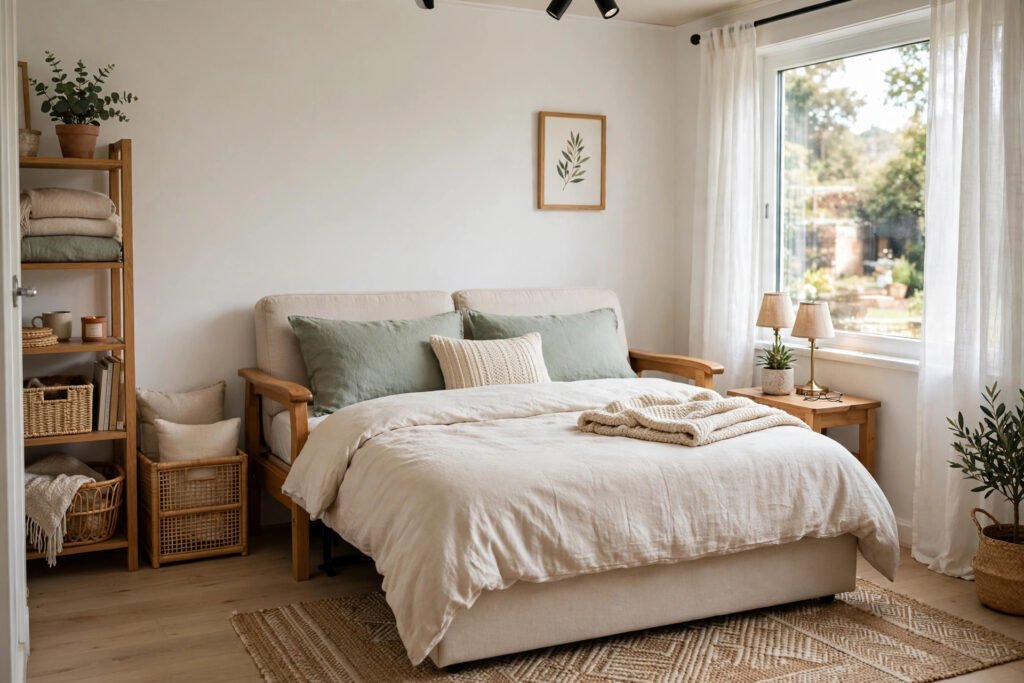
A small double sofa bed is one of the most useful pieces of furniture you can put in a small home. By day it is a sofa you actually want to sit on; by night it becomes a bed that sleeps two people, or one person very comfortably. That dual role makes it ideal for studio flats, box rooms, home offices that double as guest rooms, and living rooms that need to host visitors without giving up a whole bedroom to a permanent bed.
But not all small double sofa beds are equal, and the differences matter more than they do with an ordinary sofa. The size has to suit both the room and the sleepers, the folding mechanism has to be easy enough to use regularly, and the mattress has to be comfortable enough that guests do not wake up regretting their visit. This guide explains what the size suits, the main types, how to judge comfort, how to measure for a small room, and how to choose between daily use and occasional guest use.
What Is a Small Double Sofa Bed?
A small double sofa bed is a sofa that converts into a bed roughly the size of a UK small double mattress, which measures 120 by 190 centimetres. That is wider than a single and narrower than a standard double, which measures 135 by 190 centimetres. In practice, a small double sleeps one adult in generous comfort, or two adults who are happy to sleep close together, and it suits rooms where a full double sofa bed would dominate the floor or block a doorway.
The exact sleeping size varies by model, so always check the manufacturer’s stated bed dimensions rather than assuming the sofa’s name guarantees a particular size. Some models described as small double offer a sleeping surface slightly narrower or shorter than a standard small double mattress, which affects bedding and comfort. Ask for the open bed length and width, the height of the sleeping surface from the floor, and whether standard small double bedding fits, before you buy.
Who Does a Small Double Suit?
A small double sofa bed suits a surprising range of households. It is a natural fit for a single person in a studio or one-bedroom flat who wants a proper sofa and a bed for the occasional guest, without dedicating a room to either. It suits couples in a small flat who need a guest bed but cannot spare a spare room, and parents who want a flexible sleepover option for older children or visiting family. It also works well in a home office, where it provides a comfortable seat during the working day and a bed at night.
It is less ideal for two tall adults who need to sleep on it every night, or for anyone who needs a wide, permanent double bed for health or comfort reasons. In those cases a larger sofa bed, a permanent small double bed, or a fold-down wall bed may be a better long-term choice. Being honest about who will sleep on it, and how often, is the single most useful step in choosing well, because it decides which mechanism, mattress and frame you should prioritise.
Types of Small Double Sofa Beds
Fold-out sofa beds hide a folded mattress and frame inside the sofa base. You pull a handle, and the frame unfolds into a bed, usually with a proper mattress that is thicker and more supportive than the sofa cushions themselves. Fold-out models tend to be the most comfortable for sleeping, but they are heavier, need more floor space in front of the sofa to unfold, and can be harder for one person to operate alone.
Click-clack sofa beds work by folding the backrest down flat until it clicks into place level with the seat, creating a bed from the sofa’s own cushions. They are simple, light and quick to convert, which makes them popular for daily use and for smaller budgets. The trade-off is comfort: the sleeping surface is the sofa cushioning, so it can feel firmer or less even than a dedicated mattress, and the join between seat and backrest can be felt by some sleepers.
Pull-out sofa beds slide a bed section out from under the seat, sometimes with a pop-up section that rises to the same height as the seat to form a flat sleeping surface. They are a good middle ground: easier to operate than many fold-out models, and often more comfortable than a click-clack, because the pull-out section carries its own mattress. Check how far the bed extends into the room, whether the pull-out section locks in place, and whether the mechanism can be operated without dragging the sofa across the floor.
Less common options include futon-style sofa beds, where a thick futon mattress folds over a slatted frame, and modular sofa beds that rearrange into a bed from separate sections. Futons suit a relaxed, low look and are easy to air, but they need regular turning and can feel firm. Modular designs suit flexible living spaces, but check that the sections lock together securely when used as a bed, so sleepers do not drift apart overnight.

Mattress Comfort: What to Look For
Comfort is where cheap sofa beds reveal themselves, and it is worth testing in person wherever possible. Sit on the sofa as you normally would, then lie on the bed in your usual sleeping position, and pay attention to three things: whether you can feel the frame, bars or mechanism through the mattress, whether the sleeping surface is level across the join, and whether the mattress supports your hips and shoulders without sagging. A thin mattress over a metal bar is the classic recipe for a bad night’s sleep, however attractive the sofa looks folded up.
Mattress type matters too. Foam mattresses are light and common on click-clack and pull-out models, and a dense, good-quality foam can be surprisingly comfortable. Pocket-sprung or open-coil mattresses, more common on fold-out models, offer better support and airflow, and tend to suit nightly or frequent use. A mattress topper can improve an average sofa bed considerably for guests, but it needs somewhere to be stored during the day, and a thick topper may stop some mechanisms closing properly, so check before you rely on one.
Also consider the sleeping height and the edge support. A bed that sits very low to the floor can be hard to get in and out of, especially for older guests, while a bed with no edge support can feel as though you might roll off. If the sofa bed will be used by children, check that the mechanism cannot trap fingers, that the bed locks in both positions, and that the mattress stays in place when the bed is in use. Comfort is personal, so where you cannot test a model, read the detailed specification and the returns policy carefully before ordering.
Measuring for a Small Room
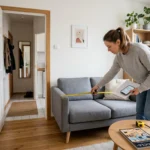
Measuring for a sofa bed means measuring twice: once as a sofa, and once as a bed. As a sofa, check the width, depth and height against your wall, and check that it does not block radiators, plug sockets, doorways or the route through the room. As a bed, measure the full open length and width, including any part of the mechanism that extends beyond the mattress, and allow walking space around at least one side so sleepers can get in and out without climbing over each other.
Also measure the space in front of the sofa, because fold-out and pull-out models need a clear zone to extend into. Move any coffee table, rug or side table that would sit inside that zone, or choose a model whose mechanism works within the space you have. Check the delivery route as well: the sofa bed’s largest dimension, whether it arrives assembled or flat-packed, and whether it will fit through your front door, hallway and any internal doorways. A sofa bed that cannot get into the room is no bargain, however good the offer.
Finally, measure the room as it will be lived in, not as an empty plan. Note where the television sits, where a desk or dining table goes, and where bedding will be stored when the bed is folded away. A small double sofa bed works best when the bedding has a home nearby, such as a storage ottoman, a nearby cupboard or a drawer under the sofa, so the nightly conversion does not become a hunt through the house for sheets and pillows.

Daily Use Versus Guest Use
How often the bed will be used should drive your budget and your choice of mechanism. For daily use, prioritise a robust frame, a smooth mechanism that one person can operate without strain, and a mattress thick and supportive enough for nightly sleep. Look for a mechanism that has been tested for frequent use, check the guarantee on the frame and the moving parts, and be prepared to spend more on comfort, because a bed you sleep on every night is not the place to cut corners.
For occasional guest use, you can prioritise the sofa itself: how it looks, how comfortable it is to sit on, and how well it fits the room during the long stretches when no guest is staying. A click-clack or a simpler pull-out model may be perfectly adequate, especially if guests stay for a night or two and you add a good topper and proper bedding. Even for guest use, though, avoid the very cheapest mechanisms, because a stiff or unreliable fold can turn hosting into a wrestling match and put guests off returning.
In both cases, think about who will be doing the converting. If the person who will fold the bed out is not strong, or has limited mobility, test the mechanism with that person present, or choose a lighter click-clack model that they can operate comfortably. A sofa bed that only one household member can open is a sofa bed that will quietly stop being used as a bed.
Small Double Sofa Bed or Murphy Bed?
If your room needs to sleep people regularly but also function as a living space, it is worth comparing a sofa bed with a fold-down wall bed before you decide. A sofa bed keeps the room looking like a living room and needs no wall fixing, which suits renters and anyone who does not want to fix heavy furniture to a wall. A Murphy bed, by contrast, offers a full mattress on a proper frame and folds completely away, freeing the whole floor, but it needs a suitable wall, professional fitting and a larger upfront commitment.
For a full comparison of how wall beds work, their types and safety essentials, read Murphy Bed: The Complete Guide to Space-Saving Fold-Down Beds. Many small homes end up with both solutions in different rooms: a sofa bed in the living room for flexible guest use, and a Murphy bed in a studio or home office where a full bed is needed without losing the room. The right choice depends on your wall, your budget, how often the bed will be used, and whether you are happy to have a bed fixed in place.
Making a Small Room Work Harder
A small double sofa bed is only part of a small-room plan. Storage is the other half, because a room that doubles as a bedroom needs somewhere for bedding, clothes and everyday clutter to go when the bed is folded away. Wall-mounted shelves, a storage ottoman, under-sofa drawers and a well-planned wardrobe run all help, and they stop the room feeling like a bedroom that has been tidied in a hurry. If fitted storage is part of your plan, Fitted Wardrobes: The Complete Guide to Design, Storage and Style explains how to design storage around awkward walls and alcoves, and how to brief a supplier so the result looks built in.
Lighting and layout matter too. A reading light near the sofa bed, a small bedside surface for a glass of water and a phone, and a clear route to the bathroom all make guest nights more comfortable. Keep the floor in front of the sofa clear enough for the bed to open without a furniture shuffle, and choose a rug that does not bunch under the mechanism or trip sleepers getting up in the night. Small choices like these are what turn a sofa bed from a compromise into a genuinely welcoming guest space.
Styling a Small Room Around a Sofa Bed
Styling a sofa bed is about making it look like a sofa first and a bed second. Choose a fabric and colour that suit the room year-round, not just the bedding you will use on guest nights, and dress it with cushions and a throw that can be quickly removed when the bed is needed. A neutral or muted sofa colour is easier to live with than a bold pattern that dominates a small room, and removable, washable covers are a practical blessing in a house with children, pets or frequent guests.
Keep the bed-making kit close and simple: a set of small double sheets, a duvet and pillows stored in one place, ready to go. Guests notice fresh bedding, a towel and a little space for their belongings far more than they notice expensive furniture, and a sofa bed that is quick to make up is one you will actually offer to guests rather than apologise for. When the bed is folded away, the room should return to being a living room in minutes, not after a major tidy.

Care and Maintenance
Care for a sofa bed is straightforward, but the mechanism deserves more attention than an ordinary sofa. Vacuum the frame and mechanism area regularly to keep dust and crumbs out of moving parts, and check hinges, bolts and legs periodically, tightening anything that feels loose. Operate the mechanism as the manufacturer instructs, without forcing it, and keep children clear while it is moving. If the mechanism becomes stiff or noisy, check for obstructions and contact the supplier before forcing it, because a forced mechanism is more likely to fail or to damage the frame.
For the upholstery, follow the fabric care label, clean spills promptly, and rotate or flip cushions where the design allows so wear stays even. Air the mattress regularly by leaving the bed open with bedding pulled back for a while, especially in rooms that are not well ventilated, and use a washable mattress protector to guard against spills and allergens. With that basic care, a good small double sofa bed should serve as both sofa and bed for many years.
Cost Factors
As with most furniture, the cost of a small double sofa bed is shaped by several factors rather than a single figure: the frame material and build quality, the mechanism type, the mattress thickness and type, the fabric, and whether delivery and assembly are included. A basic click-clack and a fold-out model with a pocket-sprung mattress are very different products, and comparing them on a headline figure alone is misleading. Compare like-for-like specifications, check what the guarantee covers for the frame, mechanism and mattress separately, and confirm whether delivery, assembly and packaging removal are included.
Common Mistakes to Avoid
- Assuming the bed size: check the open bed dimensions, not just the sofa name.
- Measuring only as a sofa: measure the open bed and the clear zone in front of it.
- Choosing on looks alone: lie on the bed and test the mechanism before you buy.
- Ignoring the mattress: a thin mattress over a bar guarantees poor sleep.
- Forgetting bedding storage: keep sheets and pillows close, or the bed will rarely be used.
- Forcing a stiff mechanism: check for obstructions and contact the supplier instead.
Frequently Asked Questions
Can two adults sleep comfortably on a small double sofa bed?
It depends on the model and the sleepers. A small double suits two adults who are happy to sleep close together, or one adult very comfortably. Two taller or broader adults who need more width will be more comfortable on a standard double sofa bed or a permanent bed.
Is a small double sofa bed suitable for nightly use?
Yes, provided you choose a robust fold-out or pull-out model with a thick, supportive mattress and a mechanism rated for frequent use. A basic click-clack with thin cushioning is better suited to occasional guest use than to nightly sleeping.
What bedding fits a small double sofa bed?
Most models suit standard small double bedding, but always check the manufacturer’s open bed dimensions first, because some sofa beds are slightly narrower or shorter than a standard small double mattress.
How do I keep a sofa bed mechanism working smoothly?
Keep it free of dust, operate it as instructed without forcing it, check bolts and legs periodically, and contact the supplier promptly if it becomes stiff, noisy or uneven rather than forcing it.
Conclusion
A small double sofa bed earns its place in a small home by doing two jobs well: a comfortable sofa by day and a genuinely sleepable bed by night. Choose the size honestly for who will sleep on it, pick a mechanism that suits daily or guest use, test the mattress for frame feel and support, and measure the room both as a sofa and as a bed. Do that, and you will end up with a flexible, welcoming piece of furniture that makes a small room live larger, rather than a sofa that guests quietly dread.