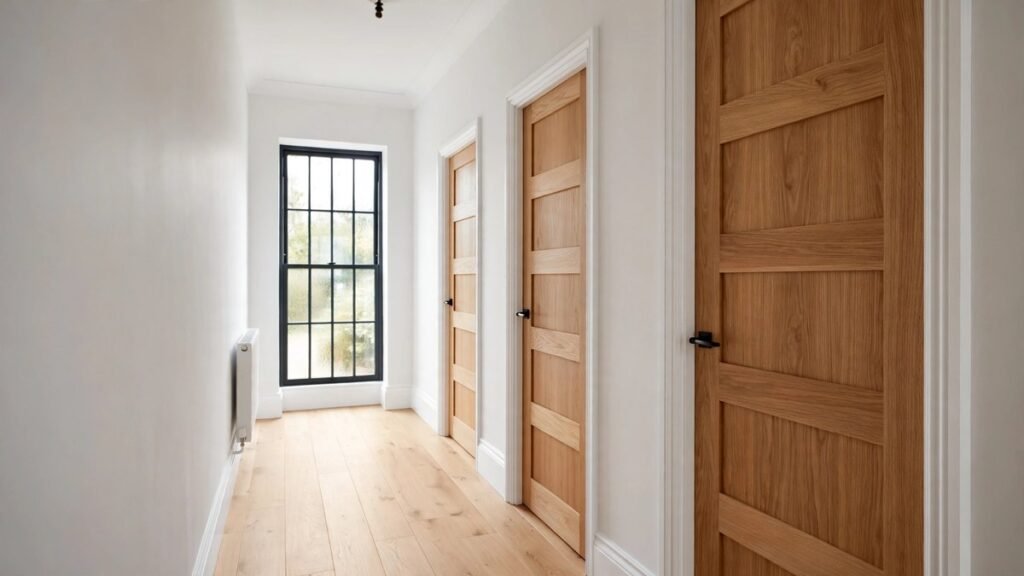
Oak internal doors are doors made from solid oak, oak veneer or engineered oak, fitted inside a UK home between rooms. They cost from about £80 for an oak veneer door to £350 for solid oak, plus £60 to £160 for fitting. Choose the construction, style and size first, then check whether any door needs an FD30 fire rating.
Key Takeaways
- Oak internal doors cost from about £80 for oak veneer to £350 or more for solid oak, and fitting adds about £60 to £160 per door.
- Engineered oak is the best all-round choice for most UK homes, because it looks like real oak and resists warping better than solid oak.
- The most common UK size is 1981mm high by 762mm wide, and most imperial doors are about 35mm thick.
- Leave a gap of 2 to 3mm around the top and sides when you hang a door, and let the door acclimatise flat for three days first.
- Hardwax oil is the best finish for most internal oak doors, and you should finish all six faces before hanging.
- FD30 fire doors are tested to hold back fire for at least 30 minutes, and homes with three or more storeys usually need them on rooms off the stairs.
- Clean oak doors with a soft cloth, warm water and a little mild soap, and re-oil high-traffic doors about once a year.
What Are Oak Internal Doors?
An oak internal door is a door fitted inside a home, between rooms, where the visible face is real oak. That oak can run right through the door, sit as a thin veneer over a core, or form the outer skin of an engineered door. The three types look similar at first glance, but they behave very differently once they are hung, and they cost very different amounts.
Oak suits almost every UK home because it is warm, hard wearing and easy to match with other timber. A Victorian terrace, a 1930s semi, a new build and a barn conversion can all carry oak doors, as long as the style fits the house. The grain is the point. Oak shows its grain clearly, so the door itself becomes part of the room, not just a slab that closes a hole in the wall.
Most oak internal doors sold in the UK today are not solid oak all the way through. Q Doors explains that most oak internal doors sold today are engineered, meaning a real oak veneer bonded to a stable core with solid oak lippings on the edges. That construction is the default across most ranges, and for most buyers it is the right one. Solid oak still has its place, mainly in period homes and in houses where the owner wants a door that can be sanded back many times over decades.
Before you order, you need four decisions in this order. First, the construction: solid, veneer or engineered. Second, the style: panel, Shaker, cottage, flush or glazed. Third, the size: measure the opening, not the old door. Fourth, the finish: prefinished, or unfinished so you can oil it yourself. Get those four right and the rest of the job is straightforward.
What Is the Difference Between Solid Oak, Oak Veneer and Engineered Oak?
This is the choice that matters most, and it is also the one that confuses buyers the most. The three terms sound similar, but they describe three different ways of building a door. Price, weight, stability and repairability all change with the construction, so it pays to understand each one before you spend.
What is a solid oak door?
A solid oak door is made from solid oak throughout. The stiles, rails and panels are all oak, joined together, usually with mortice and tenon joints. It is heavy, it feels substantial when you close it, and the grain is unique on every door because no two pieces of oak are alike.
Solid oak is the most traditional option and the most expensive. Pricing Penguin puts a 100% solid wood door at £180 to £350 or more for the door alone in its September 2026 guide. UK Oak Doors lists solid oak Victorian four-panel doors at £289.95 to £409.95, which shows the same range from a real retailer. Solid oak can be sanded and refinished many times over its life, so a well-kept solid oak door can last for decades.
The drawback is movement. Pricing Penguin notes that solid wood doors are prone to swelling, shrinking and warping as the humidity and heating in a house change between seasons. A solid oak door in a bathroom or a room with big temperature swings needs more care, and it must be finished on all six faces to slow down moisture movement. If you live in a home with steady heating and you want the most authentic door, solid oak is hard to beat. If your rooms run damp or very dry, engineered oak is the safer buy.
What is an oak veneer door?
An oak veneer door has a thin skin of real oak bonded to a core. PRM Carpentry describes it plainly: an oak veneered door is a thin skin of real oak bonded to a core, usually particleboard, a timber frame with a honeycomb or solid core, or MDF. You see real oak grain on the face, but the bulk of the door is not oak.
Veneer doors are lighter and cheaper than solid oak. PRM Carpentry gives a rough range of £80 to £200 for a veneered oak door. Internal Doors 4 UK lists oak veneer doors at £150 to £300 for the door alone in 2026, which fits the same picture once you allow for style and finish. A basic veneer cottage door from Wickes costs £76 for a 1981 x 686mm door, which shows how cheap the entry point can be.
The main risk with veneer is the thin face. Over-trimming can cut through the oak skin and into the core, and a deep scratch can be hard to repair because there is so little oak to sand back. A veneer door also needs a gentle hand when you clean it, because a soaked cloth can swell the veneer or lift the edge lippings. For most rooms, though, a good veneer door looks like solid oak from a normal distance, and it costs far less.
What is an engineered oak door?
An engineered oak door sits between the other two. It has a real oak veneer on the face, a stable engineered core, and solid oak lippings on the edges so you can trim it to fit. Q Doors says engineered oak doors resist warping far better than a single piece of hardwood, while still showing genuine oak grain. That stability is the reason engineered oak is now the default choice in most UK door ranges.
PRM Carpentry puts engineered oak doors at roughly £150 to £350, and Q Doors notes that engineered oak doors can start around £100 against £700 to £800 for high-end solid oak. The spread is wide because style, glazing, fire rating and finish all push the price up or down. For a normal family home, an engineered oak door gives you the look of oak, the stability of a modern core, and a price that sits between veneer and solid.
| Construction | What it is | Typical door-only price in 2026 | Best for | Watch out for |
|---|---|---|---|---|
| Solid oak | Oak right through the door | £180 to £350+ | Period homes, owners who want the most authentic door | Can warp with humidity changes; heavy to hang |
| Oak veneer | Thin real oak skin over a core | £80 to £200 | Tight budgets, matching a whole house cheaply | Thin face, hard to repair deep marks, trim with care |
| Engineered oak | Real oak face, stable core, solid oak edges | £150 to £350 | Most UK homes, the best balance of looks and stability | Check the trimming allowance before you plane it |
The honest summary is simple. If budget rules, buy oak veneer. If you want the best balance of looks, stability and price, buy engineered oak. If you want the most authentic door and you accept the upkeep, buy solid oak. Most buyers end up with engineered oak, and most of them are happy with it.
Which Oak Internal Door Style Suits Your Home?
Style is the second big decision, and it is the one visitors actually notice. A door style should suit the age and character of the house. A Victorian panel door in a new-build flat can look out of place, and a flat flush door in a Georgian terrace can look too plain. Match the door to the house and the whole hallway feels more settled.
How do panel doors look in a period home?
Panel doors are the classic choice for period homes. They have raised or flat panels set into a frame of stiles and rails, usually four or six panels. UK Oak Doors says its Victorian four-panel and six-panel doors recreate the panelling of their era, and its Georgian six-panel doors give formal symmetry. A four-panel door suits a Victorian or Edwardian terrace, while a six-panel door suits a Georgian home or a house with taller ceilings.
Panel doors work well because the panels break up a large flat surface and catch the light. They also suit rooms with other period details, such as ceiling roses, picture rails and deep skirting boards. If your house already has panelled doors, match the new ones to the old ones so the run of doors along a hall looks like one set. A modern oak panel door in a period style costs more than a plain veneer door, but it is the style that adds the most character to an older home.
What is a Shaker oak door?
A Shaker door has a flat recessed panel set in a plain square frame. It has no mouldings and no fuss, which is why it bridges classic and modern homes. UK Oak Doors describes the Shaker as a flat recessed panel in a plain square frame that bridges classic and modern, and that is exactly how it behaves in a real house. It looks at home in a 1930s semi, a new build, or a kitchen extension with flat-fronted units.
Shaker doors are also practical. The flat panels are easy to wipe clean, and the square frame suits both black and brass handles. If you cannot decide between traditional and modern, a Shaker oak door is usually the safe middle ground. It is one of the most popular oak door styles in the UK for that reason.
What is a cottage or ledged and braced oak door?
A cottage door is made from vertical planks, often with a ledged and braced back. The ledges are horizontal battens across the back, and the braces run diagonally to keep the door square. This is the door you see in farmhouses, cottages and barn conversions, and it suits a home with exposed beams, stone walls or a wood burner.
Wickes sells a Geneva oak veneer cottage door, which shows that the style is available at budget prices as well as from specialist joiners. The Suffolk cottage style is another common version, with a simple planked face and no glazing. Cottage doors look best in rooms where the rest of the joinery is simple too. In a smart modern flat, a ledged and braced door can look like a prop, so save this style for homes with real rustic character.
When does a flush or modern oak door work best?
A flush oak door has a flat face with no panels and no mouldings. The oak grain itself becomes the design. UK Oak Doors describes its modern flush oak doors as clean-lined doors where the oak grain itself becomes the design, and that is the appeal. In a new build, a loft apartment or a home with minimal skirting and plain walls, a flush oak door looks calm and deliberate.
Modern oak doors also include grooved designs, such as the Mexicano, which UK Oak Doors calls its most contemporary plank design, with clean machined vertical grooves. These doors suit homes where the owner wants timber warmth without period detail. A flush door shows every mark more easily than a panelled door, so choose a hardwax oil finish and accept that you will wipe it more often.
Should you choose a glazed oak door?
A glazed oak door has glass in part or all of the leaf. Clear glass moves light down a dark hallway, which is the main reason people choose it. Frosted or reeded glass gives privacy while still letting light through, so it suits bathroom and bedroom doors. A half-glazed door, with glass in the top half and solid oak below, is a good middle ground.
Glazed oak doors cost more than solid ones. Internal Doors 4 UK lists glazed oak doors at £180 to £450 for the door alone in 2026. The glass is usually toughened for safety, and on a fire door it must be fire-rated glass. Check the glass type before you buy, and think about who can see through the door. A clear glazed door on a bathroom is a mistake you only make once.
What Are the Standard Oak Internal Door Sizes in the UK?
There is no single standard door size in the UK, but a few sizes cover most homes. Knowing them before you order saves you from paying for a made-to-measure door when a stock size would have fitted.
The most common internal door size in the UK is 1981mm high by 762mm wide. Vibrant Doors calls 762mm x 1981mm the most common interior door size by far, used in the majority of British houses over the last few decades. In imperial terms that is 2 feet 6 inches wide by 6 feet 6 inches high, and builders often just call it the two-six door. Most imperial doors are about 35mm thick.
Metric doors are taller and thicker. Finewood states that metric internal doors are typically 2040mm high and around 40mm thick, in widths of 526mm, 626mm, 726mm, 826mm and 926mm. Metric sizes are common in newer homes and in Scotland, where Hazlemere notes that 2040mm tall doors are often specified. The two size families do not mix, so check whether your opening is imperial or metric before you order.
| Size (height x width) | Imperial equivalent | Thickness | Typical use |
|---|---|---|---|
| 1981 x 610mm | 6ft 6in x 2ft 0in | 35mm | Cupboards, small en suites |
| 1981 x 686mm | 6ft 6in x 2ft 3in | 35mm | Bathrooms, box rooms |
| 1981 x 762mm | 6ft 6in x 2ft 6in | 35mm | Bedrooms, living rooms, kitchens |
| 1981 x 838mm | 6ft 6in x 2ft 9in | 35mm | Wider openings, easier access |
| 2040 x 626mm | Metric | 40mm | Cupboards, bathrooms |
| 2040 x 726mm | Metric | 40mm | Bathrooms, bedrooms |
| 2040 x 826mm | Metric | 40mm | Bedrooms, living rooms |
| 2040 x 926mm | Metric | 40mm | Wide openings, accessible rooms |
An 838mm wide door matters for access. Vibrant Doors notes that a door 838mm wide is often chosen to meet Part M building regulations for wheelchair access clearance. If someone in the household uses a wheelchair or a walking frame, or if you want the home to work for older relatives, fit the wider door while you are replacing them anyway. It costs little more and it makes the whole house easier to move around.
If your opening matches none of these sizes, you have two options. A made-to-measure door is built to your exact opening, which is the right answer for old houses with odd sizes. Or you can buy the next size up and trim it down, as long as you stay inside the manufacturer’s trimming allowance. Fire doors have stricter trimming limits set by their fire certificate, so check those before you cut.
How Much Do Oak Internal Doors Cost in the UK?
Oak internal doors cost more than white primed doors, but the range is wide, and most buyers can find a door at their budget. The door itself is only part of the bill. Fitting, handles, hinges and finishing all add up, so work out the full cost per door before you order.
Pricing Penguin states that in 2026, replacing an internal door in the UK costs between £90 and £450 or more per door, fully fitted. Pricing Penguin also states that the most popular choice, a solid-core oak veneer door with premium handles and hinges fitted by a carpenter, typically averages £180 to £250 per door. Those two sentences give you a realistic frame for the whole job.
| Door type | Door only (2026) | Fitting labour | Typical fitted total |
|---|---|---|---|
| Oak veneer, basic | £80 to £200 | £60 to £90 | £140 to £290 |
| Oak veneer, solid core | £150 to £300 | £60 to £90 | £210 to £390 |
| Engineered oak | £150 to £350 | £60 to £90 | £210 to £440 |
| Solid oak | £180 to £350+ | £80 to £160 | £260 to £510+ |
| Glazed oak | £180 to £450 | £80 to £160 | £260 to £610 |
| FD30 oak fire door | £120 to £350 | £150 to £250 | £270 to £600 |
Fitting labour is usually the largest single line after the door itself. Internal Doors 4 UK states that a straightforward swap, with a new leaf into a sound existing lining, typically runs £90 to £160 per door. Internal Doors 4 UK also states that fire doors take longer because of the seals, closers and tighter tolerances, so expect £150 to £250 per door for a fire door. ScopeWise puts labour only to hang a door with ironmongery at usually £40 to £90 per door, which is the lower end for a simple job with no lining work.
Ironmongery is the cost buyers forget. Internal Doors 4 UK states that a basic pair of handles, hinges and a latch might cost £25 to £40 per door, while mid-range handles push that to £50 to £90. A cheap handle on a good oak door is a false saving, because you touch the handle every day and you see it every time you walk through the door. Budget at least £30 per door for decent ironmongery, and more if you want black or brass.
Finishing adds a final line. Internal Doors 4 UK states that £50 to £90 per door is common for a brush finish, and £70 to £120 for staining and sealing oak. A prefinished door costs more up front but saves this step, so compare the two routes honestly. An unfinished door plus a tin of hardwax oil is often cheaper if you are happy to do the work yourself.
A whole house adds up fast. Internal Doors 4 UK puts eight doors, including supply, fitting, standard ironmongery, architrave and a basic paint finish, at £1,800 to £2,800 for a budget tier, £3,000 to £4,500 for a mid-range tier, and £5,500 to £9,000 for a premium tier. For oak doors, expect the mid-range tier as a minimum. If you are replacing every door in the house, ask your carpenter for a day rate for the whole job, because hanging seven or eight doors in one visit is cheaper per door than seven separate visits.
How Do You Measure for an Oak Internal Door?
Measure the opening, not the old door. The old door may have been trimmed by someone in a hurry, or it may have swollen over the years, so its size tells you nothing reliable. Measure the frame opening instead, and measure it in several places.
Start with the width. Measure across the opening at the top, in the middle and at the bottom. Old frames are rarely square, so the three numbers will often differ by a few millimetres. Use the smallest width, because the door must fit the tightest point. Then measure the height on the left and on the right, from the top of the frame to the finished floor level, and use the smallest height.
Next, check the frame itself. Run a spirit level along the sides and across the top to see whether the frame leans or sags. If the three width measurements differ by more than about 3mm, you have a frame problem rather than a door problem, and you may need to pack or re-line the frame before the new door will hang properly. Also check the depth of the frame, because the new door must sit flush with the lining and the architrave.
Write down the smallest height and width, the thickness of the old door, and whether the frame is imperial or metric. Take those numbers to the supplier and ask which stock size fits with the least trimming. A door that needs only a light plane on each edge is a far better buy than one that needs 20mm cut off, especially if it is an engineered or veneer door with a trimming limit.
One more check before you order: look at the floor. If you are fitting new flooring, measure to the finished floor level, not the bare boards. A door hung to bare boards will scrape the new floor, and trimming a finished door a second time is a job nobody enjoys.
How Do You Hang an Oak Internal Door?
Hanging a door is a carpentry job with a clear sequence, and a careful DIYer can do it in an afternoon. The hard part is not the cutting, it is keeping the gaps even all the way round while the door is heavy and awkward to hold.
Start by letting the door acclimatise. Wickes advises laying a new door flat on an even surface in the room for three days before hanging, so it can adjust to the moisture levels in your house. A door hung straight from a cold van can shrink or swell as it settles, and then it sticks or rattles. Three days flat in the room it will live in is the simplest insurance you can buy.
Then trim the door to fit. Wickes advises trimming the top, bottom and sides equally to leave a consistent 3mm clearance gap. Checkatrade says to aim for a gap of around 2 to 3mm at the top and sides for a standard internal timber door. Divide any cut equally across opposite edges, so you do not take everything off one side. Check the manufacturer’s trimming allowance first, because an engineered door can only lose a few millimetres before you cut into the core.
Hinges come next. Wickes marks hinge positions 150mm from the top of the door and 225mm from the bottom, with an optional third hinge in the centre for a heavy door. Score round the hinge leaf with a sharp knife or chisel, cut the recess to the exact depth of the hinge plate, and test that the hinge sits flush. A hinge that stands proud will throw the whole door out of line.
Then wedge the door into the frame, check the gaps with a 3mm packer or a pound coin, and fix the hinges starting from the top. Checkatrade advises starting with one screw in each hinge rather than tightening every screw at once, so you can still adjust the fit. Screw the hinges to the frame, check that the door swings freely and closes cleanly, then fit the latch and handles.
If the door is heavy, get help. A solid oak door can weigh 25kg or more, and holding it steady while you mark hinge positions is a two-person job. If the door sticks after hanging, find the tight spot with a pencil mark, take the door down and plane a little off. Never force a sticking door, because the frame will take the strain and the hinges will loosen over time.
How Do You Finish an Oak Internal Door?
An unfinished oak door is bare timber, and bare timber needs a finish before it is hung. The finish protects the oak from moisture, hand marks and everyday knocks, and it sets the colour and sheen you will live with. Choose the finish before you order, because some doors are only guaranteed with certain finishes.
Is hardwax oil the best finish for oak doors?
For most internal oak doors, yes. UK Oak Doors states that hardwax oil is the best finish for most internal oak doors, because it soaks into the wood, keeps the natural grain and colour, and lets you patch one worn spot rather than strip the whole door back. A hardwax oil is a blend of oil and wax. It soaks in rather than sitting on top, so the door still feels like wood, and a scratch can be sanded and re-oiled in that one spot alone.
Apply two thin coats along the grain, letting each coat dry before the next. UK Oak Doors recommends a clear hardwax oil such as Treatex for unfinished oak doors, with a light sand first, dust removed, and two thin coats. Hardwax oil comes in clear matt and clear satin, and in light, medium and dark oak shades, so you can shift the tone of the oak without hiding the grain. A satin oil over a matt base coat gives a touch more sheen without the problems of a gloss varnish.
The most important rule is the one buyers skip. UK Oak Doors advises that an oak door should be finished on all six faces, including the top and bottom edges, before it is hung. The top and bottom edges are where moisture gets in, and an unfinished edge is how a door starts to swell. Finish every face, even the ones nobody sees.
What about varnish, lacquer and wax?
A varnish or lacquer forms a hard film on the surface of the wood. UK Oak Doors explains that a varnish or lacquer gives a harder surface film for doors that take heavy knocks, but a knock tends to show as a pale mark, and a repair usually means sanding the whole door back and re-coating. Varnish suits a door that takes hard wear and where you want a smooth, high-sheen surface. It does not suit a door you want to patch easily.
Wax gives a soft, natural sheen and is easy to top up, but it wears faster and offers little moisture protection. UK Oak Doors says wax suits low-wear doors, or a coat of wax over an oiled door. A wax-only finish on a busy hall door will need topping up often, so treat wax as a maintenance layer rather than the main protection.
A stain changes the colour of the oak while keeping the grain visible. It goes on under an oil or varnish, and it is the way to shift pale oak towards a darker tone without painting it. If you want a painted door, buy a primed door instead of painting over oak, because paint hides the grain you paid for.
Check the guarantee before you choose. UK Oak Doors warns that a stain, varnish or lacquer is not what it recommends for its oak doors, and applying one can affect the guarantee. Some suppliers, including JELD-WEN doors sold through DoorsDirect2U, specifically recommend avoiding oils and waxes. Always read the door maker’s guidance first, because the wrong finish can void the guarantee on a door that cost hundreds of pounds.
Should you buy prefinished or unfinished oak doors?
A prefinished door arrives with the finish already applied at the factory. It costs more, but you can hang it and use it the same day, and the finish is even because it was applied in controlled conditions. Prefinished doors suit buyers who want no mess and no drying time.
An unfinished door arrives as bare oak, and you finish it yourself once it is hung. UK Oak Doors says an unfinished door gives you control, so you can tone the oak and set the sheen exactly as you want it. Unfinished doors cost less, and you can match the finish to your skirting boards and flooring. The trade-off is time: you need to sand, oil, dry and re-coat, and the door is out of use while the finish dries.
For most buyers, the choice is simple. If you are replacing one door and you want it done quickly, buy prefinished. If you are replacing every door in the house and you want them all to match, buy unfinished and finish them all with the same oil. Either way, finish all six faces, and do not hang a bare oak door and plan to finish it later. It will pick up moisture and marks in the meantime.
How Do You Match Oak Doors With Skirting Boards and Flooring?
Oak doors look best when the timber in the room works together. That does not mean everything must be the same shade of oak. It means the tones should sit in the same family, and the profiles should suit the same era of house.
Start with the skirting boards. A deep Victorian skirting board with a torus profile suits a panelled oak door, while a slim square-edge skirting board suits a flush or Shaker oak door. Our guide to modern skirting boards explains the profiles and costs in detail, and it is worth reading before you order, because skirting boards and doors are bought together in most refits. If your skirting boards are white painted MDF, a natural oak door still works, because the white frame sets off the warm timber. If your skirting boards are oak, try to match the tone of the door to the tone of the skirting, or the two will fight each other.
Flooring matters just as much. An oak door over an oak floor can look too heavy if the tones match exactly, so many designers use a lighter floor with a darker door, or the other way round. Our engineered oak flooring guide covers the tones and finishes available, and it pairs naturally with this article. A dark laminate floor with a pale oak door gives contrast, while a pale oak floor with a mid-tone oak door gives a calm, even look. The rule is simple: pick one timber to be the star and let the other one support it.
Handles and hinges tie the set together. Black handles suit modern oak doors and dark floors, while brass or satin nickel suits period panel doors and warm oak. Keep the same metal finish on every door in the house, including the hinges, so the run of doors reads as one set. A mixed set of handles is the detail that makes a good refit look unfinished.
Do You Need a Fire Door? What Is an FD30 Oak Door?
An FD30 oak door is an oak door tested to resist fire for at least 30 minutes. JBKIND states that an FD30 fire door is tested to resist fire for a minimum of 30 minutes, and that it is the most common fire rating used in UK homes. The letters FD stand for fire door, and the number 30 is the minutes of fire resistance. An FD30S door is the same, with smoke seals added to slow the spread of cold smoke.
A fire door only works as part of a complete assembly. JBKIND explains that an FD30 door only performs as an FD30 door as part of a complete, correctly specified assembly. That means the door, the frame, the hinges, the intumescent seals and the closer must all be fitted to the fire certificate. A solid oak door is not a fire door just because it is heavy. It must be tested and certified, and it must carry test evidence assessed to BS 476 Part 22 or the European equivalent BS EN 1634-1.
Most ordinary one- and two-storey houses do not need fire doors inside. The rules come into play when you carry out building work or when the layout makes escape harder. Internal Doors Newcastle explains that fire safety in new building work is covered by the Building Regulations, with the detailed guidance in Approved Document B. The situations that matter most for homeowners are these:
| Situation | What is usually required |
|---|---|
| Loft conversion creating a third storey | FD30 doors to every habitable room off the protected stairwell |
| Door from an integral garage into the house | FD30 fire door, usually self-closing |
| Flat entrance door opening onto a shared corridor | FD30S door with a self-closer |
| House in multiple occupation (HMO) | FD30 doors on escape routes, as set by the fire risk assessment |
| Ordinary two-storey house, no garage | Usually no internal fire doors required |
A loft conversion is the most common reason a homeowner needs fire doors. Internal Doors Newcastle explains that when a loft conversion adds a storey with a floor more than 4.5 metres above ground level, the house normally needs a protected escape route, and every habitable room opening onto that stairway usually needs a fire-resisting door of at least FD20 standard. Most people fit FD30 doors, because FD20 doors are now hard to find. Our attic conversion cost guide covers the full cost of a loft conversion, including fire doors, so read it before you budget.
The garage door is the other common case. Internal Doors Newcastle states that the door between an integral garage and the house normally needs to be an FD30 fire door, and building control will usually expect it to be self-closing. A garage holds cars, fuel and stored items, so the risk is real. If you are replacing this door, do not swap it for a standard internal door, even a solid one. Our garage conversion cost guide explains how the rules change again when a garage becomes a living space.
Fire doors cost more and take longer to hang. Internal Doors 4 UK lists FD30 fire doors at £120 to £350 for the door alone, and fitting at £150 to £250 per door because of the seals, closers and tighter tolerances. The gap around a fire door must be tight and even, the intumescent seals must be fitted to the certificate, and the closer must shut the door fully every time. If you wedge a fire door open, it cannot do its job. Check the rules with your building control body before you start, because the requirements depend on your property.
How Do You Clean and Look After Oak Internal Doors?
Oak doors reward a small amount of regular care with decades of service. Most of the work is dusting, and the rest is knowing what never to use on the finish.
For everyday cleaning, a soft cloth, warm water and a little mild soap is enough. UK Oak Doors states that for everyday cleaning, an oiled oak door needs no more than a soft cloth, warm water and a little mild soap. Wipe with the grain, dry the door off, and keep silicone sprays and furniture polish well away from it. Doors2Floors advises a monthly damp wipe with a microfibre cloth wrung out until it is barely damp, wiped along the grain and dried at once with a second cloth. Water left standing in a joint is the most common cause of a lifted finish on an internal door.
Greasy hand marks gather around the handle and the leading edge. Warm soapy water on a well-wrung cloth shifts most of them. For a stubborn greasy patch, UK Oak Doors suggests a little white spirit on a cloth, used sparingly on the mark only, then wiped clean. A light surface scuff often buffs out with a dry cloth. Never use bleach, ammonia-based glass cleaner, kitchen degreaser, steam cleaners, scouring pads or magic erasers on an oak door. Doors2Floors lists all of these as products that damage oak doors, and the damage is usually permanent.
The water bead test tells you when the finish is wearing thin. Doors2Floors explains the test: put one drop of water on an inconspicuous part of the door and wait sixty seconds. If it stays as a tight bead, the finish is intact. If it flattens and spreads, the finish is thinning. If the timber underneath darkens, the finish has failed at that point and needs attention. When water no longer beads on the surface, UK Oak Doors says it is time to re-oil rather than polish.
Re-oiling is simple. Clean the door first, let it dry fully, give it a light key with a fine abrasive if the surface feels rough, then apply the same clear hardwax oil the door was finished in, working thin coats along the grain. Door Supplies Online advises reapplying oil to preserve the finish and protection of the door once a year, or as needed in high-traffic areas. A fresh coat of oil restores the sheen far better than any polish, and a worn patch can be oiled over in minutes without stripping the whole door.
Once or twice a year, give each door a proper check. UK Oak Doors advises checking the hinges and tightening any loose screws, looking at the finish along the top and bottom edges and the bottom rail, where wear and damp show first, and looking for water sitting where it should not. Catching a dry patch or a loose hinge early saves a bigger job later. This is also the moment to top up the oil on the parts that get the most use, the leading edge and around the handle, without redoing the whole door.
Veneered doors need a lighter hand. UK Oak Doors notes that a veneered oak door cleans the same way but wants a lighter hand with water, because the oak face is a thin layer over a core, so a soaked cloth or standing water can swell the veneer or the edge lippings and lift them. Keep the cloth barely damp, wipe and dry as you go, and take extra care along the edges.
Where Can You Buy Oak Internal Doors in the UK?
You can buy oak internal doors from high street DIY stores, trade counters and online specialists, and each route suits a different buyer. The right choice depends on whether you want to see the door before you buy, whether you need trade prices, and whether your sizes are standard or odd.
Wickes and B&Q are the easiest places to start. They stock oak veneer doors in standard sizes, you can collect the same day, and the prices are clear. Wickes lists its Geneva oak veneer cottage door at £76 for a 1981 x 686mm door, which is a useful benchmark for a budget oak door. B&Q sells similar own-brand oak veneer doors, including the Elveden four-panel range. The trade-off is quality control: check each door in store for marks, warping and veneer damage before you take it home, because a door bought online and delivered can arrive marked.
Howdens and Travis Perkins serve the trade, and they are the route most carpenters use. Howdens sells through depots and usually needs a trade account, although many homeowners buy through their carpenter. Travis Perkins stocks oak veneer doors from brands such as LPD and JBKIND, including FD30 fire doors. Trade counters are worth trying when you are buying a whole house of doors, because the per-door price drops and the staff can order non-standard sizes.
Online specialists offer the widest choice. UK Oak Doors, Leader Doors, Direct Doors, Doors2Floors and DoorsDirect2U all sell oak internal doors in solid, veneer and engineered construction, with glazed and fire-rated options. UK Oak Doors lists more than 280 oak door lines, from £87.75 for an unfinished LPD Belize oak door to £533.95 for a prefinished glazed fire door. Online buying suits standard sizes and buyers who know exactly what they want. For odd sizes or period styles, a specialist joiner is the better route, because they can make a door to your exact opening.
Before you order from anywhere, run through this checklist. Measure the opening, not the old door. Confirm whether the size is imperial or metric. Check the trimming allowance, and check the fire certificate limits if it is a fire door. Confirm whether the door is prefinished or unfinished, and which finish the guarantee allows. Check the delivery charge and the returns policy, because a door is bulky and awkward to send back. And order one door first if you are unsure about the quality, then order the rest once you have seen it in your home.
What Mistakes Should You Avoid With Oak Internal Doors?
Most oak door problems come from a small number of avoidable mistakes. Knowing them before you order saves money and stops the job from dragging on.
Buying the wrong size is the most common mistake. Measure the opening in several places, use the smallest measurement, and check whether the frame is imperial or metric. A door that is 10mm too wide is a trimming job, but a door that is 10mm too narrow is a return.
Trimming past the limit is the second mistake. Engineered and veneer doors can only lose a few millimetres before you cut into the core or through the oak skin. Check the trimming allowance in the maker’s instructions before you plane anything, and never trim a fire door beyond its certificate limits.
Hanging a door before it has acclimatised is the third mistake. A door hung straight from a cold van will move as it settles in a heated house. Lay it flat in the room for three days first, as Wickes advises, and the door will stay true.
Skipping the finish on the top and bottom edges is the fourth mistake. Those edges are where moisture gets in, and an unfinished edge is how a solid oak door starts to swell. Finish all six faces before you hang the door.
Using the wrong finish is the fifth mistake. Some makers void the guarantee if you use varnish, lacquer, oil or wax on their doors, so read the maker’s guidance before you open a tin. A finish that suits one maker’s door can void the guarantee on another’s.
Fitting a standard door where a fire door is required is the sixth mistake, and it is the one with real consequences. A solid oak door is not a fire door unless it is tested and certified. If building control requires an FD30 door, fit an FD30 door with the right frame, seals and closer.
Finally, mixing styles and handles across the house is the mistake that shows. Keep the same door style, the same handle finish and the same skirting profile through the house, and the refit will look planned rather than patched together.
Frequently Asked Questions
How much does an oak internal door cost in the UK?
An oak internal door costs from about £80 for a basic oak veneer door to £350 or more for solid oak, and fitting adds about £60 to £160 per door. Pricing Penguin states that a solid-core oak veneer door supplied and fitted typically averages £180 to £250 per door in 2026. Handles, hinges and finishing add about £30 to £90 per door on top, and a fire door costs more again.
What is the difference between solid oak and oak veneer doors?
A solid oak door is oak right through, while an oak veneer door is a thin skin of real oak bonded to a core such as particleboard or MDF. Solid oak is heavier, more expensive and can be sanded back many times, but it can warp with humidity changes. Veneer is lighter and cheaper and looks like solid oak from a normal distance, but the thin face is hard to repair if it is deeply scratched, and it must be trimmed with care.
What is a standard internal door in the UK?
The most common UK internal door size is 1981mm high by 762mm wide, which is 2 feet 6 inches by 6 feet 6 inches, and most imperial doors are about 35mm thick. Metric doors are usually 2040mm high and 40mm thick, in widths from 526mm to 926mm. Always measure the opening in several places and use the smallest measurement, because old frames are rarely square.
Do I need a fire door in my house?
Most ordinary one- and two-storey houses do not need internal fire doors. You usually need FD30 fire doors if your house has three or more storeys, including a loft conversion, if a door leads from an integral garage into the house, or if a flat entrance door opens onto a shared corridor. FD30 doors are tested to hold back fire for at least 30 minutes. Check with your building control body before you start work, because the rules depend on your property.
What is the best finish for oak internal doors?
Hardwax oil is the best finish for most internal oak doors, because it soaks into the wood, keeps the grain visible and lets you patch one worn spot without stripping the whole door. UK Oak Doors recommends a clear hardwax oil such as Treatex, applied in two thin coats along the grain. Finish all six faces, including the top and bottom edges, before you hang the door, and re-oil high-traffic doors about once a year.
Conclusion
Oak internal doors are one of the best value upgrades you can make inside a UK home, because they change how every room feels for a modest cost. A basic oak veneer door starts at about £80, an engineered oak door sits between £150 and £350, and solid oak runs from £180 to £350 or more, with fitting adding about £60 to £160 per door. The most common size is 1981mm high by 762mm wide, and the best all-round choice for most homes is engineered oak, because it shows real oak grain and resists warping better than solid oak.
The decisions that matter are few and simple. Choose the construction first, then a style that suits the age of your house, then measure the opening carefully and check the trimming allowance before you cut. Finish all six faces with hardwax oil, leave a gap of 2 to 3mm around the door, and check whether any door needs an FD30 fire rating before you order. Clean the doors with a soft cloth and mild soap, and re-oil them about once a year.
If you are replacing every door in the house, budget £3,000 to £4,500 for a mid-range job of eight doors, and order one door first to check the quality. Take your time, because a good oak door will serve your home for decades, and a rushed one will remind you of the mistake every time it sticks.