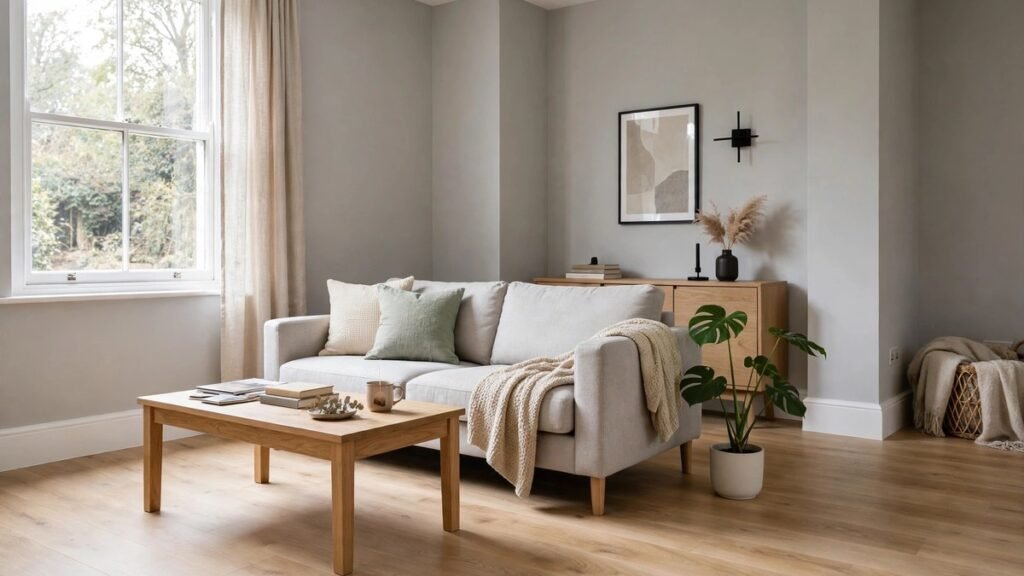
A skirting board is the strip of board that runs along the bottom of a wall where it meets the floor. It covers the joint between the two, protects the plaster from knocks, scuffs and vacuum cleaners, and hides the small gap that floors need to expand and contract. In a modern home it also does a quiet design job: it frames the room, ties the walls to the floor, and sets the tone for the whole interior. A tall, crisp board makes a plain room look finished. A low, plain board keeps the focus on the floor and the furniture.
The short answer is that modern skirting boards in the UK in 2026 typically cost £5 to £15 per metre for MDF, £20 to £60 or more per metre for solid wood, and £4 to £12 per metre for PVC. Supply and fit runs £8 to £20 per metre, a single room costs £150 to £400 fitted, and replacing skirting and architrave in a typical property costs £1,500 to £3,000. MDF is the most common choice, used in over 80 percent of UK homes, and heights typically run 100 to 300 mm, with 100 to 150 mm common in standard rooms.
In this guide, we explain what modern skirting boards are, the profiles you can choose from, how MDF, softwood, hardwood and PVC compare, what each option costs, how to pick the right height and colour, whether to fit the boards yourself or hire a carpenter, and how to paint and look after them. Everything is in plain English, with UK prices and UK homes in mind.
What Are Modern Skirting Boards?
Modern skirting boards are the boards used in today’s homes, where clean lines and simple shapes matter more than heavy decoration. In older UK homes, skirting was often tall and ornate, with deep curves and layers of moulding that matched high ceilings and period features. In a modern home, the board is usually slimmer, flatter and plainer, with a simple square edge or a soft chamfer at the top. The aim is a neat finish that does not draw attention to itself.
The job of the board has not changed. It still covers the gap between the wall and the floor, which is there because floors move slightly with heat and moisture. It still protects the bottom of the plaster from kicks, furniture, toys and the vacuum cleaner. And it still hides uneven edges where the floor meets the wall, which is common in older houses where walls are rarely straight. What has changed is the look. Modern boards are often painted the same white as the woodwork, or the same colour as the wall for a seamless finish, and they are chosen to match the architrave around the doors, so the whole room reads as one tidy frame.
What Makes a Skirting Board Modern?
A modern skirting board is defined by its shape, its height and its finish. The shape is simple: a flat face with a square edge, a small chamfer or a gentle bullnose at the top, rather than a deep S-curve or a stack of mouldings. The height is modest, 100 to 150 mm in most standard rooms, rather than the 200 to 300 mm boards found in Victorian and Edwardian houses. The finish is smooth and painted, usually in white, off-white or the wall colour.
That said, modern does not mean only one look: a square edge board in a new build flat is modern, and a slim torus board in a 1930s semi is modern too, if it is painted white and kept low. The point is that the board suits the house it is in. A tall ogee board can look right in a period home with high ceilings, and a shadow gap can look right in a flat conversion with flat walls and minimal furniture. The sections below help you match the board to your home, rather than following a single fashion.
Do You Still Need Skirting Boards?
Some modern interiors leave skirting out altogether, with a shadow gap or a flush finish instead. That look is striking, but it is not the easy option. A shadow gap needs flat walls, careful plastering and a skilled fitter, and it costs more than standard boards. It also leaves the bottom of the wall exposed to knocks, and it makes future decorating harder, because there is no board to protect the plaster edge.
For most UK homes, skirting boards are still the practical choice. They are cheap, quick to fit, protect the wall, and can be repainted or replaced one room at a time. If you like the minimal look, a square edge board painted the same colour as the wall gives you most of it, at a fraction of the cost of a true shadow gap.
Modern Skirting Board Profiles
The profile is the shape cut into the top edge of the board, and it sets the character of the room as much as anything else. A plain square edge reads as clean and minimal. A torus or ogee reads as softer and more traditional. The six profiles below cover almost every modern UK home, from a new build flat to a period terrace.
Square Edge
A square edge board has a flat face and a sharp 90 degree top edge, with no moulding at all. It is the most modern profile and the most popular choice in new builds, extensions and refurbishments where the aim is clean lines. It is the cheapest profile in most materials, and the easiest to paint and keep clean. The sharp top edge can show knocks, and it needs a neat caulk line where it meets the wall. Square edge suits low and mid height boards, and it pairs well with flat panel doors and simple architrave.
Chamfer
A chamfer profile has a flat face with the top edge cut at a 45 degree angle, which gives a single clean bevel. It softens the top of the board and hides minor gaps better than a sharp corner. Chamfer is a good middle ground for homes that want a modern look without going fully minimal. It is common in MDF and softwood, it paints well, and it costs little more than square edge.
Bullnose
A bullnose profile has a fully rounded top edge, like a half circle. It is simple and soft: it does not show knocks, it is easy to wipe clean, and it suits homes with children and pets. It is one of the cheapest shaped profiles, and it is widely available in MDF and softwood.
Torus
A torus profile has a rounded bead at the top, with a small step below it. It is a classic shape that has been used in UK homes for decades, and it is still one of the most common profiles in the country. In a low height and painted white, torus looks neat and current, and it suits 1930s semis, post-war houses and modern homes that want a softer edge. It costs a little more than square edge or bullnose, and it is widely stocked in MDF, softwood and hardwood.
Ogee
An ogee profile has an S-shaped curve at the top, with a concave sweep above a convex bead. It is the most decorative of the common profiles, and it is the one most people picture when they think of a traditional skirting board. Ogee is still the top selling profile in the UK, and in a modern home it works best at a modest height, where the curve adds interest without dominating the room. It costs more than the plainer profiles, and the curve collects dust. It is available in MDF, softwood and hardwood.
Shadow Gap
A shadow gap is not a board in the usual sense. It is a recessed channel, usually 10 to 15 mm deep, between the wall and the floor, often formed with an aluminium or MDF shadow gap profile. The wall appears to float above the floor, with a thin dark line where the two meet. It is popular in new builds, flat conversions and high end refurbishments. The catch is the cost and the skill needed: the walls must be flat, the plastering must be precise, and the fitting must be done by someone who has done it before. For most homes, a square edge board painted the wall colour gives a similar feel at a much lower cost. Choose a shadow gap only if the budget and the walls allow it, and get a written quote first.
Materials Compared
The material decides the price, the look and how long the boards last. Four materials cover almost every UK home: MDF, softwood, hardwood and PVC. The table below gives the headline figures, and the sections after it explain each material in turn.
| Material | Cost per metre | Best for | Watch out for |
|---|---|---|---|
| MDF, including MR-MDF | £5 to £15 | Most modern homes, painted finish | Standard MDF swells if it gets wet |
| Softwood, usually pine | Mid range, below hardwood | Period homes, stained finish | Can warp and twist with humidity |
| Hardwood, oak and others | £20 to £60 or more | Premium rooms, visible grain | High cost, slow to cut and fit |
| PVC, plastic | £4 to £12 | Bathrooms, kitchens, wet areas | Limited profiles, can look plain |
MDF
MDF, or medium-density fibreboard, is an engineered board made from wood fibres pressed together with resin. It is the most common skirting material in the UK, used in over 80 percent of homes, and for good reason. It is cheap and stable, it does not warp like natural timber, and it has a smooth surface with no knots or grain to show through the paint.
Moisture resistant MDF, known as MR-MDF, is the grade to use in kitchens, bathrooms and utility rooms. Standard MDF swells if water soaks into a cut edge, so it should not be used where it will get wet. MR-MDF resists moisture far better, and it is the grade most fitters use as standard now. Always seal cut edges with primer before painting, and keep the bottom edge clear of standing water. At £5 to £15 per metre, MDF is the budget choice, and for a painted finish it is also the best looking, because the surface stays flat.
Softwood
Softwood skirting, usually pine, is real wood with a grain. It can be stained, oiled or varnished to show the grain, or painted like MDF. Softwood sits in the middle on price, below hardwood and above MDF.
The drawback of softwood is movement. Pine moves with changes in humidity, so it can warp, twist or open up at the joints in a centrally heated home. It also has knots, which need sealing before painting, or the resin will bleed through. Softwood needs more preparation than MDF before the topcoat. For a stained finish in a period home, softwood is worth the extra work. For a painted finish, MDF is usually simpler and cheaper.
Hardwood
Hardwood skirting, in oak, walnut and ash, is the premium option. It is dense, hard wearing and beautiful, with a grain that is meant to be seen. Oak is the most common hardwood, and it can be oiled, waxed or varnished for a natural finish.
Hardwood costs £20 to £60 or more per metre, and the fitting takes longer, because the timber is hard to cut, waste is expensive, and every joint must be tight. For most homes, hardwood is overkill: a painted MDF board looks the same from a normal distance and costs a fraction of the price. Choose hardwood when the grain will be on show, and get a written quote first.
PVC
PVC skirting is rigid plastic, and it is the cheapest material at £4 to £12 per metre. Its main strength is water resistance: it does not swell, rot or stain, so it is a sound choice for bathrooms, kitchens, utility rooms and basements.
PVC has fewer profiles than MDF or timber, and it cannot be filled and sanded like wood if it is damaged. For a wet room, PVC is often the best practical choice. For a living room or bedroom, MDF usually looks better for a similar price. Pick a profile that matches the rest of the house.
Modern Skirting Board Costs in the UK
Skirting board costs in the UK in 2026 are easy to work out once you know the three parts: the boards, the fitting and the finishing. The boards are priced per metre. The fitting is priced per metre or per room. The finishing, which means painting, is sometimes included and sometimes charged on top, so always check the quote. The figures below are typical UK ranges for 2026, drawn from Trade2Base, MyJobQuote and other UK cost guides. They are a guide only.
Material Costs per Metre
The material is the first cost, and the range is wide. MDF costs £5 to £15 per metre, depending on the height, the profile and whether it is standard or moisture resistant grade. A plain square edge MDF board is at the lower end, and a tall ogee MR-MDF board is at the upper end. Solid wood costs £20 to £60 or more per metre, with pine at the lower end and oak, walnut and other hardwoods at the upper end. PVC costs £4 to £12 per metre, which makes it the cheapest material, though the range of profiles is smaller.
These are supply only prices, before fitting and before paint. When you compare prices, ask for the price per metre, the height, the profile and the grade, so you are comparing like with like.
Supply and Fit per Metre
Supply and fit is the figure most homeowners ask for, because it covers the boards and the labour in one number. In 2026, supply and fit for skirting boards in the UK typically runs £8 to £20 per metre. MDF in a plain profile sits at the lower end, softwood in the middle, and hardwood at the upper end and beyond, because the material costs more and the fitting takes longer.
The supply and fit figure usually covers the boards, the fixings, the fitting and clearing up, but not always the painting. Some carpenters include it in the price, while others leave it to you or to a decorator. Ask what the quote includes before you agree it: boards, fixings, fitting, filling nail holes, caulking the top edge, clearing up, and painting. A quote that names each item is a real quote. A one line price with no detail is not.
What Drives the Price Up or Down
Four things move the price more than anything else. The first is the material: MDF is cheap, hardwood is dear, and the gap can be five times the price per metre. The second is the height: a 100 mm board uses less material and is quicker to fit than a 300 mm board. The third is the profile: a square edge board is cheap to make, while an ogee or a deep torus costs more to shape. The fourth is the state of the walls: straight walls with square corners are quick to fit, while wonky walls, bay windows, chimney breasts and many corners take far longer, because every joint must be scribed or mitred by hand.
Region matters too: London and the South East cost more, because labour costs more there. A new build with flat plasterboard walls is a quick job, while a Victorian terrace with uneven plaster and out of square corners is a slow one.
A Note on VAT
Always ask whether a quote includes VAT. Some cost guides quote prices excluding VAT, and VAT at 20 percent adds a large sum to a big job. A £1,500 job becomes £1,800 with VAT. A written quote should state the net amount, the VAT amount and the total payable. If a quote does not mention VAT, ask before you accept it.
Cost by Room and by House
The easiest way to budget for skirting boards is to work out the cost room by room, then add the rooms up for the whole house. Measure the perimeter of each room, which is the total length of wall at floor level, minus the door openings, then add a little extra for cuts and waste. The figures below use the typical UK ranges for 2026, and they assume MDF boards in a plain profile, supplied and fitted, with painting on top where stated.
A Single Room
A single room typically costs £150 to £400 fitted, according to Trade2Base, for MDF boards supplied and fitted. A small box room or a small bathroom, with around 8 metres of wall, sits at the lower end of that range. A medium bedroom or living room, with around 15 metres of wall, sits in the middle. A large open plan room, with around 20 metres of wall and several corners, sits at the upper end, and can cost more if the walls are uneven or the profile is tall.
Painting is often extra, so budget for a decorator or for your own time, plus primer, paint and caulk. If you hire a carpenter for one room, expect the job to take part of a day to a full day, depending on the number of corners and the state of the walls.
A Typical Property
Replacing skirting and architrave in a typical property costs £1,500 to £3,000, according to MyJobQuote, depending on the materials and the complexity of the job. That figure covers the boards and the architrave around the doors, supplied and fitted, for a typical three bedroom house. MDF throughout sits at the lower end. Softwood or hardwood, tall boards, or a house with many rooms, bay windows and awkward corners sits at the upper end.
A whole house job is usually cheaper per metre than a single room, because the fitter works through the house in one visit. It is also the right time to replace the architrave, because the two should match in profile, height and colour. If you are replacing the skirting in a whole house, get three written quotes for the same work, and make sure each quote names the material, the profile, the height, the number of rooms and whether painting is included.
Working Out Your Own Budget
To work out your own budget, measure each room and add the lengths together. A typical three bedroom house has around 100 to 120 metres of skirting in total. At £8 to £20 per metre supplied and fitted, that gives a broad range, which is why written quotes matter: the low end suits plain MDF in a simple house, and the high end suits tall boards, hardwood, or a house with many corners.
Add a contingency of 10 percent for surprises, such as damaged plaster behind the old boards, which is common in older houses. Add painting if it is not in the quote. A budget worked out this way will be close enough to compare quotes fairly, and to spot a quote that is far above or far below the rest.
How to Choose the Right Height
Height is the choice most people get wrong, because it is easy to pick a board that looks right in the shop and wrong on the wall. Skirting board heights in the UK typically run 100 to 300 mm, with 100 to 150 mm common in standard rooms. The right height depends on the ceiling height, the size of the room and the age of the house. A board that is too tall in a small room with a low ceiling will dominate the wall. A board that is too short in a large room with a high ceiling will look lost.
Match the Height to the Ceiling
The ceiling height is the best guide. In a standard modern room with a ceiling around 2.4 metres, a board of 100 to 120 mm looks right: neat, in proportion, and not in the way. In a room with a ceiling around 2.7 metres, a board of 145 to 170 mm looks better, because the wall is taller and needs a stronger base. In a period home with ceilings of 3 metres or more, a board of 170 to 300 mm suits the scale of the room, and it matches the tall architrave and deep coving that these houses often have.
As a rough guide, the taller the ceiling, the taller the board. If you are unsure, buy one length in the height you are considering and hold it against the wall before you order the rest.
Match the Height to the Room
The size of the room matters as much as the ceiling. A small box room or a small bathroom suits a low board, because there is little wall to frame and a tall board would take up too much of it. A large living room or an open plan kitchen diner suits a taller board, because the walls are long and the room needs a clear base line to hold it together.
A new build with standard ceilings suits 100 to 150 mm boards throughout, and keeping the same height in every room gives the house a consistent feel. A Victorian or Edwardian house suits taller boards, and the height should match the original boards if any are left, or the architrave if that is original. In a period home, mismatched heights are easy to spot, and they make the joinery look wrong.
Keep Heights Consistent
Whatever height you choose, keep it the same through the house, or at least on the same floor. Different heights in adjoining rooms look like a mistake, and they make the architrave look wrong where the rooms meet. The one exception is a room with a very different ceiling height, such as a loft conversion, where a taller or shorter board may suit the space. Even then, keep the profile and colour the same.
If you are replacing boards in one room only, match the height of the boards in the rooms next door. Take a piece of the old board with you when you buy, or measure it, so the new board sits at the same height and the joint where the rooms meet looks clean.
Colour and Finish Choices
Colour is where a modern skirting board earns its keep. The board is a small part of the room, but its colour changes how the whole room feels. White is the classic choice, and it suits most homes. But the same colour as the wall, a soft grey, or a dark contrast colour can all work, if they are chosen for the right reason.
White and Off-White
White is the most popular colour for skirting boards in the UK, and it is the safest choice. A white board frames the wall, matches white architrave and white doors, and works with any wall colour. Off-white, with a warm or grey tone, suits homes where pure white looks too stark, and it hides dust and marks better than a bright white.
Paint the boards in a satin or eggshell finish, which is hard wearing and easy to wipe. Use the same white on the skirting, the architrave and the doors, so the woodwork reads as one set. If the walls are white too, the board will blend in, which suits a minimal look. If the walls are coloured, a white board will stand out and frame the room.
Same Colour as the Walls
Painting the skirting board the same colour as the wall is a modern choice that makes the room look taller and calmer. With no contrast at the base of the wall, the eye runs straight up to the ceiling, and the room feels bigger than it is. This works best in small rooms, low rooms and minimal interiors, where a white board would cut the wall in two.
Use the same paint on the board as on the wall, or a matching eggshell so it is easy to clean. This look suits square edge and chamfer boards best, because their simple shapes disappear into the wall.
Dark and Contrast Colours
A dark skirting board, in charcoal, navy or black, grounds the room, frames a light floor, and pairs well with dark doors or dark window frames. It works best in large rooms with good light, where a dark base will not make the room feel smaller. In a small or dark room, a dark board can close the space in, so use it with care.
The rule is simple: the board should match something else in the room, whether that is the doors, the floor, the furniture or the wall colour. A board colour chosen at random will look like a mistake.
Stained and Natural Finishes
If the skirting is hardwood or softwood, a stained, oiled or varnished finish shows the grain and gives a warm, natural look. This suits period homes, timber floors and rooms with wooden furniture. A clear oil or varnish protects the timber and is easy to maintain, though it will need recoating every few years in a busy hallway.
A stained finish needs more care than paint: the timber must be sanded smooth and the stain must go on evenly. It also costs more, because hardwood costs more than MDF. For most modern homes, a painted finish is the simpler choice. Choose a natural finish when the grain is the point of the board, and the room justifies the extra cost and care.
Fitting: DIY or Hire a Carpenter
Fitting skirting boards is one of the more approachable DIY jobs in the home, but straight runs are simple and corners are the hard part. Whether you do it yourself or hire a carpenter depends on the number of corners, the state of the walls and the material you have chosen.
What DIY Fitting Involves
A DIY fit needs a few tools: a tape measure, a pencil, a mitre saw or a mitre box, a coping saw, a hammer or a nail gun, grab adhesive, a spirit level and a caulk gun. The steps are simple to describe. Measure the wall and cut the board to length, with a little extra for waste. Cut the corners: internal corners are usually scribed, with one board cut square and the other cut to follow its shape, while external corners are mitred at 45 degrees. Fix the board to the wall with adhesive and pins, fill the nail holes, caulk the top edge where it meets the wall, and paint.
The skill is in the corners: UK walls are rarely straight or square, so a board cut to a perfect 45 degrees may not sit flush. Scribing an internal corner takes practice, and a tall or hardwood board is harder to cut and heavier to hold.
When to Hire a Carpenter
Hire a carpenter when the job has many corners, uneven walls, tall boards, hardwood, or a shadow gap. A carpenter will measure, scribe and mitre the joints so they close neatly and sit tight to the wall. A carpenter is also the right choice when the old boards are being removed and the plaster behind them is damaged, because the wall may need making good before the new boards go on.
Get three written quotes for the same work, and make sure each quote names the material, the profile, the height, the rooms, and whether painting is included. Ask how long the job will take and what happens if the plaster is damaged behind the old boards. Supply and fit typically runs £8 to £20 per metre, and a single room costs £150 to £400 fitted, so a written quote lets you compare fairly against those ranges.
Removing Old Skirting Boards
If you are replacing old boards, remove them with care. Score the paint line where the board meets the wall with a knife, so the paint does not tear the plaster. Work a bolster chisel or a stiff scraper behind the board, a little at a time, and lever it away from the wall gently. Old boards are often nailed and glued, and pulling them off in one go can take chunks of plaster with them.
Once the old boards are off, check the wall. Fill holes and cracks, sand the surface flat, and let filler dry fully before the new boards go on. If the plaster is badly damaged, it may need a skim or a patch repair first. Do not rush it: a new board fixed to a damaged wall will gap and move, and the finish will never look right.
Fitting Order: Floors First
Fit skirting boards after hard flooring and before carpet. A hard floor, such as laminate, engineered wood or tile, needs an expansion gap at the edge, and the skirting covers that gap. If the skirting goes on first, the floor fitter must cut around it, and the gap will show. Carpet is the other way round: the skirting goes on first, and the carpet is fitted up to it, with the gripper rod hidden behind the board.
If you are fitting a new floor and new skirting together, plan the order first, so the floor goes down, the skirting goes on, and the paint goes on last.
Painting and Maintenance
Painting is what makes a skirting board look finished, and it is also what protects it. A painted board resists knocks, wipes clean, and can be refreshed in an afternoon when it starts to look tired. The key is preparation: a board painted well lasts for years, while a board painted in a rush will chip, peel and show every mark.
How to Paint Skirting Boards
Start with a clean, dry board. Sand the surface lightly to give the paint something to grip, and wipe off the dust with a damp cloth. Fill nail holes and small dents with wood filler, let it dry, and sand it smooth. Prime any bare wood or cut edges, especially on MDF, where an unsealed edge will soak up paint and swell. Caulk the top edge where the board meets the wall, and the joints where boards meet, then let the caulk dry.
Paint with a small brush or a mini roller, in thin coats, and let each coat dry fully before the next. Two topcoats are usually enough over primer. Use a satin or eggshell paint, because it is hard wearing and easy to wipe. A gloss finish looks smart but shows every bump and brush mark, so it needs a very smooth surface. Paint the boards before you fit them if you can, with a final coat after fitting to cover the fixings and the caulk.
Keeping Skirting Boards Looking Good
Skirting boards take more wear than any other joinery in the house, because they sit at floor level where feet, furniture, toys and vacuum cleaners hit them. A quick wipe with a damp cloth once a month keeps dust and marks from building up. A magic eraser or a mild cleaner will shift scuffs, but test it on a small area first, because it can dull the paint.
Touch up chips and scuffs as soon as you see them, with the same paint you used before. A full repaint every few years will keep the boards looking fresh, and it is a quick job: a light sand, a wipe down, and two coats. In a hallway or a family bathroom, repaint more often, because these rooms see the most traffic and the most moisture.
Repairing Damage
Small dents and chips can be filled and painted, and the repair will be invisible. Larger damage, such as a cracked board or a section that has swollen from water, needs the board replaced. Cut out the damaged section, fit a new piece with a neat joint, fill, caulk and paint, and the repair will blend in.
If a board has come away from the wall, check why before you fix it back. It may be that the adhesive failed, the pins missed the stud, or the wall behind it is damp. Fix the cause first, then refix the board with adhesive and pins. If the wall is damp, find the source of the damp before you do anything else, because a new board on a damp wall will fail again.
Skirting Boards for Bathrooms and Kitchens
Bathrooms and kitchens are the hardest rooms for skirting boards, because they are wet rooms. Water splashes, steam settles, mops pass over the floor, and a board that would last for years in a bedroom can swell, stain or rot in a bathroom. The choice of material and the way it is sealed matter more here than anywhere else in the house.
What to Use in a Bathroom
In a bathroom, use MR-MDF or PVC. Standard MDF is the wrong choice here: it swells when water soaks into a cut edge or sits against the bottom of the board, and once it swells it does not go back. MR-MDF resists moisture far better, and it is the grade most fitters use in bathrooms as standard. PVC is fully waterproof, so it is the safest choice of all, especially around a bath or a walk-in shower where water reaches the floor often.
Whichever material you choose, seal the cut edges with primer before painting, and seal the bottom edge where the board meets the floor with a bead of silicone, so water cannot creep behind it. In a bathroom, a low board is often better than a tall one, because there is less board to get wet, and it is easier to wipe down. A square edge or bullnose profile suits a bathroom, because there are no deep curves for water and grime to sit in.
What to Use in a Kitchen
A kitchen is a wet room too, but it is drier than a bathroom. MR-MDF is the usual choice, and it copes well with mopping, spills and steam from cooking. PVC is also used, often behind the plinth of the kitchen units, where it is out of sight and needs to survive the odd leak from the sink or the dishwasher.
In a kitchen, the skirting should match the rest of the joinery, so use the same profile and colour as the rest of the house, and the same height where you can. Pay attention to the run behind the fridge and the cooker, where heat and grease collect, and wipe the boards down when you clean the floor. If the kitchen has a tiled floor, the board should sit tight to the tiles with a silicone seal at the bottom, so water cannot run behind it.
Wet Rooms and Utility Rooms
A wet room, with a level access shower and no tray, is the wettest room in the house, and skirting there needs the most care. PVC is the best choice, because it cannot swell or rot, and it can be wiped dry. If you prefer the look of painted timber, use MR-MDF, seal every cut edge, and seal the bottom with silicone. In a utility room, where the washing machine and the sink live, the same rules apply: MR-MDF or PVC, sealed edges, and a silicone bead at the floor.
In any wet room, check the boards now and then for swelling or soft spots at the bottom edge. Catching a problem early means replacing one length, not the whole room.
Common Mistakes
Skirting boards are simple, but the same mistakes come up again and again. Most of them are easy to avoid if you know about them before you start. The list below covers the ones that cost the most time and money to fix.
Choosing the Wrong Height
The most common mistake is picking a height that does not suit the room. A tall board in a small room with a low ceiling dominates the wall and makes the room feel smaller. A short board in a large room with a high ceiling looks lost and makes the wall look unfinished. Measure the ceiling, test one length against the wall before you order, and keep the height the same through the house.
Using Standard MDF in a Wet Room
Standard MDF and water do not mix. A standard MDF board in a bathroom or a wet room will swell at the bottom edge, and once it swells it cannot be fixed: the board has to come out. Always use MR-MDF or PVC in bathrooms, kitchens, utility rooms and basements, and always seal the cut edges. It costs little more, and it saves a replacement job a year later.
Skipping the Primer and the Caulk
A board that is not primed will soak up paint unevenly, and the finish will look patchy. Cut edges are the worst, because raw MDF drinks paint and swells. Prime every bare surface and every cut edge before the topcoat. Caulk the top edge where the board meets the wall, or a dark shadow line will show and dust will settle in the gap.
Bad Mitres and Open Joints
Mitres that do not close and joints that open up are the mark of a rushed fit. Internal corners should be scribed, not mitred, because walls are rarely square, and a scribed joint stays tight when the timber moves. External corners should be mitred carefully, with the angle checked against the actual wall, not assumed to be 45 degrees. If a joint opens up after fitting, fill small gaps with caulk or filler, but if it keeps opening, take the board off and refit it properly.
Measuring Without Waste
Boards are sold in long lengths, and every corner, every cut and every mistake uses some of it. Measure the perimeter of each room, then add at least 10 percent for cuts and waste, and more if the room has many corners or a bay window. Running out of boards halfway through a room means a trip back to the supplier, and the new boards may come from a different batch, with a slightly different colour or finish. Order a little extra, keep the spares, and you will have matching boards if a length is damaged later.
Forgetting the Architrave
Skirting and architrave are fitted together, and they should match in profile, height and colour. A square edge skirting with an ogee architrave looks wrong, and a tall skirting with a short architrave looks wrong too. When you replace the skirting, check the architrave at the same time, and replace it too if it does not match.
Quick Takeaways
- Modern skirting boards cost £5 to £15 per metre in MDF, £20 to £60 or more per metre in solid wood, and £4 to £12 per metre in PVC.
- Supply and fit runs £8 to £20 per metre, a single room costs £150 to £400 fitted, and replacing skirting and architrave in a typical property costs £1,500 to £3,000.
- MDF is used in over 80 percent of UK homes. Use MR-MDF or PVC in bathrooms and kitchens, never standard MDF.
- Heights typically run 100 to 300 mm, with 100 to 150 mm common in standard rooms. Match the height to the ceiling and keep it the same through the house.
- Square edge and chamfer are the most modern profiles. Torus and ogee suit older homes. A shadow gap is the most minimal look, but it costs more and needs flat walls.
- White is the safest colour. Painting the board the same colour as the wall makes a small room look taller.
- Always ask whether a quote includes VAT, get three written quotes, and add 10 percent to your measurements for cuts and waste.
FAQs
How much do modern skirting boards cost in the UK in 2026?
Modern skirting boards in the UK in 2026 cost £5 to £15 per metre for MDF, £20 to £60 or more per metre for solid wood, and £4 to £12 per metre for PVC. Supply and fit runs £8 to £20 per metre. A single room typically costs £150 to £400 fitted, and replacing skirting and architrave in a typical property costs £1,500 to £3,000.
What is the best material for modern skirting boards?
MDF is the best material for most modern homes. It is cheap at £5 to £15 per metre, stable, and used in over 80 percent of UK homes. Use MR-MDF, the moisture resistant grade, in kitchens and bathrooms. Solid wood is best when the grain will be on show, and PVC is best for wet rooms, because it cannot swell or rot.
What height should modern skirting boards be?
Skirting board heights typically run 100 to 300 mm, with 100 to 150 mm common in standard rooms. In a standard room with a ceiling around 2.4 metres, a board of 100 to 120 mm looks right. In a room with a higher ceiling, a board of 145 to 170 mm looks better. In a period home with ceilings of 3 metres or more, a board of 170 to 300 mm suits the room. Keep the height the same through the house.
Can I fit skirting boards myself?
Yes, a single room with four square corners is a fair first DIY job, if you have a mitre saw, a coping saw, grab adhesive and pins. The skill is in the corners: internal corners should be scribed and external corners mitred, and UK walls are rarely straight or square. Hire a carpenter for a whole house, a bay window, tall boards, hardwood, or a shadow gap. Get three written quotes for the same work.
What skirting boards should I use in a bathroom?
Use MR-MDF or PVC in a bathroom. Standard MDF swells when water soaks into a cut edge, and once it swells it cannot be fixed. MR-MDF resists moisture far better, and PVC is fully waterproof, so it is the safest choice around a bath or a walk-in shower. Seal the cut edges with primer, and seal the bottom edge with a bead of silicone. A low square edge or bullnose board is often best, because it is easy to wipe down.
Conclusion
Modern skirting boards are a small part of the room, but they change how the whole room feels. The right board frames the wall, protects the plaster and ties the room together. The wrong board fights the house, shows every gap and costs money to fix. The good news is that the choice is simple once you know the options: MDF at £5 to £15 per metre for most modern homes, solid wood at £20 to £60 or more per metre when the grain matters, and PVC at £4 to £12 per metre for wet rooms. Supply and fit runs £8 to £20 per metre, a single room costs £150 to £400 fitted, and a typical property costs £1,500 to £3,000 for skirting and architrave together.
Choose the height to suit the ceiling, with 100 to 150 mm for standard rooms and taller boards for period homes. Pick a profile that suits the house, with square edge or chamfer for a clean modern look, and torus or ogee where a softer edge fits better. Use MR-MDF or PVC in wet rooms, prime every cut edge, caulk the top of the board, and get three written quotes that state whether VAT is included. Whether you fit the boards yourself or hire a carpenter, the same rules apply: measure twice, add 10 percent for waste, and match the architrave. Do that, and the boards will look right for years, in every room of the house.