
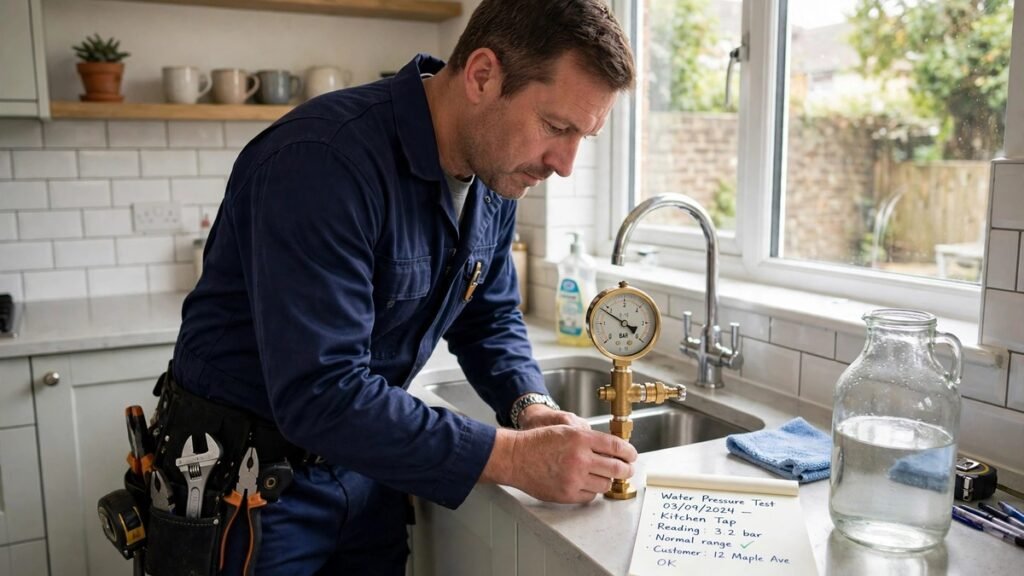
How to improve water pressure in home starts with a test: use a jug or a gauge, then clean tap aerators, descale the shower head and open the stopcock fully. If the whole house is still weak, ask your water company to test the supply. A booster pump costs £300 to £900 fitted.
Low water pressure turns simple jobs into chores. The shower runs as a trickle, the bath takes ages to fill, and the kitchen tap barely rinses a plate. In a UK home the cause is often simple, and the fix is often free. A partly closed stopcock, a scaled shower head or a clogged tap aerator can cut the flow in half, and each one takes minutes to sort.
This guide explains how to improve water pressure in home step by step, in order. First, what good pressure looks like in the UK and how to test yours. Then the common causes, the free fixes, the shower and tap fixes, and the bigger jobs: booster pumps, accumulators and new pipework. It gives UK prices throughout, explains what your water company must do by law, and says plainly when to stop and call a plumber.
Key Takeaways
- Most UK homes get 1 to 3 bar at the tap, and 1.5 to 2.5 bar feels comfortable for showers and taps.
- A 1 litre jug should fill in about 7 seconds from the kitchen cold tap, according to Severn Trent and Bristol Water.
- Water companies must keep at least 0.7 bar in the communication pipe, according to Ofwat, and they aim for 1.0 bar.
- Clean the tap aerators, descale the shower head and open the stopcock fully before spending any money.
- A shower pump costs £250 to £900 fitted, according to MyBuilder, and a whole-house mains booster costs £300 to £900 fitted.
- A pump that draws more than 12 litres a minute from the mains must be notified to the water company first, under the Water Supply (Water Fittings) Regulations 1999.
- If the pressure falls below 0.7 bar twice in 28 days, each time for over an hour, a £25 payment is due under the guaranteed standards scheme.
What Is Water Pressure and What Counts as Good in the UK?
Water pressure is the force that pushes water through the pipes to your taps, and in the UK it is measured in bar. One bar is roughly the pressure needed to push water up 10 metres. Most UK homes get between 1 and 3 bar at the tap, and around 1.5 to 2 bar feels comfortable for showers and taps, according to HomeEmbellish.
Pressure and flow are not the same thing, and the difference matters when you try to fix the problem. Pressure is the force behind the water. Flow is the volume of water that comes out, measured in litres per minute. A home can have good pressure but poor flow if the pipes are narrow or blocked, and it can have good flow but low pressure if the supply itself is weak. Severn Trent puts it plainly: water pressure is the force behind the water and flow is the volume of water.
What Do the Numbers Mean in a UK Home?
| Pressure at the tap | What it means | What to do |
|---|---|---|
| Below 1 bar | Low pressure | Test the flow, try the free fixes, then call the water company |
| 1 to 1.5 bar | Acceptable, but on the low side | Fine for most taps, weak for upstairs showers |
| 1.5 to 2.5 bar | Normal, and the ideal range | No action needed |
| 2.5 to 3.5 bar | High, watch it | Fine for most homes, but check appliances |
| Above 3.5 bar | Too high | Ask a plumber about a pressure reducing valve |
Water companies must keep a minimum pressure of 0.7 bar in the communication pipe, according to Ofwat. The communication pipe runs from the water main in the street to the outside stop valve at your boundary, and it belongs to the water company. Most water companies aim to provide at least 1.0 bar at the end of their pipe, according to WaterSafe. The company has no duty to meet a pressure standard inside your own supply pipe or inside your home, according to the Consumer Council for Water.
How Can I Check My Water Pressure at Home?
You can test your water pressure in a few minutes with no tools at all, or with a gauge that costs about £10 to £15 from a DIY shop, according to HomeEmbellish. Do the tests in the morning and again in the evening, because pressure changes through the day. It is often lowest in the morning and early evening, when everyone in the street is using water at the same time.
What Is the Jug Test?
The jug test needs no tools. Turn off all taps and appliances, then hold a 1 litre jug under the cold kitchen tap and time how long it takes to fill. If it fills in under 7 seconds, your flow is fine, according to Bristol Water. If it takes much longer, you have a pressure or flow problem. WaterSafe gives the same test in gallons: the first tap in the home, usually the kitchen tap, should fill a 4.5 litre bucket in 30 seconds, with all other taps and appliances turned off.
How Do I Use a Pressure Gauge?
A pressure gauge gives an exact reading in bar. Buy one with a standard half inch BSP thread, which fits a normal outside tap. Turn off every tap in the house, screw the gauge onto the outside tap, then turn the tap on fully and read the dial. A reading of 1 to 3 bar is normal in a UK home. A reading below 1 bar means the pressure is low. Test at the cold kitchen tap too if you can, because that tap is usually fed straight from the mains.
How Do I Test for a Leak?
A leak can steal pressure without any visible sign. Find your water meter, usually in a small chamber under a cover in the pavement or in the front garden. Turn off every tap and appliance in the house, then watch the meter. If the dial is still moving, water is escaping somewhere, and you have a leak. Check for damp patches on walls and floors, a patch of garden that stays wet, and a toilet that keeps running. A leak on your side of the boundary is your job to fix, and a plumber should find it. A leak on the street side is the water company’s job.
Should I Ask My Neighbours?
Yes, and do it early. If your neighbours have low pressure too, the problem sits in the street, not in your house, and only the water company can fix it. If your neighbours are fine and you are not, the problem is in your own supply pipe or inside your home. This one question saves a lot of wasted effort, and it tells you who to call.
What Kind of Water System Do I Have?
The right fix depends on the system in your home. A fix that works for a combi boiler can be wrong for a gravity-fed system, and a shower pump that suits a tank-fed shower can damage a mains-fed one. Work out which system you have before you buy anything.
How Does a Combi Boiler System Work?
A combi boiler heats water straight from the mains, with no cold water tank and no hot water cylinder. The pressure at your taps is the mains pressure, so if the mains is weak, every tap and shower is weak. Most combi boilers need at least 1 bar of mains pressure to work well, and the boiler display often shows a warning when the pressure drops. A combi boiler cannot take a shower pump on its hot side, because the pump would fight the mains. The fixes for a combi home are the free checks, a mains booster pump, or a new supply pipe.
How Does a Gravity-Fed System Work?
A gravity-fed system has a cold water tank in the loft and a hot water cylinder in the airing cupboard. The pressure at the taps comes from the height of the tank above the tap, not from the mains. A tank 3 metres above the shower gives about 0.3 bar, which is a weak shower. The mains only fills the tank, so a weak mains supply shows up as a slow-filling tank rather than a weak tap. Gravity-fed homes suit shower pumps, because the pump boosts the stored hot and cold water to the shower. Raising the tank higher also helps, but only a plumber should move it.
How Does an Unvented Cylinder Work?
An unvented cylinder stores hot water at mains pressure, with no cold water tank in the loft. The pressure at the taps is the mains pressure, like a combi system, but the cylinder holds a large volume of hot water, so several taps can run at once. An unvented cylinder needs a qualified installer for any work on it, because it is a pressurised vessel. A shower pump must never be fitted to an unvented system. The fixes are the same as for a combi home: free checks, a mains booster, or a new supply pipe.
Why Is My Water Pressure Low?
Low pressure has a short list of usual causes. Work through them in order, from the cheapest to the dearest, and stop when you find the fault. Most homes find the cause in the first four items on this list.
Is the Stopcock Fully Open?
The internal stopcock, usually under the kitchen sink, controls all the water into the house. If it is only partly open, it throttles the flow to every tap. Turn it anti-clockwise until it is fully open, then turn it back a quarter turn so it does not seize. Check the outside stop valve too, in the pavement chamber. A stopcock that was turned down during past work and never turned back up is one of the most common causes of low pressure, and it costs nothing to fix.
Are the Aerators and Shower Head Clogged?
The aerator is the small mesh at the tip of a tap. Shower heads have dozens of tiny holes. In hard water areas, which cover much of England, limescale and grit block both, according to HomeEmbellish. Unscrew the aerator, tip out the grit, and soak the parts in white vinegar for 30 to 60 minutes. For a shower head, fill a plastic bag with white vinegar, tie it over the head so the holes sit in the vinegar, and leave it overnight. If the head is old and badly scaled, a new one costs £15 to £40 and takes two minutes to fit, according to HomeEmbellish.
Is Limescale Blocking the Pipes?
Limescale builds up inside pipes, boilers and cylinders in hard water areas. It narrows the pipe from the inside, so less water gets through. The signs are a shower that has got weaker over months or years, a kettle that furs up fast, and white marks on taps. A plumber can test for scale and flush the system. A water softener stops new scale forming, but it does not clear scale that is already there. Flushing the pipes can clear light sediment, according to Checkatrade.
Is There a Leak?
A leak lets water out before it reaches your taps. Look for damp patches, a musty smell, a patch of lawn that stays green in dry weather, and a water bill that has risen for no reason. Do the meter test described above. If the meter moves with all taps off, call a plumber to find the leak. A standard leaking pipe repair costs around £330 on average, according to Checkatrade.
Is the Pressure Reducing Valve Set Too Low?
Some modern homes have a pressure reducing valve, or PRV, fitted to stop high mains pressure damaging appliances. If the valve fails or is set too low, it throttles your pressure for no reason. The valve is usually near the stopcock, with a screw or a bolt on top. A plumber can test it and adjust it. Do not adjust it yourself unless you know what you are doing, because setting it too high can damage appliances and joints.
Are the Pipes Old, Narrow or Corroded?
Old galvanised steel pipes corrode from the inside over decades, and the rust narrows the bore until the flow is a trickle. Lead pipes, common in homes built before 1970, are narrow too, and they should be replaced for health reasons as well as for pressure. A 15 mm pipe run that feeds a whole bathroom will always be weaker than a 22 mm run. If the pipes are the problem, only new pipework fixes it, and the cost section below gives the figures.
Am I on a Shared Supply?
Many older terraces and flats share one supply pipe from the street. When a neighbour runs a bath, your pressure drops. A shared supply also makes leaks harder to find, because the pipe serves more than one home. Some water companies run a shared supply separation scheme, and Severn Trent lists one on its website. Ask your water company whether your supply is shared and whether separation is possible.
Is It Peak Demand?
Pressure falls when demand rises. Mornings and early evenings are the worst, when showers, washing machines and dishwashers all run at once. If your pressure is fine at midday but weak at 7 in the morning, the cause is demand, not a fault in your home. A booster pump or an accumulator helps here, because it stores water or adds force when the mains is busy.
Is Height or Distance the Problem?
Water loses pressure as it climbs. One bar pushes water up about 10 metres, so a bathroom on the second floor of a tall house gets less pressure than the kitchen on the ground floor. A long supply pipe from the street also loses pressure along its length, especially if the pipe is narrow. Homes at the end of a long supply or on a hill often have the weakest pressure in the street.
Is There Work on the Street?
Roadworks, a burst main or maintenance on the network can cut pressure for a day or two. Check your water company’s website or social media for work in your area, or ring them. If the cause is their work, there is nothing to fix in your home, and the pressure should return when the work ends.
What Free Fixes Can I Try First?
Start with the free fixes, in this order. They take an hour or less, and they solve the problem in many homes. Do not buy a pump until you have tried them.
- Open the stopcock fully, then back a quarter turn. Check the outside stop valve too.
- Clean every tap aerator. Unscrew it, tip out the grit, soak the parts in white vinegar for 30 to 60 minutes, scrub with an old toothbrush, rinse and refit.
- Descale the shower head overnight in white vinegar, or replace it if it is old. A new head costs £15 to £40.
- Check the pressure reducing valve with a plumber if your home has one. A valve set too low throttles the whole house.
- Check the boiler pressure on a combi system. The gauge on the boiler should read 1 to 1.5 bar when the heating is cold. If it reads below 1 bar, top it up using the filling loop, following the boiler manual. This fixes low hot water pressure on a combi, but it does not fix low cold water pressure.
- Flush the pipes. Turn on the cold kitchen tap fully for a few minutes to clear light sediment, according to Checkatrade.
- Run the jug test again after each fix, and write down the result. If the flow is back to under 7 seconds for a litre, the fix worked.
How Do I Fix Low Pressure in the Shower?
The shower is where low pressure is felt most, and it is often the only place it shows. The fix depends on the system and on whether the problem is the head, the valve or the supply.
Should I Clean or Replace the Shower Head?
Yes, first. A scaled head is the most common cause of a weak shower, and a soak in vinegar often restores the flow without any cost at all, according to Checkatrade. If the head is old, buy a new one made for low-pressure systems. These heads mix air into the water, so the spray feels stronger even when the flow is low. A new head costs £15 to £40 and takes two minutes to fit.
Will a Shower Pump Help?
A shower pump helps a gravity-fed system, where the shower runs from a cold water tank and a hot water cylinder. A twin impeller pump boosts hot and cold water equally, so the mixer stays balanced. A single impeller pump boosts one supply only, and it suits a shower where only one side is weak. A shower pump must not be fitted to a combi boiler or an unvented cylinder. The pump needs a fused spur for power, and a plumber should fit it.
What Does a Shower Pump Cost?
A shower pump costs £250 to £900 fitted, according to MyBuilder. The pump itself costs £120 to £180 for a single impeller 1.5 bar model, £160 to £240 for a twin impeller 1.5 bar model, £220 to £320 for a twin impeller 2.0 bar model, and £300 to £420 for a twin impeller 3.0 bar model, according to Trade2Base. Labour costs £150 to £300, according to MyBuilder, and a straightforward install takes half a day, according to Trade2Base. A new fused spur from a nearby circuit costs £80 to £180 if an electrician is needed, according to Trade2Base.
Should I Switch to an Electric Shower?
An electric shower draws cold water straight from the mains and heats it as it flows, so it does not rely on stored pressure. It suits a combi home or a gravity-fed home where the shower is weak. The flow is limited by the power of the unit, usually 8.5 kW to 10.5 kW, so the shower will not be as strong as a pumped mixer shower, but it is steady. An electric shower needs its own electrical circuit, and an electrician must fit it.
What Is a Power Shower?
A power shower has a pump built into the shower unit, and it boosts the flow from an existing hot water tank and cold water tank. It suits a gravity-fed system, and it is a neat fix when there is no room for a separate pump in the airing cupboard. It does not suit a combi boiler or an unvented cylinder. Ask a plumber to suggest a make and model with the right capacity and then install it, according to Aspect.
How Do I Improve Water Pressure Upstairs?
Upstairs taps and showers get less pressure than the kitchen tap, because water loses force as it climbs. One bar pushes water up about 10 metres, so a bathroom 5 metres above the ground loses about 0.5 bar before the water even reaches the tap. In a two-storey house with 1.5 bar at the kitchen tap, the upstairs shower may see only 1 bar, and in a three-storey house it may see less.
What Should I Check First Upstairs?
Check the upstairs taps on their own first. If the kitchen tap is strong and only the upstairs is weak, the mains supply is fine, and the problem is height, the pipe run or the fittings upstairs. Clean the upstairs tap aerators and descale the upstairs shower head, because scale builds up fastest where the water is hottest. Check the isolation valves under the upstairs basin and bath, and make sure they are fully open. A valve that was turned down during past work is a common cause of a weak upstairs tap.
Does the Tank Height Matter in a Gravity-Fed Home?
Yes, it matters a lot. In a gravity-fed home the pressure comes from the height of the cold water tank above the tap. A tank 3 metres above the shower gives about 0.3 bar, which is a weak shower. A tank 5 metres above the shower gives about 0.5 bar, which is better but still low. Raising the tank helps, but only a plumber should move it, because the tank is heavy when full and the pipework must be redone. A shower pump is the usual fix for a gravity-fed upstairs shower, and it costs £250 to £900 fitted, according to MyBuilder.
What Helps an Upstairs Shower on a Combi System?
On a combi system the upstairs shower runs at mains pressure, so the fixes are the same as for the whole house: clean the head, check the stopcock, and test the pressure at the kitchen tap. If the kitchen tap reads 1 bar and the upstairs shower is weak, the pipe run to the bathroom may be narrow or partly blocked, and a plumber should check it. A mains booster pump helps the whole house, upstairs included, and it costs £300 to £900 fitted. An electric shower is another option for one upstairs bathroom, because it heats mains water as it flows and does not rely on the height of a tank.
How Do I Fix Low Pressure at One Tap?
If only one tap is weak, the problem is at that tap, not in the supply. Clean the aerator first, as described above. If the flow is still weak, the tap valve or cartridge may be worn. A faulty valve or cartridge can be replaced, according to Checkatrade. Check the isolation valve under the sink too, and make sure it is fully open. A flexible tap connector that is kinked or partly crushed will also cut the flow, and it costs a few pounds to replace. If the tap is old and the bore is scaled, replacing the tap is often cheaper than repairing it.
Does Low Water Pressure Affect My Boiler and Appliances?
Yes. Low pressure affects more than the shower. It slows the bath, weakens the kitchen tap, and makes washing machines and dishwashers take longer to fill. It can also stop a combi boiler working properly, and it can shorten the life of appliances that need a steady supply.
What Happens to a Combi Boiler?
A combi boiler needs mains pressure to fire up and to heat water. Most combi boilers need at least 1 bar of mains pressure to work well, and the boiler display often shows a warning when the pressure drops. The boiler has its own internal pressure gauge, which should read 1 to 1.5 bar when the heating is cold. If it reads below 1 bar, top it up using the filling loop, following the boiler manual. If the pressure keeps dropping after you top it up, there may be a leak in the heating system, and a Gas Safe registered engineer should check it. Do not keep topping up a boiler that loses pressure every day, because fresh water brings in oxygen, and oxygen causes rust inside the radiators.
What Happens to Washing Machines and Dishwashers?
Washing machines and dishwashers fill from the mains, and most need at least 1 bar to fill in a reasonable time. A machine that fills slowly will take longer to run, and some machines show an error if the fill takes too long. Check the inlet filter on the back of the machine, where the hose joins the valve, because grit and scale collect there. Turn off the water, unscrew the hose, and clean the small mesh filter. Check that the inlet valve is fully open too. If the machine still fills slowly after that, the problem is the supply, not the machine.
Should I Fit a Water Softener?
A water softener stops new limescale forming in pipes, boilers and appliances, and it suits a hard water area. It does not clear scale that is already there, so it is a guard for the future, not a fix for the present. A softener needs space, a drain and a salt supply, and a plumber should fit it. It will not raise the pressure on its own, but it stops the pressure falling again as scale builds up, and it protects the boiler and the shower head at the same time.
How Much Does a Booster Pump Cost?
A booster pump is the usual fix when the mains supply itself is too weak for the home. It adds force to the incoming water, so taps and showers run stronger. It does not create water, so it cannot help if the supply pipe is blocked or leaking. Fix those causes first.
What Is the 12 Litres a Minute Rule?
UK water rules limit how much water a pump may draw straight from the mains. A pump that draws more than 12 litres per minute from the mains must be notified to the water company before it is installed, under the Water Supply (Water Fittings) Regulations 1999, according to GasMaster UK. Small pumps up to 12 litres a minute are usually allowed without notice, according to HomeEmbellish. Anything bigger needs a break tank, which stores water first and then pumps it to the house, and it needs the water company’s agreement. A pump that pulls too hard can take pressure away from neighbours, and one Sheffield case cost over £2,400 to put right after a pump was fitted without notice, according to a 2026 buying guide.
Which Mains Booster Pumps Are Sold in the UK?
| Product | What it does | Supply price seen, November 2026 |
|---|---|---|
| Salamander HomeBoost 1.6 bar | Inline mains booster, boosts whole-house flow to 12 litres per minute | £318.50 to £379.99 |
| Stuart Turner STORMBOOST 2.5 bar | Inline mains booster, boosts pressure by up to 2.5 bar | £303.50 |
| Salamander CombiBoost | Inline booster for combination boilers, up to 10 litres per minute | £340.34 |
| Salamander TapBoost | Single outlet booster for one tap or shower | £158.99 |
| Salamander TankBoost 100L, 3.0 bar | Tank and pump system, up to 3.0 bar | £1,224.49 |
| Salamander TankBoost 200L, 3.0 bar | Tank and pump system, up to 3.0 bar | £1,306.99 |
| Salamander TankBoost 350L, 3.0 bar | Tank and pump system, up to 3.0 bar | £1,822.49 |
Prices are retail prices seen in November 2026 from Toolstation, Plumbworld, Plumbnation and Wolseley, and they include VAT where shown. The Salamander HomeBoost is WRAS approved for connection directly to the mains, and it is quiet enough to sit under a kitchen sink, according to City Plumbing. The Stuart Turner STORMBOOST is also WRAS approved, and it can be installed in less than an hour, according to Plumbworld.
What Does a Booster Pump Cost Fitted?
A domestic water pump installation costs £300 to £1,000 on average, according to MyBuilder. A booster pump itself costs £200 to £800, and installation labour costs £150 to £300, according to MyBuilder. A whole-house mains booster costs £300 to £700 for the product and £250 to £450 for installation, according to a 2026 pump guide. A full inline booster plus accumulator system costs £400 to £900 including materials, according to the same guide, with higher figures in London and the South East. A plumber charges £40 to £60 an hour on average, or £320 to £480 a day, according to Checkatrade’s October 2026 cost guide. London and the South East cost more, with plumbers charging £60 to £90 an hour, according to Gumtree’s 2026 guide.
Should a Plumber Fit the Pump?
Yes. A mains booster pump should be installed by a qualified plumber, preferably one registered with the Water Industry Approved Plumber scheme (WIAPS), according to a 2026 pump buying guide. The fitter must check that the pump is WRAS approved, that the flow stays within the 12 litres a minute limit, and that the pipework and electrics are safe. A pump fitted badly can damage the mains, annoy the neighbours and void the warranty.
What Is an Accumulator and When Do I Need One?
An accumulator is a pressure vessel that stores water under pressure, so the home can draw on it when several taps run at once. The mains fills the vessel slowly, and the vessel releases water fast when a tap opens. It smooths out peaks in demand, and it works well in homes where the pressure is fine at quiet times but weak in the morning.
How Does an Accumulator Work?
The vessel holds water on one side of a rubber diaphragm and compressed air on the other. When a tap opens, the air pushes the stored water out at a steady pressure. When the tap closes, the mains refills the vessel. An accumulator vessel costs £80 to £200 on its own, according to a 2026 pump buying guide. Salamander AccuBoost unpumped accumulator tanks cost £585.60 for the 120 litre model and £850.80 for the 180 litre model, according to Plumbworld. The pumped versions, sold as TankBoost systems, cost £1,224.49 for 100 litres, £1,306.99 for 200 litres and £1,822.49 for 350 litres, according to Toolstation.
When Should I Choose an Accumulator Instead of a Pump?
Choose an accumulator when the mains pressure is acceptable but the flow cannot keep up with peak demand. It suits a home with several bathrooms, or a home where the shower goes weak when the washing machine runs. Choose a pump when the mains pressure itself is too low all day. A pumped accumulator, such as a TankBoost, does both jobs: it stores water and it boosts the flow, and it can deliver up to 36 litres per minute for 7 minutes from the 350 litre model, according to Toolstation. Ask a plumber which one fits your home, because the right choice depends on your pressure reading, your flow reading and the number of bathrooms.
How Much Does Replacing Pipework Cost?
New pipework is the dearest fix, and it is the right one when the pipes themselves are the problem. Old lead, galvanised steel and narrow 15 mm runs cannot carry enough water, and no pump will fix a pipe that is blocked with rust or scale.
Should I Replace Lead Pipes?
Yes, and soon. Lead pipes have not been used in new builds since the 1970s, according to Checkatrade, but many older homes still have them. Lead can leach into drinking water, and the legal limit for lead in drinking water is 10 micrograms per litre, under the Water Supply (Water Quality) Regulations 2016. The water company owns the pipe from the main in the road to your boundary, and it will usually replace its section free of charge, according to Checkatrade. The section from the boundary into your home is yours, and you pay for it.
What Does a Supply Pipe Replacement Cost?
| Job | Typical UK cost in 2026 | Source |
|---|---|---|
| Main water pipe replacement, 20 metres | £2,000 to £4,000, average £3,000 | Checkatrade, July 2026 |
| Stopcock to house, 5 metres, private plumber | £400 to £800, average £600 | Checkatrade, July 2026 |
| Stopcock to house, 5 metres, WIAPS approved | £500 to £1,000, average £750 | Checkatrade, July 2026 |
| New pipe by moling, per metre | £100 per metre | Checkatrade, July 2026 |
| New pipe by dug trench, per metre | £200 per metre | Checkatrade, July 2026 |
| Lead pipe replacement, typical home | £800 to £2,500 | Ready Steady Sell, 2026 |
| Small internal pipe run | £300 to £1,000 | Assett Plumbing, 2026 |
Moling is a trenchless method that pushes the new pipe through the ground from two small pits, so the garden and driveway stay mostly untouched. A dug trench is cheaper per metre but needs the surface relayed afterwards. The job usually takes half a day to three days, depending on the length of pipe and the access, according to Checkatrade. Some water companies offer grants of around £500 to £2,000 towards a new supply pipe, according to Assett Plumbing, so ask your water company before you pay.
What Must My Water Company Do?
Your water company has legal duties, and knowing them saves you money. If the fault is on their side of the boundary, the fix is theirs, and you should not pay a plumber for it.
What Is the Minimum Pressure My Water Company Must Supply?
Water companies must keep a minimum pressure of 7 metres static head, or 0.7 bar, in the communication pipe serving your home, according to Ofwat. The communication pipe ends at the outside stop valve, and the company has no duty to meet a pressure standard inside your own supply pipe, according to the Consumer Council for Water. Most companies aim to provide 10 metres head, or about 1.0 bar, at the end of their pipe, according to WaterSafe.
Can I Get Compensation for Low Pressure?
Yes, in some cases. If the pressure falls below 0.7 bar on two occasions, each lasting over an hour, within 28 days, a payment of £25 is due under the guaranteed standards scheme, according to Ofwat. Only one payment can be made in any one financial year, according to The Complaining Cow. Keep a record of the dates and times when the pressure drops, and report them to your water company. The company can visit your home to test the pressure, according to the Consumer Council for Water.
How Do I Report Low Pressure?
Ring the number on your water bill, or report it on the company’s website. Give them the dates and times of the low pressure, the result of your jug test, and whether your neighbours are affected. The company will check for work in the area, test the pressure at your boundary stop valve, and tell you whether the fault is theirs or yours. If the pressure at the boundary is below 1 bar with the stopcock open, it is their responsibility to improve it, according to Aspect.
How Much Does It Cost to Improve Water Pressure?
| Fix | Typical UK cost in 2026 | Who fits it |
|---|---|---|
| Clean aerators and descale shower head | £0, or £15 to £40 for a new head | You |
| Pressure gauge for testing | £10 to £15 | You |
| Open stopcock and check valves | £0 | You |
| Plumber visit, first hour | £40 to £60, average £50 | Plumber |
| Plumber day rate | £320 to £480, average £400 | Plumber |
| Emergency plumber call-out fee | £100 to £120 | Plumber |
| Shower pump, supplied and fitted | £250 to £900 | Plumber |
| Mains booster pump, supplied and fitted | £300 to £900 | Plumber |
| Accumulator vessel only | £80 to £200 | Plumber |
| AccuBoost 120L unpumped accumulator | £585.60 | Plumber |
| TankBoost 100L to 350L system | £1,224 to £1,822 | Plumber |
| Supply pipe replacement, 20 metres | £2,000 to £4,000 | Plumber or WIAPS contractor |
| Lead pipe replacement, typical home | £800 to £2,500 | Plumber or WIAPS contractor |
All prices are typical UK ranges for 2026, drawn from Checkatrade, MyBuilder, Trade2Base, Toolstation and Plumbworld. Prices vary by region, and London and the South East cost more. Always ask whether a quote includes VAT, because some guides quote prices excluding VAT, and VAT at 20 percent adds a large sum to a £900 job.
What Would It Cost for a Typical 3-Bedroom Semi?
Take a typical 3-bedroom semi with a combi boiler, 1 bar at the kitchen tap, and a weak upstairs shower. The free fixes cost nothing: open the stopcock, clean the aerators and descale the shower head. A pressure gauge costs £10 to £15. If the free fixes do not work, a plumber’s visit costs £40 to £60 for the first hour, according to Checkatrade. A Salamander HomeBoost costs £318.50 to £379.99 to buy, and fitting adds £150 to £300, according to MyBuilder, so the whole job lands at about £470 to £680. If the plumber finds a leak instead, a standard leaking pipe repair costs around £330 on average, according to Checkatrade. If the supply pipe is lead and needs replacing, a 5 metre run costs £400 to £800 from a private plumber, according to Checkatrade. The total bill for this home is most likely £0 to £680, and only the dearest cause pushes it above £1,000.
When Should I Call a Plumber?
Call a plumber when the free fixes have not worked, when the cause is inside your home, and when the job needs tools or knowledge you do not have. A plumber charges £40 to £60 an hour, with an average of £50, according to Checkatrade. Get three written quotes for a big job, and make sure each one covers the same work.
Call the water company first, not a plumber, when your neighbours are affected too, when the pressure at the boundary is below 1 bar, when there is work on the street, or when the meter chamber or the outside stop valve is the problem. The company’s number is on your water bill, and the visit to test the pressure is free.
Call a plumber when the meter test shows a leak on your side, when the pressure reducing valve needs adjusting, when a shower pump or a booster pump needs fitting, when pipework needs replacing, and when the boiler pressure keeps dropping. A Gas Safe registered engineer must do any work on a gas boiler. An electrician must fit a new fused spur or a new circuit for a pump or an electric shower.
What Mistakes Should I Avoid?
The most expensive mistakes are made before the work starts. The first is buying a pump before testing the pressure. A pump cannot fix a blocked pipe, a leak or a partly closed stopcock, and it costs £300 to £900 to learn that. Test first, with a jug or a gauge, and work through the free fixes.
The second is fitting a pump that draws more than 12 litres a minute from the mains without telling the water company. The rules exist to protect your neighbours, and breaking them can lead to a bill for the damage. A pump that draws more than 12 litres a minute must be notified to the water company first, under the Water Supply (Water Fittings) Regulations 1999.
The third is fitting a shower pump to a combi boiler or an unvented cylinder. A shower pump suits a gravity-fed system only. On a combi or unvented system it will not work properly, and it can damage the system.
The fourth is ignoring a leak. A leak wastes water, raises the bill, and rots floors and walls. If the meter moves with all taps off, find the leak before you spend money on anything else.
The fifth is replacing the supply pipe before asking the water company about grants. Some companies offer around £500 to £2,000 towards a new supply pipe, according to Assett Plumbing, and some replace their own lead section free of charge. Ask first, and get the answer in writing.
How Do I Keep Good Pressure?
A few small habits keep the pressure good year after year. Clean the tap aerators every few months, and descale the shower head twice a year in a hard water area. Turn the stopcock fully open and back a quarter turn once a year, so it does not seize. Check the boiler pressure monthly on a combi system, and top it up when it reads below 1 bar.
Watch for the early signs of a problem. A shower that gets weaker over months, a tap that splutters, and a toilet that fills slowly all point to scale or a blockage starting. Deal with them early, while the fix is still a clean and a soak in vinegar. If you live in a hard water area, a water softener stops new scale forming, and it protects the boiler and the pipes as well as the taps.
What About Frozen Pipes in Winter?
Cold weather can freeze pipes and cut the pressure, especially in lofts, garages and outside walls. If the pressure drops suddenly on a cold morning, check for frost on exposed pipes. Thaw a frozen pipe gently, with warm towels or a hairdryer on a low setting, according to Checkatrade. Never use an open flame. Once the pipe thaws, check for leaks, because a frozen pipe can crack. Lag exposed pipes with foam insulation before winter, and leave the heating on low if the house will be empty in a cold snap.
FAQs
How can I improve water pressure in my home?
How to improve water pressure in home is simple: test it first, then clean the tap aerators, descale the shower head and open the stopcock fully. If the whole house is still weak, ask your water company to test the supply at the boundary. A booster pump costs £300 to £900 fitted and is the usual fix when the mains supply itself is too weak.
What is normal water pressure in the UK?
Normal water pressure in the UK is 1 to 3 bar at the tap, and 1.5 to 2.5 bar feels comfortable for showers and taps. Water companies must keep at least 0.7 bar in the communication pipe, according to Ofwat, and they aim for 1.0 bar. A reading below 1 bar at the tap means the pressure is low.
How much does a booster pump cost in the UK?
A booster pump costs £300 to £900 fitted in the UK, according to MyBuilder. The pump itself costs £200 to £800, and installation labour costs £150 to £300. A Salamander HomeBoost costs £318.50 to £379.99 to buy, and a Stuart Turner STORMBOOST costs £303.50, based on retail prices seen in November 2026.
Can I fit a booster pump on the mains supply?
Yes, but only within the rules. A pump that draws up to 12 litres a minute from the mains is usually allowed without notice, according to HomeEmbellish. A pump that draws more than 12 litres a minute must be notified to the water company before it is installed, under the Water Supply (Water Fittings) Regulations 1999. A qualified plumber should fit the pump, preferably one registered with the Water Industry Approved Plumber scheme.
What should I do if my water pressure is below 1 bar?
First, do the jug test and check with your neighbours. If the neighbours are affected too, ring your water company, because the fault is likely in the street. If only your home is affected, open the stopcock fully, clean the aerators and descale the shower head. If the pressure is still below 1 bar, ask the water company to test the pressure at your boundary, and call a plumber if the fault is inside your home.
Conclusion
How to improve water pressure in home comes down to three steps: test first, fix the free causes, and only then spend money on a pump or new pipework. Most UK homes get 1 to 3 bar at the tap, and 1.5 to 2.5 bar feels comfortable. A 1 litre jug should fill in about 7 seconds from the kitchen cold tap. If it takes much longer, the cause is often simple: a partly closed stopcock, a scaled shower head or a clogged aerator.
When the free fixes do not work, the numbers decide the next step. A shower pump costs £250 to £900 fitted. A whole-house mains booster costs £300 to £900 fitted. A supply pipe replacement costs £2,000 to £4,000 for 20 metres. Your water company must keep at least 0.7 bar in the communication pipe, and if the pressure falls below that twice in 28 days, a £25 payment is due. A pump that draws more than 12 litres a minute from the mains must be notified to the water company first.
Start with the jug test today and work through the free fixes in order. If the whole house is weak and your neighbours are too, ring the water company before you pay anyone.