
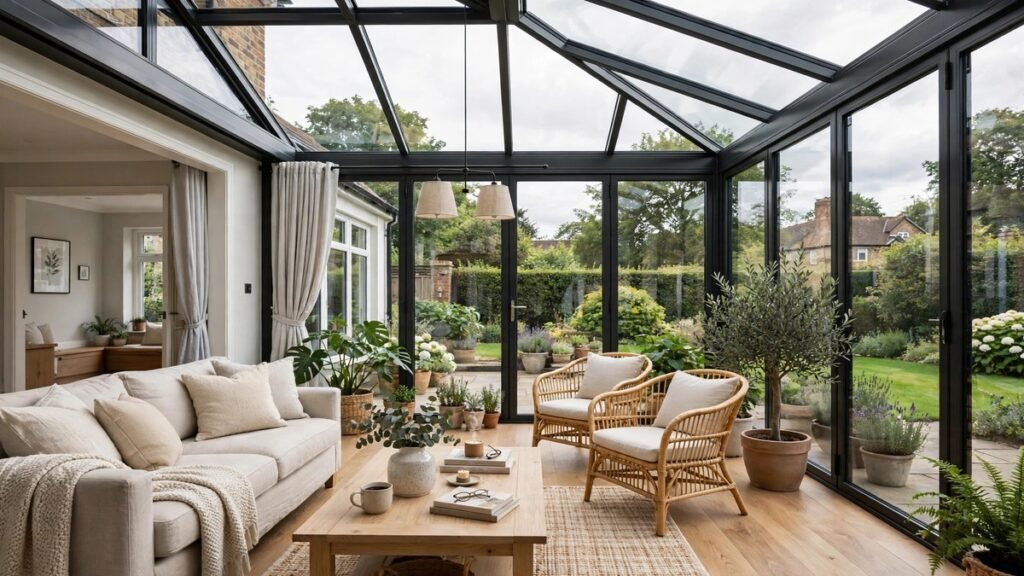
A modern conservatory is one of the simplest ways to add light and space to a UK home. It is a glass room, usually built onto the back of the house, that brings the garden inside and gives you a bright place to eat, sit, work or play. Done well, it feels like part of the house, not an add-on. Done badly, it is too hot in summer, too cold in winter, and used only a few weeks a year.
The short answer is that a modern conservatory in the UK in 2026 typically costs between £10,000 and £35,000, depending on the style, the size, the roof and the frames. A small lean-to in uPVC sits at the lower end. A large orangery with a solid roof and aluminium frames sits at the top end, and can cost more. Most homeowners spend around £15,000 to £25,000 on a typical project. The style you pick, the roof you choose and the frames you fit change the price, the look and how the room feels through the year.
In this guide, we explain what a modern conservatory is, how the five main styles compare, whether to pick a glass roof or a solid roof, how uPVC, aluminium and timber frames compare, what each style costs, whether you need planning permission, what building regulations apply, how to heat the room in winter and cool it in summer, which glass to choose, how to furnish it, and whether it adds value to your home. Everything is in plain English, with UK prices and UK rules in mind.
What Is a Modern Conservatory?
A conservatory is a room with a glass roof and glass walls, built onto a house, usually at ground level at the back. It started as a place to grow plants in winter, which is why the name comes from the word conserve. Today it is a living space: a dining room, a sitting room, a home office or a playroom, with far more glass than a normal room.
A modern conservatory looks different from the white plastic boxes many people picture from the 1980s and 1990s. The frames are slimmer, the glass is better, and the roofs are often solid or part solid, so the room stays warm in winter and does not turn into an oven in summer. Modern designs use clean lines, large panes of glass, flat or low-pitched roofs, and colours such as grey, black and green, instead of bright white. The result looks like it belongs with the house, not like it was bolted on.
How a Conservatory Differs From an Extension
A conservatory and an extension both add space, but they are built and treated in different ways. An extension is built like the rest of the house, with brick or block walls, a tiled or flat roof, and the same heating as the rest of the home. A conservatory has a glass roof, or a solid roof with a lot of glass, and it is usually separated from the house by doors. That separation matters for the rules: a conservatory that meets certain conditions does not need building regulations approval, while an extension always does. A conservatory is also usually quicker and cheaper to build than an extension of the same size, because the structure is lighter and much of it is made off site.
What Makes a Conservatory Modern
Three things make a conservatory modern. The first is the glass. Modern double glazing, and in some cases triple glazing, keeps heat in far better than the thin single glazing of old conservatories. Solar control glass cuts the heat from the sun, so the room stays cooler in summer. The second is the roof. A solid or part-solid roof, with tiles or panels and insulation, makes the room usable all year, while a full glass roof gives the most light but needs shading and ventilation to stay comfortable. The third is the design. Modern conservatories use slim frames, large panes, and colours that match the house, so the room looks like a deliberate part of the home rather than a cheap add-on. When all three are right, the room works in January and in July.
Modern Conservatory Styles
There are five main conservatory styles in the UK. The style you pick decides the shape of the room, how much floor space you get, how it looks from the garden, and what it costs. Here is each one in turn.
Lean-To Conservatory
A lean-to conservatory, also called a sunroom or a Mediterranean conservatory, has a single sloping roof that leans against the wall of the house. It is the simplest and cheapest style, and it suits homes with limited space or a low roofline, such as bungalows and houses with a low eaves height. A lean-to is usually rectangular, with a clean, straight look that suits modern homes well. It costs the least because the roof is simple and there is less structure to build. The trade-off is head height: the roof slopes down from the house, so the far side of the room is lower, and the style gives less of a sense of space than a taller design. A lean-to is a good choice when you want a bright dining area or a garden room on a modest budget, and when the house does not have room for a taller roof.
Edwardian and Victorian Conservatories
Edwardian and Victorian conservatories are the two classic styles, and they suit period homes as well as modern ones. An Edwardian conservatory is rectangular or square, with a flat front and a pitched roof, which gives you the most usable floor space for the size, because there are no curved walls eating into the room. A Victorian conservatory has a curved front, usually with three or five facets, and a steeply pitched roof with a decorative ridge. It looks more traditional and gives a rounded, bay-window feel, but the curved walls mean slightly less usable floor space than an Edwardian of the same size. Both styles cost more than a lean-to, because the roof is more complex and there is more glazing. They suit homes where the conservatory is a main living room or dining room, and where the look of the room from the garden matters as much as the space inside.
Gable-End Conservatories and Orangeries
A gable-end conservatory has a roof that rises to a point at the front, like the gable of a house, with a tall window in the front wall. It gives the most height and the most light of any conservatory style, and it suits large homes and rooms that need to feel grand. It costs more than an Edwardian or Victorian, because the tall front and the roof structure need more material and more work. An orangery is different again: it has brick pillars or walls at the corners, a flat roof with a glass lantern in the middle, and far less glass than a conservatory. It feels more like a solid extension with a lot of light, and it is the most expensive style, because it needs brickwork and a more complex roof. An orangery suits homes where you want a solid, warm room that still feels bright, and where the budget allows for the extra building work.
Glass Roof or Solid Roof: Which Suits a Modern Conservatory?
The roof is the most important choice in a modern conservatory, because it decides how the room feels in winter and in summer, how much light you get, and what the room costs. There are two main options: a glass roof and a solid roof. Each suits a different home and a different way of using the room.
Glass Roofs
A glass roof is the classic conservatory roof. It is made of double glazed panels, usually with solar control glass, and it lets in the most light of any roof type. A glass roof makes the room feel open and bright, and it gives you a view of the sky, which is part of the pleasure of a conservatory. Modern glass roofs are far better than the old ones: the glass is thicker, the seals are better, and the panels can include solar control coatings that cut the heat from the sun. Even so, a glass roof is the hardest roof to keep comfortable. In summer it can let in too much heat, and in winter it loses heat faster than a solid roof. Roof vents, blinds and good ventilation help, but they add cost. A glass roof suits a home where light matters most, and where the room is used mainly in spring, summer and autumn, or where the heating and shading have been planned from the start.
Solid and Tiled Roofs
A solid roof, also called a tiled roof, is made of insulated panels or tiles, like the roof of a normal room, with plaster inside. It keeps the room warm in winter and cool in summer, because the insulation slows heat passing through in both directions. A solid roof also cuts rain noise, which is a real benefit in a British winter, when rain on a glass roof can be loud enough to drown out conversation. The trade-off is light: a solid roof lets in less light than a glass roof, so the room feels more like a normal room and less like a garden room. Many homeowners solve this with a roof lantern, a raised glass box in the middle of the solid roof, which brings light back into the centre of the room. A solid roof costs more than a glass roof, but it is the best choice when you want to use the room all year round as a dining room, a living room or a home office.
Which Roof Suits Your Home
The choice comes down to three questions. First, how will you use the room? If it is a garden room for spring and summer, a glass roof gives the most light and the best feel. If it is a dining room or a home office you will use every day, a solid roof is the better choice, because it stays comfortable in all four seasons. Second, which way does the garden face? A south-facing conservatory gets the most sun and the most heat, so a solid roof or solar control glass matters more. A north-facing conservatory gets less sun, so a glass roof brings in more of the light that is there. Third, what is your budget? A solid roof adds thousands to the cost, but it also makes the room usable for more of the year, which is what you are paying for. Many installers now offer a part-solid roof, with solid panels on the sides and glass in the middle, which gives a balance of light and warmth. Ask your installer to show you both options on a similar home before you decide.
Frames: uPVC, Aluminium or Timber?
The frames hold the glass and set the look of the conservatory. There are three main materials in the UK: uPVC, aluminium and timber. Each has its own strengths, its own look and its own price.
uPVC Frames
uPVC is the most common conservatory frame material in the UK, and it is the cheapest. It needs almost no maintenance: it does not rot, it does not need painting, and it only needs a wash with warm soapy water now and then. Modern uPVC frames come in colours such as grey, black, green and wood-effect finishes, so they no longer have to be bright white. The trade-off is bulk: uPVC frames are thicker than aluminium frames, so they let in slightly less light and look less slim. They are also the least strong of the three materials, so very large panes of glass need thicker frames or extra support. uPVC suits most homes and most budgets, and it is the best choice when cost matters most and the conservatory is a standard size.
Aluminium Frames
Aluminium is the modern choice, and it is the material most often used in high-end conservatories. It is strong, so the frames can be very slim, which means more glass and more light. It does not rust, it needs little maintenance, and it comes in almost any colour, with a powder-coated finish that lasts for years. Aluminium is more expensive than uPVC, often by 20 to 40 percent for the same conservatory, and it conducts heat more easily, so good aluminium frames need a thermal break, a layer of insulating material inside the frame, to stop heat escaping. Check that any aluminium frame you are offered has a thermal break, and ask for the U-value of the frame. Aluminium suits modern homes, large panes of glass, and conservatories where slim frames and a clean, sharp look matter.
Timber Frames
Timber is the traditional choice, and it suits period homes and conservation areas where uPVC or aluminium would look wrong. It is warm to the touch, it can be painted any colour, and it gives a soft, natural look that suits older houses. Hardwood frames, such as oak or mahogany, last for decades when they are looked after. The trade-offs are cost and care: timber is the most expensive frame material, and it needs regular painting or staining to stop it rotting and to keep it looking good. Softwood frames are cheaper but need more care and do not last as long. Timber suits listed buildings, period homes and owners who are willing to look after the frames. If you choose timber, ask the installer what wood it is, how it is treated, and what care it will need each year.
How Much Does a Modern Conservatory Cost in the UK?
Modern conservatory costs in the UK in 2026 vary widely by style, size and specification. The ranges below are typical UK guide prices from trade cost guides such as Checkatrade, drawn together for this article. They are a guide only. Prices vary by region, ground conditions and installer, so always get written quotes for your own home.
Cost by Style
| Conservatory style | Typical UK cost in 2026 |
|---|---|
| Lean-to | £10,000 to £20,000 |
| Edwardian | £12,000 to £25,000 |
| Victorian | £12,000 to £25,000 |
| Gable-end | £15,000 to £30,000 |
| Orangery | £20,000 to £40,000 or more |
These ranges cover the build and the finish for a typical size, usually around 12 to 20 square metres, with uPVC frames and a glass roof. A solid roof adds roughly £5,000 to £15,000 to the cost, depending on the size and the roof system. Aluminium frames add roughly 20 to 40 percent to the frame cost. Timber frames add more again. A larger conservatory, a difficult site, or a high-end finish can push the cost above these ranges.
Cost per Square Metre
Cost per square metre is a useful way to compare quotes, but it needs care, because a small conservatory costs more per square metre than a large one, since the fixed costs, such as the base, the doors and the installer, are spread over fewer square metres. As a guide, a uPVC conservatory with a glass roof typically costs around £1,500 to £2,500 per square metre in 2026. A conservatory with a solid roof typically costs around £2,000 to £3,000 per square metre. An orangery typically costs around £2,500 to £4,000 per square metre. Use the per-square-metre figure to sense-check a quote, not to set your budget. A quote that is far below these bands usually leaves something out, such as the base, the flooring or the electrics. A quote far above them may include a high-end finish or a difficult site. Ask the installer to break the quote down by part, so you can see what each square metre actually buys.
What Drives the Cost Up or Down?
Two identical-looking conservatories can get very different quotes. Here are the factors that move the price most.
Size and Style
A bigger conservatory costs more, because there is more base, more glass, more roofing and more finish. But the style matters just as much. A lean-to is the cheapest style because the roof is a single slope and the structure is simple. A Victorian or Edwardian costs more because the roof is pitched and the glazing is more complex. A gable-end costs more again because the tall front needs more glass and more structure. An orangery costs the most because it needs brickwork and a more complex roof. The shape of your garden matters too: a conservatory on a flat, clear site costs less than one on a sloping site or one that needs trees removed, old paving lifted, or drains moved.
Frames and Glazing
The frames and the glass are a large part of the cost. uPVC is the cheapest frame material, aluminium costs more, and timber costs the most. The glass matters too: standard double glazing is the cheapest option, while solar control glass, self-cleaning glass and triple glazing each add to the cost. A glass roof costs less than a solid roof, but the glass itself can be expensive if you choose high-specification panels. Large panes of glass cost more than small panes, and shaped glass, such as curved panels for a Victorian front, costs more than flat panels. Decide the frames and the glass before the installer quotes, so the quote matches what you actually want, and so you are not choosing expensive glass after the work has started.
Groundwork and Extras
The base is the part people forget, and it can be a large part of the bill. A conservatory needs foundations, a dwarf wall, a floor slab and drainage. If the ground is soft, sloping or hard to reach, the groundwork costs more. If drains need to be moved, or if the conservatory is built over a manhole, the cost rises further. Extras add up too: underfloor heating, radiators, electrics, lighting, plastering, flooring, blinds and roof vents are often quoted separately. A quote of £15,000 for the shell can become £20,000 or more once the heating, the electrics and the finish are added. Always ask whether a quote includes the base, the heating, the electrics, the flooring and the VAT, and get each item listed separately.
Do You Need Planning Permission for a Modern Conservatory?
Many conservatories in England do not need planning permission, because they fall under permitted development rights. That does not mean there are no rules. It means the work is allowed without a full planning application, as long as it stays within strict limits. The rules below are for England. Scotland, Wales and Northern Ireland have their own rules, so check with your local planning authority if you live outside England.
Permitted Development Rules
Under permitted development in England, a conservatory counts as an extension, and it must stay within these limits: it must be single storey and at ground level; it must not cover more than half the land around the original house; it must not go forward of the principal elevation, which usually means the front of the house; the maximum height is 4 metres, with eaves no higher than 3 metres, and if any part is within 2 metres of a boundary, the maximum height is 3 metres; a rear extension must not extend beyond the rear wall by more than 3 metres for a terraced or semi-detached house, or 4 metres for a detached house, unless you use the larger home extension scheme, which allows up to 6 metres for a semi-detached or terraced house and 8 metres for a detached house, subject to neighbour consultation. A side extension must be single storey, no more than 4 metres high, and no wider than half the width of the original house. These limits are strict, and going beyond any one of them means you need a full planning application.
When You Need Full Planning Permission
You need a full planning application if the conservatory goes beyond the permitted development limits, if it is built on the front of the house, if it is more than one storey, or if the property is a flat or a maisonette, where permitted development rights do not apply in the same way. A planning application takes around 8 weeks for a decision, and it costs a few hundred pounds. If the application is refused, you can change the design and apply again, but that costs time and fees. Even when your conservatory falls under permitted development, it is worth applying for a Lawful Development Certificate. It is a written document from the council that confirms the work is lawful, and it is useful when you sell the house, because a buyer and their solicitor will ask for proof. It costs less than a planning application and takes around 8 weeks.
Listed Buildings and Conservation Areas
If your home is listed, or if it is in a conservation area, an Area of Outstanding Natural Beauty or a National Park, the rules are different. Permitted development rights are often removed or restricted in these areas, and a listed building needs listed building consent for almost any change, including a conservatory. Talk to your local planning authority before you commit to a design, and allow extra time for the application. A conservatory that suits a modern house may not suit a listed cottage, and the planning officer can tell you what is likely to be accepted before you spend money on plans.
Building Regulations for a Modern Conservatory
Building regulations are separate from planning permission, and they are about safety, structure and energy, not about whether the work is allowed. Many conservatories are exempt from building regulations, but only when they meet strict conditions. If your conservatory does not meet them, it needs building regulations approval, and the work must be inspected.
When a Conservatory Is Exempt
A conservatory in England is usually exempt from building regulations when it meets all of these conditions: it is built at ground level; its floor area is less than 30 square metres; it is separated from the rest of the house by external quality walls, doors or windows, which means the doors between the house and the conservatory must be the same standard as external doors; and any heating in the conservatory has its own separate controls, so it can be turned off without affecting the heating in the rest of the house. The glazing must also meet safety standards, with safety glass in doors and in low-level panels. If any one of these conditions is not met, the conservatory is not exempt, and you need building regulations approval. A solid roof does not change the exemption by itself, but a conservatory with a solid roof and no separating doors is treated as an extension, and it needs full approval.
Rules That Still Apply
Even when a conservatory is exempt from building regulations, some rules still apply. The glazing must be safe, with toughened or laminated glass in doors and in panels below 800 millimetres from the floor. The structure must be sound, with foundations that suit the ground. The electrics must be installed by a qualified electrician and certified, because electrical work in a conservatory is notifiable work in many cases. If the conservatory has a solid roof, the roof must meet insulation standards, so the room does not lose too much heat. Your installer should know these rules and should tell you before work starts whether your conservatory is exempt or not. If you are unsure, ask your local building control office. A conservatory built without the approval it needs can cause problems when you sell the house, because the buyer will ask for the completion certificate.
Heating a Modern Conservatory in Winter
Heating is the part of a conservatory that most often goes wrong. A glass room loses heat faster than a brick room, so it needs more heating than a normal room of the same size. The choice of heating decides whether the room is usable in January or sits empty for four months a year.
Underfloor Heating
Underfloor heating is the best choice for most modern conservatories. It is fitted under the floor, so it takes up no wall space and gives an even warmth across the whole room, with no cold spots near the glass. Electric underfloor heating mats are the usual choice for a conservatory, because they are simple to fit and they can be controlled separately from the rest of the house, which is also what the building regulations exemption needs. Wet underfloor heating, which runs hot water through pipes, costs more to fit and needs to connect to the boiler, but it is cheaper to run. Underfloor heating takes time to warm a room, so it suits a conservatory that is used every day. It is the most expensive heating option to fit, but it is also the one that makes the room feel most comfortable.
Radiators and Electric Heating
Radiators are the simplest heating option. A radiator can be connected to the existing central heating, but it must have its own thermostatic valve so it can be controlled separately from the rest of the house. If the conservatory is separated from the house by external doors, a radiator on the house heating circuit is often the cheapest way to heat it. Electric heating is the other option: electric radiators, panel heaters and fan heaters are cheap to buy and simple to fit, and they heat a room quickly. They cost more to run than gas central heating, because electricity costs more per unit of heat than gas, but they suit a conservatory that is used for a few hours at a time rather than all day. A small electric heater can also be a useful back-up on a cold evening. Whatever you choose, do not rely on a single small heater for a large glass room. A conservatory needs more heating power than a normal room, so get the installer or a heating engineer to work out the size you need.
Keeping Running Costs Down
A conservatory costs more to heat than a normal room, so it is worth thinking about running costs before you build. A solid roof cuts heat loss more than any other single change, because the roof is where most heat escapes. Good double glazing with a low U-value also helps: the lower the U-value, the less heat escapes. Thick curtains or blinds at night cut heat loss through the glass, and draught-proofing the doors stops cold air coming in. A thermostat that heats the room only when you use it saves more than leaving the heating on all day. If you heat the conservatory with electricity, a timer that warms the room before you use it, and lets it cool when you leave, keeps the bills down. The cheapest conservatory to run is a well-insulated one with a solid roof, good glass and heating that only runs when the room is in use.
Keeping a Modern Conservatory Cool in Summer
A conservatory that is too hot in summer is the most common complaint about the room. A south-facing glass room can reach 30 degrees or more on a sunny day, which makes it unusable. The good news is that overheating can be prevented, but only if the cooling is planned before the room is built, not added afterwards.
Roof Vents and Airflow
Airflow is the cheapest and most effective way to cool a conservatory. Roof vents, which open at the top of the roof, let hot air escape, because hot air rises. Opening a roof vent and a door or a low window at the same time creates a flow of air through the room, which cools it far better than opening a door alone. Most modern conservatories have at least one roof vent, and larger ones need two or more. Automatic vents, which open when the room reaches a set temperature and close when it cools, cost more but work without you having to remember. A ceiling fan also helps, because moving air feels cooler on the skin, even when the temperature is the same. Plan the vents when the conservatory is designed, because adding them later costs more and can be difficult.
Blinds and Shading
Blinds are the second line of defence against summer heat. Roof blinds, which fit under the glass roof, block the sun before it heats the room, and they are the most effective type of blind for a conservatory. Side blinds on the walls help too, but they do less, because most of the heat comes through the roof. External shading, such as an awning or a pergola outside the glass, blocks the sun before it reaches the glass at all, and it is the most effective shading of all, but it costs more and needs space outside. Light-coloured blinds work better than dark ones, because they reflect heat instead of absorbing it. Blinds cost from a few hundred pounds to a few thousand, depending on the size of the room and whether they are manual or electric. Budget for them from the start, because a conservatory without blinds is hard to use on a sunny day.
Solar Control Glass
Solar control glass is glass with a coating that cuts the amount of heat from the sun that passes through, while still letting in light. It is fitted in the roof and in south-facing walls, and it can make a real difference to summer temperatures. It costs more than standard double glazing, but it works all the time, with no effort, and it does not block the view. Self-cleaning glass, which has a coating that breaks down dirt so rain washes it away, is often fitted in the roof at the same time, because cleaning a glass roof is difficult and sometimes dangerous. Solar control glass does not solve overheating on its own: it works best with roof vents and blinds. But for a south-facing conservatory, it is one of the best investments you can make, because it cuts the heat at the source.
Glass Choices: Double Glazing, Triple Glazing and Solar Control
The glass in a conservatory decides how warm it is in winter, how cool it is in summer, and how quiet it is when it rains. There are three main choices: double glazing, triple glazing and solar control glass. Here is how they compare.
Double Glazing
Double glazing is the standard choice for a modern conservatory, and it suits most homes. It is two panes of glass with a gap between them, usually filled with argon gas, which slows heat passing through. Modern double glazing has a low-emissivity coating, called low-e, on the inner pane, which reflects heat back into the room in winter. A good double glazed unit has a U-value of around 1.2 to 1.6, which means it loses far less heat than the single glazing of old conservatories. Double glazing is the cheapest of the three options, it is lighter than triple glazing, and it suits most conservatory roofs and frames. For most UK homes, good quality double glazing is enough, as long as the roof and the heating are also right.
Triple Glazing
Triple glazing has three panes of glass and two gaps, which makes it better at keeping heat in than double glazing. A good triple glazed unit has a U-value of around 0.8 to 1.0, which is a real improvement on double glazing. The trade-offs are cost and weight: triple glazing costs more, it is heavier, so the frames and the roof structure need to be stronger, and it lets in slightly less light, because there is an extra pane. Triple glazing suits a conservatory that will be used as a main living room all year, a north-facing conservatory that loses a lot of heat, or a home in a cold or exposed place. For a garden room used mainly in spring and summer, it is more than you need, and the extra cost is better spent on a solid roof or on blinds.
Solar Control and Self-Cleaning Glass
Solar control glass and self-cleaning glass are coatings, not separate types of glazing: they can be fitted to double or triple glazed units. Solar control glass cuts the solar gain, the heat from the sun, by reflecting part of it away, while still letting in most of the light. It is fitted in the roof and in south-facing walls, where the sun is strongest. Self-cleaning glass has a coating that uses sunlight to break down dirt, so rain washes the glass clean. It is fitted in the roof, where cleaning is hard, and it keeps the roof looking clear without climbing up to wash it. Both coatings add to the cost of the glass, but they solve real problems: overheating in summer and a dirty roof that is hard to reach. Ask your installer which coatings they offer, and what they add to the price, before you sign the order.
Flooring and Finishes for a Modern Conservatory
The floor and the finish of a conservatory need to cope with sun, heat and cold, which is more than a normal room asks of them. The wrong flooring can fade, warp or feel cold underfoot, while the right one lasts for years and makes the room feel like part of the house.
Flooring That Suits a Glass Room
The best flooring for a conservatory is hard-wearing, sun-proof and easy to clean. Porcelain tiles are the most popular choice: they do not fade in sunlight, they cope with temperature changes, they are easy to clean, and they work well with underfloor heating, because they conduct heat into the room. Stone tiles are similar, but they cost more and need sealing. Luxury vinyl tiles, known as LVT, are a good cheaper option: they look like wood or stone, they are warm underfoot, they do not fade easily, and they cope well with heat. Laminate flooring can work, but it must be a good quality product rated for temperature changes, because cheap laminate can warp in a hot glass room. Solid wood is the least suitable choice: it can shrink, gap and fade in strong sun, and it does not cope well with underfloor heating. Whatever you choose, leave a small gap around the edges for the floor to expand in summer, and use a rug to soften the room and keep it feeling warm underfoot.
Walls, Lighting and Electrics
The walls of a conservatory are mostly glass, so the finish is about the dwarf wall, the part of the wall below the glass, and the ceiling. The dwarf wall is usually plastered and painted, and it is a good place for a radiator or for power sockets. The ceiling, if the roof is solid, is plastered like a normal room, which makes the room feel warmer and more solid. Lighting matters more in a conservatory than in a normal room, because the room is used at different times of day. Downlights in a solid roof give an even light in the evening, while wall lights and floor lamps give a softer light for sitting. Plan the electrics before the room is built: put sockets where the furniture will go, add a socket outside for garden tools, and make sure the electrician certifies the work. A conservatory with too few sockets is a common regret, and adding them later costs more than fitting them from the start.
Furniture and Layout Ideas for a Modern Conservatory
Furniture makes the difference between a conservatory that is used every day and one that is used only when guests come. The room is bright, warm and full of glass, so the furniture needs to suit the light and the heat, and the layout needs to make the most of the shape.
Dining and Living Layouts
The layout depends on what the room is for. A dining conservatory needs a table that fits the room with space to walk around it: allow at least 90 centimetres behind each chair so people can sit down and stand up without hitting the glass. A rectangular table suits a lean-to or an Edwardian conservatory, while a round table suits a Victorian conservatory, because it fits the curved front. A living room conservatory needs seating that faces the garden, not the house, so the view is part of the room. A sofa against the house wall with chairs facing the garden works well, and a low coffee table keeps the view open. If the room is long and narrow, divide it into zones: a dining area near the house and a sitting area near the garden, with a rug or a change of flooring to mark the change. Measure the room and the furniture before you buy, and leave space to walk through without squeezing past chairs.
Furniture That Lasts in a Glass Room
Furniture in a conservatory faces strong sun, heat and temperature changes, so it needs to be chosen with care. Rattan and wicker furniture suit conservatories well, because they are light, they cope with heat, and they give a relaxed garden feel. Metal frames with outdoor cushions also work, because they do not fade and they are easy to clean. Wooden furniture needs care: solid wood can fade and dry out in strong sun, so choose a good quality finish and keep it out of direct sun where you can. Fabric sofas and chairs need a fade-resistant fabric, and light colours work better than dark ones, because dark fabric absorbs heat and fades faster. Avoid placing leather furniture in direct sun, because it can dry out and crack. Whatever you choose, use blinds or curtains to shade the furniture at the hottest part of the day, and the furniture will last far longer.
Plants and Finishing Touches
Plants are the finishing touch that makes a conservatory feel like a garden room. They suit the light and the warmth, and they soften the hard edges of glass and frames. Choose plants that like bright light and warm rooms: citrus trees in pots, olive trees, palms, succulents and orchids all do well in a conservatory. Avoid plants that need shade or cool rooms, because they will struggle in summer. Use pots with saucers, so water does not damage the floor, and group plants in odd numbers for a natural look. Finishing touches matter too: a rug softens a tiled floor, cushions add colour, and a few pictures or a mirror on the dwarf wall make the room feel like part of the house. Keep the room simple: too much furniture and too many objects make a glass room feel crowded, while a few well-chosen pieces make it feel calm and bright.
What Can You Use a Modern Conservatory For?
A modern conservatory is one of the most flexible rooms in a house. Because it is bright and close to the garden, it suits many uses, and the best use depends on your home and your family. Here are the most common ones.
Dining Room and Living Room
The most common use for a conservatory is a dining room. It is bright, it is close to the kitchen, and it gives a view of the garden while you eat, which makes everyday meals feel better and makes the room a natural place for family dinners and for guests. A dining conservatory needs a table, chairs and a sideboard or a storage unit, and it needs heating and blinds so it can be used in winter and in summer. A living room is the second most common use. A conservatory living room is a bright, calm place to sit, read and talk, and it suits homes where the main living room is dark or at the front of the house. It needs comfortable seating, good lighting for the evening, and a way to keep it warm in winter, because a room that is cold in January will not be used.
Home Office and Playroom
A conservatory makes a good home office, because it is bright, quiet and separate from the rest of the house, which helps you focus. It needs a desk, a chair, power sockets and a good internet connection, and it needs blinds and ventilation, because a glass room can get too hot to work in on a sunny afternoon. A solid roof helps a home office more than any other use, because it keeps the room at a steady temperature and cuts the glare on a computer screen. A playroom is another good use, because children like the light and the view of the garden, and the room is easy to clean. It needs storage for toys, a washable floor, and safety glass in the doors and low panels, which is a legal requirement in any case. A playroom conservatory also needs heating that is safe for children, such as underfloor heating, which has no hot surfaces.
Kitchen Extension and Garden Room
A conservatory can also extend a kitchen, giving you a dining area next to the cooking area, which is one of the most popular layouts in UK homes. It works well when the conservatory is built off the back of the kitchen, with the kitchen units on the house side and the dining table in the glass room. It needs a solid roof or good shading, because a kitchen is already warm, and a glass roof can make it too hot. A garden room is the simplest use of all: a bright room with a chair, a table and a few plants, where you can sit and look at the garden in all weathers. It needs little furniture and little heating, and it is the use that works best in a small conservatory. Whatever you use it for, choose the use before you build, because the use decides the roof, the heating and the layout.
Modern Conservatory or Extension: Which Is Better?
A conservatory and a full extension both add space, and many homeowners have to choose between them. There is no single right answer: it depends on your budget, your home and how you will use the room.
Cost and Time
A conservatory is usually cheaper and quicker than an extension of the same size. A typical conservatory costs £10,000 to £35,000 and takes 2 to 6 weeks to build, once the base is ready. A typical single-storey extension costs £30,000 to £60,000 or more, and takes 8 to 16 weeks to build, because it needs brickwork, a full roof, plumbing and more inspections. A conservatory is also simpler to plan: many do not need planning permission, and many are exempt from building regulations. An extension always needs building regulations approval, and it often needs planning permission. If your budget is limited and you want the room quickly, a conservatory is the better choice. If you want a room that feels exactly like the rest of the house, and you have the budget and the time, an extension is the better choice.
Light and Warmth
A conservatory gives more light than an extension, because it has a glass roof and glass walls. On a bright day, a conservatory is the lightest room in the house, and that light is the main reason people choose one. An extension gives less light, because it has a solid roof and normal windows, but it is warmer in winter and cooler in summer, because the walls and the roof are insulated like the rest of the house. A conservatory with a solid roof sits between the two: it has the insulation of an extension and more light than an extension, because it still has large windows and a roof lantern. If light matters most, choose a conservatory. If warmth and year-round comfort matter most, choose an extension, or a conservatory with a solid roof.
Which Suits Your Home
The choice also depends on your home. A conservatory suits a house with a garden it can open onto, and a house where the extra room does not need to match the rest of the house exactly. It suits period homes where a glass room looks right, and modern homes where a slim aluminium conservatory looks right. An extension suits a house where the extra room needs to be a bedroom, a bathroom or a kitchen, because those rooms need solid walls, plumbing and the same heating as the rest of the house. An extension also suits a house where the garden is small, because a conservatory needs a garden to look onto, while an extension can be built on a small plot. Talk to a builder or an architect before you decide, and ask them to show you both options on a home like yours.
How to Choose a Conservatory Installer
A conservatory is a structural job, so the installer you choose matters more than the price they quote. A cheap quote from the wrong installer can cost far more in the end than a fair quote from the right one.
What a Good Quote Includes
A good quote is broken down by part, so you can see what you are paying for. It should list the base and foundations, the dwarf wall, the frames, the glazing, the roof, the doors, the heating, the electrics, the flooring and the finish. It should say whether VAT is included, whether the base and the groundwork are included, and how long the work will take. It should name the materials, so you know whether the frames, the glass and the roof are the ones you agreed. Get at least three written quotes, and compare them line by line, not just by the total at the bottom. A quote that is far cheaper than the others usually leaves something out, such as the base, the heating or the blinds.
Questions to Ask Before You Hire
Ask the installer how many conservatories they have built in the last year, and ask to see photos and to speak to a past customer. Ask whether they use their own team or subcontractors, and who will be on site each day. Ask what happens if the work finds a problem, such as soft ground, old drains or a sloping site, and how extra work is priced. Ask about insurance, guarantees and the planning and building control process. Ask whether they are registered with FENSA or a similar scheme, and whether the work comes with a guarantee. A good installer answers these questions plainly. An installer who avoids them is a warning sign.
Red Flags to Watch For
Be careful of a quote that is far cheaper than the others, because it usually leaves something out. Be careful of an installer who asks for a large payment up front, or the full amount before work starts. Never pay the full amount up front. Agree a payment schedule tied to stages of the work, with a final payment held back until the snagging is done and the room is finished to your satisfaction. Be careful of an installer with no written contract, no insurance and no references. Use a trade directory such as Checkatrade to find rated installers, and always check reviews and photos of past work. A conservatory is a large purchase, so take your time choosing the installer, and do not let a sales pitch rush you into signing.
Mistakes to Avoid With a Modern Conservatory
Most conservatory problems are avoidable. Here are the mistakes that cause the most trouble, and how to avoid them.
Skipping the Planning Checks
The first mistake is starting work without checking the planning and building rules. Some homeowners build a conservatory that is too big, too tall or too close to a boundary, and then find out it needed planning permission. Others build a conservatory that is not exempt from building regulations, and then find out it needed approval. Both mistakes can be expensive to fix, and they can cause problems when you sell the house. Check the permitted development limits and the building regulations exemption before you commit to a design, and get a Lawful Development Certificate if the conservatory falls under permitted development. A short call to your local planning authority before you start can save you months of trouble later.
Choosing the Wrong Roof
The second mistake is choosing the wrong roof for how you will use the room. A full glass roof on a south-facing conservatory that will be a dining room can make the room too hot to eat in on a sunny day. A solid roof on a small garden room can make the room feel dark and closed in. The roof must suit the direction the garden faces, the way you will use the room, and your budget. Talk to the installer about the roof before you sign, ask to see both types on a similar home, and think about how you will use the room in July as well as in January. The roof is the hardest part of a conservatory to change later, so get it right the first time.
Forgetting Heating, Cooling and Shading
The third mistake is forgetting the heating, the cooling and the shading until after the room is built. A conservatory with no heating is a room you cannot use in winter. A conservatory with no roof vents and no blinds is a room you cannot use in summer. Both are common, and both are expensive to fix later. Plan the heating, the roof vents and the blinds at the design stage, and include them in the budget from the start. A conservatory that is warm in winter and cool in summer is a room you will use every day. A conservatory that is cold in winter and hot in summer is a room you will use only a few weeks a year, which is a poor return on the money you spent.
Does a Modern Conservatory Add Value to Your Home?
A modern conservatory can add value to your home, but the amount depends on the quality of the build, the size of the room, and where you live. It is not a guaranteed return, and it should not be the only reason to build one.
What the Value Depends On
The value a conservatory adds depends on three things. The first is quality: a well-built conservatory with a solid roof, good frames and proper heating adds more than a cheap glass box that is too hot in summer and too cold in winter. The second is size: a conservatory that adds a usable dining room or living room adds more than a small porch-like room that is too small to use. The third is location: a conservatory adds more in an area where extra space is in demand, and less in an area where house prices are low and buyers have other choices. UK property guides commonly suggest that a good quality conservatory can add around 5 to 10 percent to the value of a home, but this is a guide only, not a promise. The real figure depends on your street, your house and the quality of the build.
When a Conservatory Adds the Most
A conservatory adds the most value when it feels like part of the house, not an add-on. That means a solid roof or a good glass roof with shading, proper heating, a finish that matches the house, and a use that makes sense, such as a dining room or a living room. It adds the most when it takes a house from three bedrooms to four usable rooms, or when it gives a home a dining room it did not have. It adds the least when it is too small to use, when it is in poor condition, or when it was built without the planning permission or building approval it needed. Before you spend, talk to a local estate agent about what a conservatory is worth on your street, and check sold prices for similar homes with and without one. Build the conservatory because you want the room, and treat any extra value as a bonus, not as the reason to build.
Quick Takeaways
- A modern conservatory in the UK typically costs £10,000 to £35,000, with most projects costing £15,000 to £25,000.
- A lean-to costs £10,000 to £20,000, an Edwardian or Victorian £12,000 to £25,000, a gable-end £15,000 to £30,000, and an orangery £20,000 to £40,000 or more.
- A solid roof costs more than a glass roof, but it keeps the room warm in winter and cool in summer, so you can use it all year.
- Many conservatories fall under permitted development, but all of them must meet the planning limits, and some need building regulations approval.
- Roof vents, blinds and solar control glass are what stop a conservatory overheating in summer, so plan them from the start.
- Underfloor heating is the most comfortable heating for a conservatory, and it needs its own controls.
- A good quality conservatory can add around 5 to 10 percent to the value of a home, but build it because you want the room, not only for the value.
Frequently Asked Questions
How much does a modern conservatory cost in the UK?
A modern conservatory in the UK typically costs between £10,000 and £35,000 in 2026, depending on the style, the size, the roof and the frames. A small lean-to in uPVC costs £10,000 to £20,000, while a large orangery with a solid roof and aluminium frames costs £20,000 to £40,000 or more. A solid roof adds roughly £5,000 to £15,000 to the cost. Most homeowners spend around £15,000 to £25,000 on a typical project. These are guide prices only, so always get written quotes for your own home.
Do I need planning permission for a conservatory?
Often not. Many conservatories in England fall under permitted development, which means no full planning application is needed, as long as the conservatory is single storey, at ground level, no more than 4 metres high, and does not cover more than half the land around the house. You need full planning permission if the conservatory goes beyond these limits, if it is built on the front of the house, or if the property is listed or in a conservation area. Scotland, Wales and Northern Ireland have their own rules, so check with your local planning authority before you commit to a design.
Can I use a conservatory all year round?
Yes, if it is built and heated for year-round use. A conservatory with a solid roof, good double glazing, underfloor heating and blinds can be used in January and in July. A conservatory with a full glass roof, no heating and no shading will be too cold in winter and too hot in summer, and it will be used only a few weeks a year. The roof, the glass and the heating are what decide whether the room works all year, so plan them from the start and include them in the budget.
Glass roof or solid roof: which is better?
A glass roof gives the most light and the best view of the sky, and it suits a garden room used mainly in spring and summer. A solid roof keeps the room warm in winter and cool in summer, cuts rain noise, and suits a dining room, a living room or a home office used every day. A solid roof costs more, roughly £5,000 to £15,000 extra, but it makes the room usable for more of the year. Many homeowners choose a part-solid roof, with solid panels on the sides and glass in the middle, which gives a balance of light and warmth.
Does a conservatory add value to my home?
Usually, yes, but the amount depends on the quality of the build, the size of the room and where you live. UK property guides commonly suggest that a good quality conservatory can add around 5 to 10 percent to the value of a home, but this is a guide only, not a promise. A conservatory adds the most when it feels like part of the house, with a solid roof or good shading, proper heating, and a use that makes sense, such as a dining room. It adds the least when it is too small to use, in poor condition, or built without the planning permission or building approval it needed.
Conclusion
A modern conservatory is one of the best ways to add light and space to a UK home, and it works when the choices are made for how you will actually use the room. In 2026, a lean-to costs £10,000 to £20,000, an Edwardian or Victorian £12,000 to £25,000, a gable-end £15,000 to £30,000, and an orangery £20,000 to £40,000 or more. A solid roof adds roughly £5,000 to £15,000, and it is the single change that makes the room usable all year, because it keeps the heat in during winter and out during summer. Aluminium frames cost more than uPVC and give slimmer sightlines, while timber suits period homes but needs regular care.
The rules are clear. Many conservatories fall under permitted development, but every one must stay within the size and height limits, and a conservatory that is not separated from the house by external doors needs building regulations approval. Heating, roof vents, blinds and solar control glass are not extras to add later: they are what decide whether the room is used in January and in July. Get three written quotes, compare them line by line, check the installer, and never pay the full amount up front. Do that, and you will end up with a bright, comfortable room that suits your home, your budget and the way you live.