
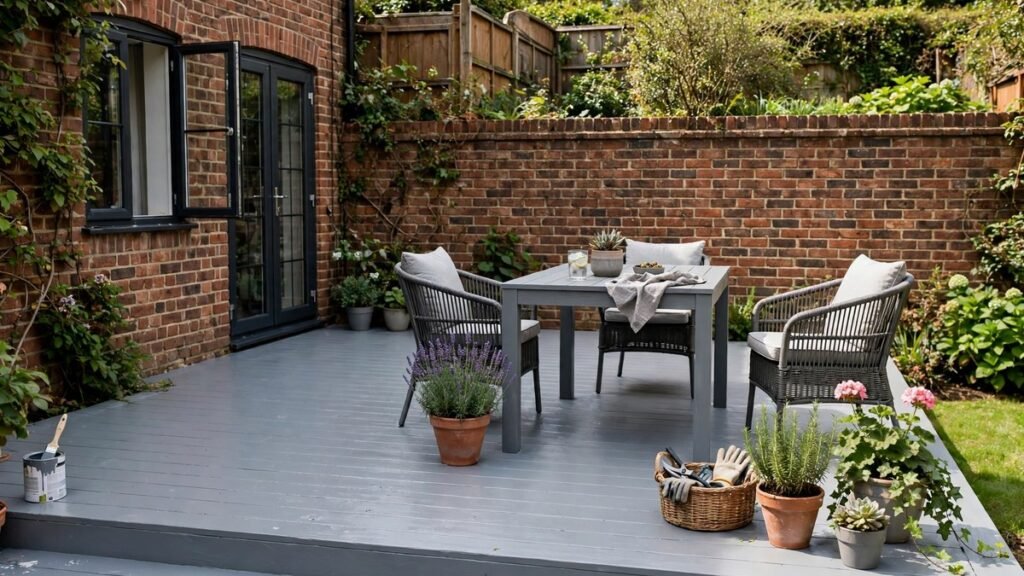
A garden deck takes a hard life. It sits outside all year, it gets rained on, baked by the sun, walked on in wet shoes and covered in leaves through autumn. After a few summers the boards turn grey, the surface feels rough under bare feet, and small splinters start to appear. Decking paint is the simplest way to bring a tired deck back to life. It covers the grey wood, locks down small splinters, adds grip underfoot and puts a layer of colour between the timber and the weather.
The short answer is that decking paint in the UK in 2026 typically costs £8 to £16 per litre. A 20 square metre deck needs about 5 litres of paint for two coats, which costs £50 to £120 depending on the product and whether the boards are smooth or grooved. A small 10 square metre deck needs one 2.5 litre tin, which costs £20 to £40. A professional paint job for a typical 20 square metre deck costs £200 to £500, including labour and materials. A good solid decking paint lasts 4 to 7 years on the deck floor before it needs a full recoat.
In this guide, we explain what decking paint is, what it costs in the UK, which paints are best, how much paint your deck needs, how to prepare and paint a deck, how long the paint takes to dry, how long it lasts, whether you can paint composite decking, which colours work best, and what it costs to hire a professional. Everything is in plain English, with UK prices and UK weather in mind.
What Is Decking Paint?
Decking paint is a thick, opaque coating made for exterior timber decking. It sits on top of the boards as a coloured film, covering the wood grain completely, unlike a stain, which soaks in and lets the grain show through, or an oil, which feeds the wood and leaves a natural finish. Paint gives the strongest colour change and the best cover for old, grey or weathered boards, which is why it is the usual choice for a deck that has seen better days.
Most decking paints sold in the UK are water based. They are easy to apply with a brush or roller, they clean up with water, and they dry fast. Good decking paints include anti-slip additives, which give the surface grip when it is wet, and they resist rain, frost and sun. Ronseal Ultimate Protection Decking Paint, for example, is rainproof in 90 minutes, fills small cracks, locks down minor splinters and gives long lasting colour. Cuprinol Anti-Slip Decking Stain uses invisible anti-slip microbeads and an algicide that helps the surface resist green algae and mould growth.
Paint, Stain and Oil: The Quick Difference
Paint covers the wood completely and hides the grain. Stain soaks into the wood and tints it while the grain still shows. Oil soaks in too, but it leaves a more natural look and needs reapplying more often. Paint lasts longest between recoats, but when it fails it peels, and peeling paint needs stripping before you can repaint. Stain and oil wear away evenly, so recoating is simpler. The full comparison is in the section on paint versus stain versus oil below.
What Decking Paint Is For
Decking paint is for timber decking that needs a fresh look and a new layer of protection. It suits old decks that have gone grey, decks with small cracks and splinters, and decks where the owner wants a solid colour rather than a wood tone. It is not for composite decking in most cases, and it is not a fix for rotten boards. If a board is soft, spongy or rotten through, it needs replacing, not painting. Paint protects sound timber. It does not bring dead timber back.
How Much Does Decking Paint Cost in the UK?
Decking paint in the UK in 2026 costs £8 to £16 per litre for the main brands, based on retail prices seen in November 2026. The price per litre falls when you buy a bigger tin, and it rises for premium products and for bright colours. The table below shows the prices found for the main products.
| Product | Tin size | Price seen, November 2026 | Cost per litre |
|---|---|---|---|
| Ronseal Ultimate Protection Decking Paint | 2.5L | £32.29 to £38.75 | £12.92 to £15.50 |
| Ronseal Ultimate Protection Decking Paint | 5L | £60.63 | £12.13 |
| Ronseal Decking Rescue Paint | 2.5L | £29.24 | £11.70 |
| Ronseal Ultimate Protection Decking Stain | 5L | £42.30 to £55.04 | £8.46 to £11.01 |
| Ronseal Ultimate Protection Decking Stain | 2.5L | £26.48 to £31.55 | £10.59 to £12.62 |
| Cuprinol Anti-Slip Decking Stain | 2.5L | £19.51 to £26.69 | £7.80 to £10.68 |
| Cuprinol Anti-Slip Decking Stain | 5L | £38.96 to £42.17 | £7.79 to £8.43 |
| Cuprinol Garden Shades | 1L | £12.99 to £16.49 | £12.99 to £16.49 |
| Liberon Superior Decking Stain | 5L | £43.38 to £45.16 | £8.68 to £9.03 |
Prices are retail prices seen in November 2026 from UK sellers, and they vary by shop, colour and offer. Always check the price for the colour you want, because some colours cost more than others. A tin bought in a sale can cost much less, and buying two tins together is often cheaper per litre than buying one.
Cost per Square Metre
The cost per square metre is what matters for a budget. It depends on the price per litre and on how far the paint goes. Ronseal Ultimate Protection Decking Paint covers up to 8 square metres per litre in one coat, so for two coats one litre covers about 4 square metres. At around £13 per litre, that works out at about £3.25 per square metre for two coats. Cuprinol Anti-Slip Decking Stain covers up to 8 square metres per litre with two coats, so at around £8 to £10 per litre it works out at about £1 to £1.35 per square metre. In round terms, paint for a deck costs £1 to £4 per square metre for two coats, depending on the product. Grooved decking uses more paint, so the cost per square metre rises. The worked examples in the next section show the totals for common deck sizes.
What Else You Need to Buy
Paint is not the only cost. A decking cleaner costs £5 to £15 for a bottle or a tub. A stiff brush or a decking brush costs £10 to £25. A good paint brush or a decking applicator pad costs £10 to £20. Sandpaper and a sanding block cost a few pounds. A wood preserver, if the deck needs one before painting, costs £15 to £30 for a 5 litre tin. Masking tape and dust sheets cost a few pounds. For a first-time job, allow £20 to £50 for tools and cleaning products on top of the paint, if you do not own them already.
Decking Paint Cost by Deck Size
The cost of painting a deck depends on its size, whether the boards are smooth or grooved, and which product you choose. The examples below use two coats, which is what Ronseal and Cuprinol both recommend for decking paint and stain. Grooved decking needs roughly double the paint of smooth decking, because the grooves soak up more product and the surface area is greater.
Small Deck: 10 Square Metres
A 10 square metre deck is a small patio deck or a balcony deck. With Ronseal Ultimate Protection Decking Paint at up to 8 square metres per litre, one coat needs 1.25 litres and two coats need 2.5 litres, which is one 2.5 litre tin at £32.29 to £38.75. With Cuprinol Anti-Slip Decking Stain at 8 square metres per litre for two coats, the same deck needs 1.25 litres, so one 2.5 litre tin at £19.51 to £26.69 covers it with paint to spare. A small deck costs £20 to £40 in paint. Add £20 to £30 for cleaner and brushes if you need them.
Typical Deck: 20 Square Metres
A 20 square metre deck is the most common size in a UK garden, about 5 metres by 4 metres. With Ronseal paint at 8 square metres per litre, one coat needs 2.5 litres and two coats need 5 litres, which is one 5 litre tin at £60.63. With Cuprinol stain at 8 square metres per litre for two coats, the deck needs 2.5 litres, which is one 2.5 litre tin at £19.51 to £26.69. If the boards are grooved, double the paint: 10 litres of Ronseal paint, which is two 5 litre tins at about £120. A typical smooth deck costs £20 to £65 in paint, and a typical grooved deck costs £40 to £120.
Large Deck: 30 Square Metres
A 30 square metre deck is a large garden deck or a deck that wraps around a corner of the house. With Ronseal paint at 8 square metres per litre, one coat needs 3.75 litres and two coats need 7.5 litres, which is one 5 litre tin plus one 2.5 litre tin, about £93 to £99. With Cuprinol stain, the same deck needs about 3.75 litres, which is one 5 litre tin at £38.96 to £42.17. If the boards are grooved, double the paint again, which takes the cost to £80 to £200. A large smooth deck costs £40 to £100 in paint, and a large grooved deck costs £80 to £200.
The Best Decking Paints in the UK for 2026
There is no single best decking paint for every deck. The right product depends on whether the deck is old or new, smooth or grooved, and whether you want a solid colour or a wood tone. The products below are the ones that UK reviewers and Which? tested and rated in 2026. Which? tested Cuprinol, Ronseal and Sadolin in winter conditions in February 2026, and found no meaningful difference in the staying power of the paints tested, including Ronseal Ultimate Protection, Liberon Extreme, Trade Paints and V33 Colour Guard Paint. Their advice is to pick a decking paint that is a good price and comes in a colour you like.
| Product | Best for | Coverage | Drying | Price guide |
|---|---|---|---|---|
| Ronseal Ultimate Protection Decking Paint | Old, grey and tired decking | Up to 8 to 10 m² per litre | Rainproof in 90 minutes, 2 coats | 2.5L £32.29 to £38.75; 5L £60.63 |
| Cuprinol Anti-Slip Decking Stain | Grip and algae resistance | 12 m² per litre (Which?); 8 m² per litre with 2 coats | Showerproof in under 1 hour; dry in 2 to 6 hours | 2.5L £19.51 to £26.69; 5L £38.96 to £42.17 |
| Ronseal Decking Rescue Paint | Budget revamp of a worn deck | Up to 8 m² per litre | Rainproof in 90 minutes | 2.5L £29.24 |
| Trade Paints Garden Timber Decking Paint | Value non-slip finish | 13 m² per litre | Dry in 2 to 4 hours | Mid range, often dearer than Ronseal per litre |
| Sadolin Beautiflex | Premium stain finish | Around 12 m² per litre | Dry in 4 hours | Premium price |
| Liberon Superior Decking Stain | Premium anti-slip stain | Around 10 m² per litre | Dry in 4 hours | 5L £43.38 to £45.16 |
| Cuprinol Garden Shades | Bright colours on garden wood | Up to 10 m² per litre | Dry in 2 to 4 hours | 1L £12.99 to £16.49 |
Ronseal Ultimate Protection Decking Paint
Ronseal Ultimate Protection Decking Paint is the editor pick in several UK round-ups, with a score of 9.5 out of 10 from Posh. It is a water based paint that revives old, grey and tired decking, fills small cracks and locks down minor splinters. It is rainproof in 90 minutes, it comes in around 10 to 13 colours, and it needs two coats. Coverage is up to 8 to 10 square metres per litre. It is the best choice for an old deck that needs a solid colour and a fresh surface. The 2.5 litre tin costs £32.29 to £38.75, and the 5 litre tin costs £60.63.
Cuprinol Anti-Slip Decking Stain
Cuprinol Anti-Slip Decking Stain is the best choice for grip. It has invisible anti-slip microbeads that improve safety on wet boards, and an algicide that helps the surface resist green algae and mould growth. It is showerproof in under an hour, it dries in 2 to 6 hours depending on the weather, and it needs 2 to 3 coats. Which? gives its coverage as 12 square metres per litre, and the maker gives 8 square metres per litre with two coats. The colour range is smaller than Ronseal’s, with neutral tones such as Urban Slate, Natural Oak and Golden Maple. The 2.5 litre tin costs £19.51 to £26.69, and the 5 litre tin costs £38.96 to £42.17. It is cheaper per litre than Ronseal paint, and it covers more ground, which makes it the best value for a large deck.
Ronseal Decking Rescue Paint
Ronseal Decking Rescue Paint is the budget pick. It is made to revive and protect tired outdoor surfaces, and it costs £29.24 for a 2.5 litre tin. It is a good choice when the deck is sound but looks worn, and you want a quick colour refresh without paying for the top range product. It still needs two coats and the same preparation as any other decking paint.
Trade Paints Garden Timber Decking Paint
Trade Paints Garden Timber Decking Paint is a non-slip decking paint sold in 14 colours. Property Workshop rated it 7 out of 10, with coverage of 13 square metres per litre and a drying time of 2 to 4 hours. It costs around 50 percent more than Ronseal and Cuprinol per litre without offering a clear advantage in performance, so it is worth buying only if you want one of its colours or you buy from a trade supplier.
Sadolin, Liberon and V33
Sadolin Beautiflex, Liberon Superior Decking Stain and V33 Colour Guard Paint were all tested by Which? in February 2026 and proved hardy in winter conditions. Liberon Superior Decking Stain is a 5 litre anti-slip stain at £43.38 to £45.16, with a new biosourced formula. Sadolin also makes a Wet Wood Decking Stain that can be applied in damp conditions, which suits the UK climate. These are premium products, and they are worth the extra money if you want a specific colour or a stain finish rather than a solid paint.
Decking Paint vs Stain vs Oil: Which Is Right for You?
Paint, stain and oil all protect a deck, but they work in different ways and they suit different decks. The choice matters, because the wrong finish on the wrong deck peels, fades or needs redoing far sooner than it should.
Decking Paint
Paint forms a thick, opaque film on top of the boards. It hides the grain completely, covers grey wood and old marks, and gives the strongest colour. It lasts longest between recoats, at 4 to 7 years on the deck floor. The drawback is that when paint fails, it peels and flakes, and peeling paint must be stripped back before you can repaint. Paint is the best choice for an old deck that looks tired and needs a full colour change.
Decking Stain
Stain soaks into the wood and tints it, while the grain still shows through. A solid stain hides most of the grain and lasts 3 to 5 years. A semi-transparent stain shows more grain and lasts 2 to 3 years. Stain wears away evenly, so recoating is simple: clean the deck, let it dry, and apply a fresh coat. There is no peeling to strip. Stain is the best choice for a deck in fair condition where you want to keep the wood look, and for a deck you want to maintain with the least work.
Decking Oil
Oil soaks deep into the wood, feeds it and leaves a natural finish with a slight sheen. It is the easiest finish to apply and the easiest to maintain, because you can top it up without stripping. The drawback is that it needs reapplying most often, usually every 1 to 2 years, and it gives the least colour change. Ronseal Ultimate Protection Decking Oil is rainproof in 90 minutes, needs 4 hours between coats and 24 hours before heavy use. Oil is the best choice for a new deck or a good deck where you like the natural timber colour.
Which Lasts Longest?
Solid decking paint lasts longest, at 4 to 7 years on the deck floor and 7 to 10 years on railings, according to The Honest Reviewers. EngineerFix puts solid deck paint at 5 to 10 years. Solid stain lasts 3 to 5 years, semi-transparent stain lasts 2 to 3 years, and clear sealer or oil lasts 1 to 2 years. The trade-off is clear: paint lasts longest but is hardest to redo, while oil is easiest to redo but lasts shortest. For most UK gardens, a solid paint or a solid stain is the best balance.
How Much Decking Paint Do You Need?
Working out how much paint you need takes two minutes, and it stops you buying too little and running out halfway across the deck, or buying too much and wasting money.
Measure the Deck
Measure the length and the width of the deck in metres, and multiply them together to get the area in square metres. A deck 5 metres long and 4 metres wide is 20 square metres. Measure each section separately if the deck is L shaped or has steps, and add the sections together. Do not forget the steps and the edges of the boards, which use extra paint.
Use the Coverage on the Tin
Check the coverage on the tin, in square metres per litre. Divide the deck area by the coverage to get the litres needed for one coat, then double it for two coats. For example, a 20 square metre deck with Ronseal paint at 8 square metres per litre needs 2.5 litres per coat and 5 litres for two coats. The same deck with Cuprinol stain at 8 square metres per litre for two coats needs 2.5 litres in total.
Allow Extra for Grooved Boards
Grooved decking needs roughly double the paint of smooth decking, because the grooves hold more product and the surface area is greater. Wood Finishes Direct warns that grooved decking normally needs double the quantity. Rough, weathered or very dry boards also soak up more paint than smooth boards. Add 10 percent to your total for cuts, spills and touch ups, and round up to the next tin size. It is better to have a little paint left over for repairs than to run out with half a board unpainted.
Quick Calculator Table
| Deck size | Smooth boards, 2 coats | Grooved boards, 2 coats |
|---|---|---|
| 10 m² | 2.5L | 5L |
| 15 m² | 3.75L | 7.5L |
| 20 m² | 5L | 10L |
| 25 m² | 6.25L | 12.5L |
| 30 m² | 7.5L | 15L |
The table uses Ronseal Ultimate Protection Decking Paint at 8 square metres per litre. Other products cover more or less, so always check the tin. Cuprinol Anti-Slip Decking Stain at 8 square metres per litre for two coats needs half the paint in the table, because its two-coat coverage is already counted.
How to Prepare Decking Before Painting
Preparation is the part that decides whether the paint lasts 5 years or peels in 5 months. Paint sticks to clean, dry, sound wood. It does not stick to dirt, algae, loose flakes or wet boards. Allow a full day for preparation on a typical deck, and do not rush it.
Clean the Deck
Start by sweeping the deck clear of leaves, dirt and loose debris. Then wash it with a decking cleaner and a stiff brush. A decking cleaner costs £5 to £15, and it lifts dirt, algae and green growth from the boards. Scrub along the boards, not across them, and pay attention to the gaps between boards, where dirt and leaves collect. Rinse with clean water from a hose or a bucket. A pressure washer can help, but keep it on a low setting and hold it well back, because a strong jet can damage the wood and raise the grain.
Let the Deck Dry Fully
After washing, the deck must dry completely before you paint. Water can stay inside decking boards long after the surface looks dry. Wood Finishes Direct allowed a deck to dry for just over two days after cleaning before painting, and warns that you may need longer in cooler or damp weather, especially in shaded areas. Tikkurila says the moisture content of the timber must be under 20 percent for oils and stains to stick well, and the same rule applies to paint. If you paint damp boards, the paint traps the water inside, and it will peel. Plan the job for a dry spell, and check the forecast for at least two dry days.
Sand and Repair
Once the deck is dry, check every board. Replace any board that is rotten, soft or split through. Tighten loose screws and hammer down any nails that stick up. Sand rough patches, splinters and flaking old paint with coarse sandpaper, then finish with a medium grit. Sanding gives the paint a key to grip, and it takes off the grey, weathered surface so the paint bonds to sound wood. Sweep and vacuum the dust away before you start painting, because dust under paint causes peeling.
New Decking Needs Time
New decking should not be painted straight away. Tikkurila advises leaving new decking to weather naturally for the first six months after it is laid, so that any treatment applied at the factory wears off and the wood settles. New pressure treated boards are often damp from the treatment, and paint will not stick to them until they have dried out. If your deck is less than six months old, wait, or test a small hidden area first and check that the paint sticks.
Treat Bare Wood First
If the deck has bare patches where the old finish has worn away, treat them with a wood preserver before painting, especially if the boards are softwood. A preserver protects the timber against rot and woodworm, and it gives the paint a sound base. Let the preserver dry fully, following the time on the tin, before you apply the paint.
How to Paint Decking Step by Step
Painting a deck is a simple job, but the order matters. Work on a warm, dry day when the temperature is above 10 degrees, as Ronseal recommends, and avoid painting in direct hot sun, which dries the paint too fast, or when rain is expected within a few hours.
What You Need
You need decking paint, a decking cleaner, a stiff brush, a good quality decking brush or an applicator pad, a smaller brush for edges and gaps, masking tape, dust sheets, sandpaper and a paint tray or bucket. A decking brush is wide and flat, and it paints the boards faster than a normal brush. A roller can work on smooth boards, but a brush pushes the paint into the grooves and the gaps better.
Step 1: Protect the Surroundings
Cover plants, paths and walls near the deck with dust sheets. Tape off any areas you do not want painted, such as the house wall, posts and steps. Remove plant pots, furniture and the barbecue from the deck.
Step 2: Stir the Paint
Stir the paint well before you start, and stir it again each time you refill the brush or tray. The colour and the anti-slip additives settle at the bottom of the tin, and unstirred paint gives a patchy finish and less grip.
Step 3: Paint the Edges and Gaps First
Start with a small brush and paint the edges of the deck, the gaps between boards and the ends of the boards. These are the parts that soak up most paint and are hardest to reach with a wide brush. Work on a few boards at a time so the paint stays wet at the edges.
Step 4: Paint the Boards
Paint the boards one at a time, working along the length of each board from one end to the other. Use long, even strokes and keep a wet edge, which means each new stroke overlaps the last one while it is still wet. This stops lap marks, which are the dark lines left where wet paint meets paint that has already dried. Work your way across the deck, and do not walk on paint you have just applied. Start at the far end of the deck and work towards the house or the exit, so you do not paint yourself into a corner.
Step 5: Apply the Second Coat
Ronseal Ultimate Protection Decking Paint needs two coats. Apply the second coat after about 4 hours, and do not leave more than 4 to 6 hours between coats, or the first coat can dry too hard for the second coat to bond well. Cuprinol Anti-Slip Decking Stain needs 2 to 3 coats, with 2 to 6 hours drying time between coats depending on the weather. Always read the time on the tin, because it varies by product and by temperature.
Step 6: Clean Up
Wash brushes and applicators in water straight away, because water based decking paint sets hard once it dries. Seal the tin lid tightly and store leftover paint somewhere frost free, so you have it for touch ups. Remove the tape and dust sheets once the paint is dry to the touch.
Drying Times and When You Can Use the Deck Again
Drying times vary by product, by temperature and by humidity. The table below gives the times for the main products, but always read the tin, because the maker knows its own product best.
| Product | Rainproof or showerproof | Between coats | Ready to use |
|---|---|---|---|
| Ronseal Ultimate Protection Decking Paint | Rainproof in 90 minutes | About 4 hours | 48 hours before furniture or normal use |
| Ronseal Ultimate Protection Decking Stain | Rainproof in 90 minutes | 4 hours | 24 hours |
| Ronseal Ultimate Protection Decking Oil | Rainproof in 90 minutes | 4 hours | 24 hours before heavy traffic |
| Cuprinol Anti-Slip Decking Stain | Showerproof in under 1 hour | 2 to 6 hours | 24 hours |
| Cuprinol Garden Shades | Rainproof in 1 hour | 2 to 4 hours | 24 hours |
Rainproof does not mean dry. A deck can survive a light shower 90 minutes after painting, but it is not ready to walk on, and furniture will mark it. Wood Finishes Direct recommends waiting 48 hours before replacing garden furniture or returning the deck to normal use after painting with Ronseal Ultimate Protection Decking Paint. Cool or damp weather extends every drying time, so give the deck longer if the air feels cold or humid. Plan the job so the deck has at least two dry days after painting, and keep pets and children off it until it is fully dry.
How Long Does Decking Paint Last?
A good solid decking paint lasts 4 to 7 years on the deck floor, according to The Honest Reviewers, and 7 to 10 years on railings, which take less wear. EngineerFix puts solid deck paint at 5 to 10 years before a full recoat is needed. The exact life depends on how much sun and rain the deck gets, how much foot traffic it takes, and how well it was prepared before painting. A south facing deck in full sun fades and wears faster than a shaded deck, and a deck by a back door that everyone walks across wears faster than a deck used only in summer.
Signs the Deck Needs Repainting
Repaint when the colour has faded badly, when the surface feels rough or grey again, or when water soaks into the boards instead of beading on the surface. The water test is simple: sprinkle water on the deck. If it beads up, the protection is still working. If it soaks in and darkens the wood within a few minutes, the coating has worn through and the deck needs a fresh coat. Do not wait until the paint is peeling in large sheets, because then the old paint must be stripped first, which is a much bigger job.
How Long Do Stain and Oil Last?
Solid stain lasts 3 to 5 years on the deck floor, semi-transparent stain lasts 2 to 3 years, and clear sealer or oil lasts 1 to 2 years. Railings last about twice as long as the deck floor, because vertical surfaces shed water and take less sun and less foot traffic. Tooled-Up puts Cuprinol decking treatments at 2 to 4 years of protection depending on exposure and foot traffic. A regular cycle of every 2 to 3 years for stain and every 4 to 7 years for paint is far cheaper and far less work than letting the deck go grey and then stripping it back.
What Shortens the Life of Decking Paint?
Poor preparation is the main cause of early failure. Paint over dirt, algae or damp wood peels within months. Painting in cold or damp weather also shortens the life, because the paint does not cure well. Standing water is another cause: if the deck does not drain and water sits on the boards, the paint softens and lifts. Keep the gaps between boards clear, sweep leaves off the deck in autumn, and clean the deck each spring. A deck that is cleaned and looked after lasts years longer between repaints than a deck that is left to itself.
Can You Paint Composite Decking?
Composite decking is made from wood fibre mixed with plastic, and it is designed to be the finished surface, not a base for paint. Most UK composite decking sold today is capped, which means a hard polymer shell is bonded around the core. Paint does not bond well to that shell, and it peels.
Why Painting Composite Is Usually a Mistake
DuraLive, a UK decking installer, says you usually can paint composite decking, but in almost every case you should not. A paint job on a composite deck lasts only 2 to 5 years before it needs redoing, and when it starts to flake it looks worse than honestly weathered composite. Painting also voids the warranty on nearly every major brand, including Trex, TimberTech and Fiberon, whose warranties often run 25 years or more. That cover is a big part of what you paid for, and painting can throw it away in an afternoon.
When Painting Composite Can Work
The one case where painting composite can work is an old, uncapped deck that is well out of warranty and has gone tired. Uncapped boards have no polymer shell, so the paint has something to hold onto. Even then, the paint is a temporary fix, not a permanent one, and you should go in knowing it will need redoing every few years. Clean the boards well, sand them lightly, use a paint made for composite or for plastic, and test a small hidden area first. If the deck is still in warranty, do not paint it. Clean it instead, or ask the maker what they recommend.
What to Do Instead
If a composite deck looks tired, clean it first with a composite deck cleaner and a stiff brush. Most of the grey or green tint on composite is dirt and algae on the surface, not damage to the boards, and a good clean brings the colour back. If the boards are stained or faded, a composite restorer product made for the job is a safer choice than ordinary decking paint.
Decking Paint Colours and Finishes
Colour is where decking paint earns its keep. A solid colour changes the whole feel of the garden, and it can tie the deck to the house, the fence and the furniture. The choice is personal, but a few rules help.
Grey and Slate
Grey is the most popular decking paint colour in the UK. Slate grey, urban slate and charcoal suit modern gardens, grey fences and grey garden furniture. Grey hides dirt well, it does not show fading as fast as brighter colours, and it works with most house styles. It is the safe choice if you are unsure.
Natural Wood Tones
Natural oak, golden maple, cedar and walnut keep the deck looking like wood while adding colour and protection. These tones suit traditional gardens, timber fences and brick houses. Cuprinol Anti-Slip Decking Stain comes in natural oak, golden maple, Hampshire oak and silver birch. Ronseal Ultimate Protection Decking Paint comes in chestnut, English oak and country oak. Wood tones fade faster in strong sun than grey, so a south facing deck may need recoating sooner.
Green, Blue and Bright Colours
Green, blue and other bright colours make a statement, and they suit cottage gardens and colourful planting. Cuprinol Garden Shades comes in 38 colours, including beach blue, sage green and bright tones, and Ronseal Garden Paint comes in 29 colours. Bright colours look best on a small deck or on decking used as a feature, and they fade fastest in sun, so expect to repaint sooner. Dark colours also get hot in summer sun, which can be uncomfortable under bare feet.
Solid Colour or Wood Tone?
A solid colour paint hides the grain and gives the most even finish, which suits an old deck with marks and patches. A stain keeps the grain visible and looks more natural, which suits a deck in good condition. If the deck has boards of different ages or colours, a solid paint evens them out. If the boards are new and even, a stain shows them off better.
Hiring a Professional vs Doing It Yourself
Painting a deck is a job most homeowners can do themselves in a weekend. Hiring a professional makes sense when the deck is large, when it needs a lot of repair, or when you do not have the time.
Doing It Yourself
Doing it yourself costs £20 to £200 in paint and materials for a typical deck, depending on the size and the product. A 20 square metre smooth deck needs about 5 litres of Ronseal paint at £60.63, plus £20 to £50 for cleaner, brushes and sundries if you do not own them. The job takes a day for preparation and a day for painting, with drying time in between. The main cost is your time, and the main risk is poor preparation, which causes peeling. If you follow the preparation steps in this guide, a DIY job can last as long as a professional one.
Hiring a Professional
A professional painter or decking specialist charges for labour and materials. Checkatrade puts a painter and decorator day rate at around £300 a day, and exterior painting at £15 to £25 per square metre. MyJobQuote puts exterior painting at £20 to £40 per square metre. Local market data from Domifyr puts fence and deck painting at £180 to £1,000, depending on the area and the size of the job. Airtasker job examples show sanding and repainting a deck at £200, cleaning and staining a deck at £200, and sanding and staining an 18 square metre deck at £350. For a typical 20 square metre deck, expect £200 to £500 for a professional paint job, including materials. London and the South East cost more, because labour costs more there.
Getting a Fair Quote
Get three written quotes for the same work, and make sure each one covers the same job: cleaning, sanding, repairs, the number of coats, the product name and VAT. A quote that is far below the others usually leaves something out, such as the preparation or the second coat. Ask each painter how they prepare the deck, which product they use, and how long the finish should last. A painter who explains the preparation clearly is usually the safer choice.
Common Mistakes to Avoid
Most decking paint failures come from a few avoidable mistakes. Knowing them before you start saves a weekend of work and the cost of doing the job twice.
Painting a Dirty or Damp Deck
The most common mistake is painting over dirt, algae or damp wood. Paint needs a clean, dry surface to bond to. Wash the deck, let it dry for at least two days, and check that the boards feel dry deep down, not just on the surface. If in doubt, wait another day. A deck painted damp will peel within months.
Painting New Decking Too Soon
New decking needs six months to weather before it is painted, because the factory treatment must wear off and the boards must dry out. Painting new boards straight away is one of the fastest ways to get peeling paint. Wait, or test a small area first.
Painting in the Wrong Weather
Do not paint in rain, in cold weather below 10 degrees, or in very hot direct sun. Rain washes wet paint off the boards. Cold weather stops the paint curing properly. Hot sun dries the paint too fast and leaves lap marks. Pick a warm, dry day with no rain forecast for at least 24 hours, and start in the morning so the paint has the whole day to dry.
Skipping the Second Coat
One coat of decking paint is not enough. Ronseal and Cuprinol both recommend two coats, and Cuprinol stain needs 2 to 3 coats. One coat looks thin, wears through fast on the traffic paths, and leaves the wood open to water. Apply the second coat at the time given on the tin, and do not leave more than 4 to 6 hours between coats for Ronseal paint.
Using the Wrong Product
Do not use fence paint, shed paint or interior paint on a deck. Fence paint is thinner and wears off fast under foot traffic. Interior paint is not made for rain, frost or sun. Use a product made for decking, with anti-slip properties and weather protection. Do not use ordinary decking paint on composite decking, because it will peel and it voids the warranty.
Forgetting the Gaps and Edges
The gaps between boards and the ends of the boards soak up the most water, and they are the first places to rot. Paint them properly with a small brush before you paint the main surface. If the gaps are full of dirt and leaves, clean them out first, because paint over dirt does not stick.
How to Look After a Painted Deck
A painted deck lasts longer with a little care each year. The work is small, and it stops small problems turning into a full repaint.
Clean It Each Spring
Sweep the deck regularly, and wash it each spring with a decking cleaner and a stiff brush. This removes the algae and dirt that make a deck slippery and that break down the paint. Rinse with clean water and let it dry. Do not use a pressure washer on a high setting, because it can lift the paint.
Clear Leaves in Autumn
Leaves left on a deck through autumn and winter hold water against the paint and feed algae and mould. Sweep them off every week or two in autumn, and clear the gaps between boards so water can drain away. A leaf blower makes the job quick on a large deck.
Touch Up Worn Spots
Touch up worn spots as soon as you see them, with the same paint you used before. Lightly sand the spot, clean it, and apply one or two coats. Touching up a small area takes minutes, and it stops water getting under the paint and lifting a large patch. Keep the leftover tin from the original job for touch ups, stored somewhere frost free.
Move Furniture and Pots
Plant pots and furniture left in one place all year trap water under them and wear the paint in one spot. Move pots and furniture now and then, and put pot feet or small blocks under pots so air can flow underneath. This stops damp patches and rings on the paint.
Recoat on Condition, Not on the Calendar
Recoat when the deck tells you it needs it, not because a set number of years has passed. Use the water test: sprinkle water on the boards. If it beads up, the protection is still working. If it soaks in and darkens the wood, the deck needs a fresh coat. Recoating on condition is cheaper than repainting on a fixed schedule, because a shaded deck can last years longer than a deck in full sun.
Quick Takeaways
- Decking paint in the UK costs £8 to £16 per litre, and a 20 square metre deck costs £50 to £120 in paint for two coats.
- Ronseal Ultimate Protection Decking Paint and Cuprinol Anti-Slip Decking Stain are the best buys in 2026, and Which? found no meaningful difference in staying power between the brands it tested.
- A 20 square metre smooth deck needs about 5 litres of paint for two coats, and a grooved deck needs roughly double that.
- Prepare the deck properly: clean it, let it dry for at least two days, sand rough patches and repair damaged boards first.
- Paint on a warm, dry day above 10 degrees, apply two coats, and wait 48 hours before putting furniture back.
- Solid decking paint lasts 4 to 7 years on the deck floor, longer than stain at 3 to 5 years and oil at 1 to 2 years.
- Do not paint composite decking in most cases: it peels, and it voids the warranty on brands such as Trex, TimberTech and Fiberon.
FAQs
How much does decking paint cost in the UK in 2026?
Decking paint in the UK costs £8 to £16 per litre for the main brands. Ronseal Ultimate Protection Decking Paint costs £32.29 to £38.75 for a 2.5 litre tin and £60.63 for a 5 litre tin. Cuprinol Anti-Slip Decking Stain costs £19.51 to £26.69 for a 2.5 litre tin. A 20 square metre deck costs £50 to £120 in paint for two coats, and a professional paint job for the same deck costs £200 to £500.
What is the best decking paint in the UK?
Ronseal Ultimate Protection Decking Paint and Cuprinol Anti-Slip Decking Stain are the best buys in 2026. Ronseal is the best choice for an old, grey deck that needs a solid colour, and Cuprinol is the best choice for grip and value, with the best coverage at 12 square metres per litre. Which? tested Cuprinol, Ronseal, Sadolin, Liberon, Trade Paints and V33 in February 2026 and found no meaningful difference in staying power, so pick on price and colour.
How much decking paint do I need for a 20 square metre deck?
A 20 square metre smooth deck needs about 5 litres of Ronseal Ultimate Protection Decking Paint for two coats, which is one 5 litre tin. The same deck needs about 2.5 litres of Cuprinol Anti-Slip Decking Stain, which is one 2.5 litre tin. A grooved deck needs roughly double the paint, so allow 10 litres of Ronseal paint or 5 litres of Cuprinol stain. Always check the coverage on the tin and add 10 percent for waste.
How long does decking paint take to dry?
Ronseal Ultimate Protection Decking Paint is rainproof in 90 minutes, and the second coat goes on after about 4 hours. Cuprinol Anti-Slip Decking Stain is showerproof in under an hour and dries in 2 to 6 hours. Wait 48 hours before putting furniture back on the deck or using it normally after painting, and longer in cool or damp weather.
Can you paint composite decking?
You usually can, but in almost every case you should not. Paint does not bond well to capped composite decking, it lasts only 2 to 5 years, and painting voids the warranty on most major brands, including Trex, TimberTech and Fiberon, whose warranties often run 25 years or more. The only case where painting can work is an old, uncapped deck that is well out of warranty. Clean a composite deck instead, or use a restorer made for composite.
Conclusion
Decking paint in the UK in 2026 costs £8 to £16 per litre, and a typical 20 square metre deck costs £50 to £120 in paint for two coats. Ronseal Ultimate Protection Decking Paint and Cuprinol Anti-Slip Decking Stain are the best buys, and Which? found no meaningful difference in staying power between the brands it tested, so the choice comes down to price, colour and coverage. A smooth deck needs about 5 litres of paint, a grooved deck needs roughly double, and a professional paint job for a typical deck costs £200 to £500.
The finish lasts as long as the preparation allows. Clean the deck, let it dry for at least two days, sand the rough patches and repair damaged boards before you start. Paint on a warm, dry day above 10 degrees, apply two coats, and wait 48 hours before the furniture goes back. A solid decking paint then lasts 4 to 7 years on the deck floor, longer than stain or oil. Do not paint composite decking, and do not paint new decking until it has weathered for six months.
Measure your deck, work out how much paint you need from the coverage on the tin, and buy the right product for the job. A deck that is planned well, prepared well and painted well will look good for years. Pick a dry weekend, and do the work once, properly.