
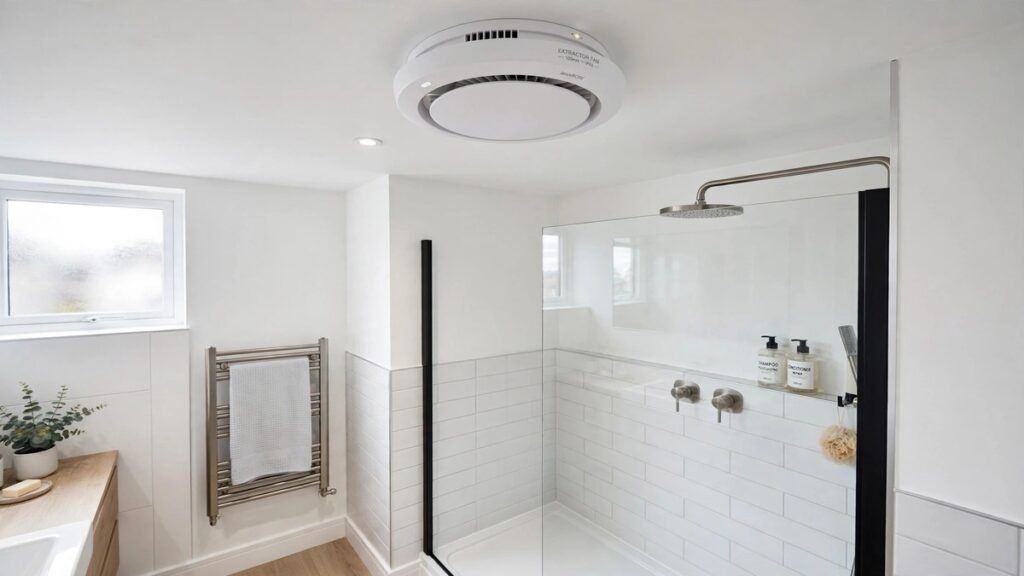
A bathroom extractor fan is a small fan that pulls damp, steamy air out of your bathroom and sends it outside. It is one of the cheapest and most useful fittings in a UK home, and it is also one of the most overlooked. A good fan stops mirrors from fogging, stops condensation running down the walls, and helps keep mould away. A bad fan, or no fan at all, leaves a bathroom damp after every shower, and damp is what mould feeds on.
In this guide, we explain what a bathroom extractor fan does, why your bathroom needs one, which type to buy, what size you need, what it costs in the UK, what the building regulations say, how ducting works, which controls to choose, and how to fit, clean and fix a fan. All prices are typical UK prices from late 2026, and they are a guide only. Prices vary by fan, home and installer, so always get written quotes for your own bathroom.
What Is a Bathroom Extractor Fan?
A bathroom extractor fan is a small electric fan, usually fitted in the wall or ceiling of a bathroom, that removes moist air from the room and sends it outside through a duct. It runs while you shower or bathe, and often for a short time after, so the steam does not settle on cold walls, ceilings and mirrors. Most fans are round, about 100 mm across, which is 4 inches, and they sit in a neat white cover that blends into the wall or ceiling.
How It Differs From a Normal Fan
A normal fan, such as a desk fan, just moves air around inside a room. It does not remove anything. An extractor fan is different because it takes air out of the room and sends it outside the house. That is the whole point. The damp air leaves the building instead of staying inside and turning into condensation. A bathroom extractor fan is a ventilation fitting, not a cooling device, and it is sized and built for damp air, not for moving air around a room.
Where You Will Find One
You will find an extractor fan in most modern UK bathrooms. It is usually high on a wall, near the shower or bath, or in the ceiling above the shower. In older homes, you may find one fitted in a window, or you may find no fan at all, just a window that opens. Homes with a bathroom that has no window, called an internal bathroom, must have mechanical ventilation by law, which usually means an extractor fan. If your bathroom has no fan and no opening window, that is a problem worth fixing.
Why Your Bathroom Needs an Extractor Fan
A bathroom makes more moisture than any other room in the house. A hot shower fills the air with steam in minutes. A bath does the same, more slowly. If that damp air has nowhere to go, it cools on the coldest surfaces in the room, which are usually the walls, the ceiling, the mirror and the window. That is condensation, and it is the first step towards mould.
Steam, Condensation and Mould
Condensation is water that forms when warm, damp air touches a cold surface. In a bathroom, it shows up as a fogged mirror, water running down tiles, and damp patches on the ceiling. If the room stays damp, black mould grows in the corners, around the bath seal and on the ceiling. Mould looks bad, smells bad, and it can make breathing problems worse, especially for children and for people with asthma. An extractor fan pulls the damp air out before it can settle, so the room dries faster and mould has less chance to grow.
Protecting Your Home
Mould is not the only problem damp causes. Over time, damp air damages paint, plaster, grout and sealant. Paint peels, grout turns black, and sealant around the bath lifts and lets water get behind the bath. Wooden window frames and skirting boards can swell and rot. A fan that costs £30 and a few pounds a year to run can save hundreds of pounds in repairs. It also protects the rest of the house, because damp air from the bathroom can spread into bedrooms and hallways if it is not removed at the source.
The Law and Your Landlord
For social housing landlords in England, damp and mould are now a legal matter. Awaab’s Law, which came into force in October 2025, sets strict timescales for social landlords to fix damp and mould hazards after a tenant reports them. Private landlords also have duties to keep a home free from serious damp and mould under housing health and safety rules. A working extractor fan is one of the simplest ways to show that a bathroom is being ventilated properly. If you rent and your bathroom has no working fan, tell your landlord in writing and keep a copy.
How a Bathroom Extractor Fan Works
A bathroom extractor fan works in a simple way. When it runs, a small motor spins a set of blades, called an impeller. The blades pull air from the bathroom into the fan, push it through a duct, and send it outside through a vent or grille on the wall or roof. Fresh air comes into the bathroom through the gap under the door or through a trickle vent, and that fresh air replaces the damp air that has been removed.
The Motor and the Impeller
The motor is the part that does the work. Most bathroom fans use a small, low-power motor that runs quietly and uses little electricity. The impeller is the set of blades attached to the motor. Axial fans have blades like a small propeller. Centrifugal fans have a drum-shaped impeller that throws air outwards. The shape of the impeller decides how much air the fan can move and how well it copes with a long duct. A well-made fan moves a lot of air for very little power, which is why the best fans are both strong and quiet.
Airflow and Extraction Rates
Airflow is measured in litres per second, written as l/s, or in cubic metres per hour, written as m3/h. One litre per second is the same as 3.6 cubic metres per hour. A typical 100 mm bathroom fan moves around 85 to 95 m3/h, which is about 24 to 26 l/s. A larger 150 mm fan can move 200 m3/h or more. The building regulations set a minimum of 15 l/s for a bathroom, but a bigger room or a longer duct may need a stronger fan. The extraction rate is printed on the box and on the product data sheet, so check it before you buy.
What Happens to the Damp Air
The damp air does not vanish. It travels through the duct and leaves the house through a vent on the outside wall, a roof vent, or a vent in the soffit under the roof edge. This is an important point. The duct must lead outside, not into the loft or into a wall cavity. If damp air is sent into the loft, it condenses on the cold roof timbers and insulation, and that causes damp and rot in the roof. Always check where the duct ends before you fit a new fan or replace an old one.
Types of Bathroom Extractor Fan
There are three main types of bathroom extractor fan, and the right one depends on where the fan sits and how far the air has to travel. The three types are axial fans, centrifugal fans and in-line fans. Most UK bathrooms use an axial fan, but a long duct run or a large bathroom may need one of the other two.
Axial Fans
An axial fan is the most common type in UK homes. It sits in the wall or ceiling of the bathroom, and the air passes straight through it in a line, from the room into the duct. Axial fans are cheap, small, easy to fit and easy to replace. They work best when the duct is short and straight, for example when the fan is fitted in an outside wall and the air goes straight out. They struggle with long ducts and bends, because they cannot push air hard against resistance. A standard 100 mm axial fan suits most small to medium bathrooms.
Centrifugal Fans
A centrifugal fan uses a drum-shaped impeller that throws air outwards at high pressure. It can push air through a longer duct and around bends, which makes it a good choice when the fan is not on an outside wall. Centrifugal fans cost more than axial fans, and they are larger, so they need more space. They are also usually quieter for the amount of air they move, because the motor runs at a lower speed. You will find centrifugal fans in larger bathrooms and in homes where the duct has to run across the loft.
In-Line Fans
An in-line fan sits inside the duct, away from the bathroom, usually in the loft. The part you see in the bathroom is just a grille in the ceiling, and the fan itself is hidden in the loft, which makes it very quiet in the room. In-line fans are strong, and they cope well with long duct runs, so they suit large bathrooms and bathrooms far from an outside wall. They cost more to buy and more to fit, because the ducting and the fan need to be installed in the loft, but the result is a quiet bathroom with strong extraction.
Axial Fans vs Centrifugal Fans vs In-Line Fans
Choosing between the three types comes down to three questions: how far does the air have to travel, how much space do you have, and how quiet do you want the bathroom to be? The table below compares them side by side.
| Feature | Axial fan | Centrifugal fan | In-line fan |
|---|---|---|---|
| Typical cost of the fan | £15 to £40 | £40 to £100 | £60 to £150 |
| Best duct length | Short, up to about 2 metres | Medium, up to about 5 metres | Long, 5 metres or more |
| Noise in the bathroom | 30 to 40 dB(A) | 25 to 35 dB(A) | 20 to 30 dB(A) |
| Where it sits | In the wall or ceiling | In the wall or ceiling | Hidden in the loft, in the duct |
| Best for | Small bathroom on an outside wall | Larger bathroom, longer duct | Large bathroom, long duct, quiet room |
When an Axial Fan Is Enough
An axial fan is enough for most UK bathrooms. If your bathroom is small or medium, and the fan can go in an outside wall or in a ceiling with a short duct to the outside, a good 100 mm axial fan will do the job. It is the cheapest option, the easiest to fit, and the easiest to replace later. Look for one with a timer or humidistat if you want it to run after you leave the room, and check the noise level on the box, because cheap axial fans can be loud.
When You Need a Centrifugal or In-Line Fan
You need a centrifugal or in-line fan when the air has a long way to travel. If the bathroom is in the middle of the house, or the duct has to cross the loft to reach the roof, an axial fan will not push the air far enough, and steam will stay in the room. A centrifugal fan in the ceiling can cope with a medium duct run, while an in-line fan in the loft can cope with a long one. Both cost more, but they are the right choice when the duct is long, because a fan that cannot move the air is money wasted.
What Size Extractor Fan Do You Need?
Fan size is about airflow, not just the size of the hole in the wall. The two numbers that matter are the duct size, usually 100 mm or 150 mm, and the extraction rate in litres per second. Both should match the size of your bathroom and the length of the duct.
The 100 mm and 150 mm Choice
Most UK bathrooms use a 100 mm fan, which fits a 4 inch duct. It suits small to medium bathrooms with a short duct. A 150 mm fan, which fits a 6 inch duct, moves much more air and suits large bathrooms, bathrooms with a long duct, or bathrooms with a big shower or a bath and a shower. If you are replacing a fan, check the size of the existing hole and duct first, because changing from 100 mm to 150 mm means a bigger hole and a bigger duct, which adds to the cost.
Working Out the Extraction Rate You Need
A simple rule used by fan makers is to aim for about 8 air changes per hour in a bathroom. That means the fan should replace all the air in the room 8 times in an hour. To work it out, multiply the length, width and height of the room to get the volume in cubic metres, then multiply by 8 to get the cubic metres per hour you need, then divide by 3.6 to get litres per second.
For example, a bathroom 2 metres long, 2 metres wide and 2.4 metres high has a volume of 9.6 cubic metres. Multiply by 8 and you need about 77 m3/h, which is about 21 l/s. A standard 100 mm fan that moves 85 to 95 m3/h covers that easily. A larger bathroom, say 3 metres by 2.5 metres by 2.4 metres, has a volume of 18 cubic metres and needs about 144 m3/h, which is 40 l/s. That needs a 150 mm fan or an in-line fan. The building regulations set a minimum of 15 l/s for a bathroom, but that is a minimum, not a target, and a bigger room needs more.
Duct Length Changes the Answer
A long duct makes a fan work harder, and the air that comes out is less than the number on the box. Every bend in the duct cuts the airflow further. A fan that moves 95 m3/h on a short, straight duct may only move 60 m3/h through a long duct with two bends. That is why fan makers give two numbers, the free-air rate and the rate through a duct, and why you should size the fan for the duct, not just for the room. If the duct is long, choose a stronger fan or an in-line fan, and keep the duct as short and straight as you can.
Bathroom Extractor Fan Costs in the UK
The cost of a bathroom extractor fan in the UK has two parts: the fan itself and the fitting. The fan is cheap. The fitting is where most of the money goes, especially if a new hole has to be drilled through a wall or a duct has to run through the loft. The figures below are typical UK prices from late 2026, and they are a guide only. Prices vary by brand, by region and by installer, so always get written quotes for your own bathroom.
What the Fan Costs
A basic 100 mm axial fan with a pull cord or a light switch costs around £15 to £40. A fan with a timer, which keeps running for a set time after you switch it off, costs around £25 to £60. A fan with a humidistat, which switches itself on when the air gets damp, costs around £40 to £90. A centrifugal fan costs around £40 to £100, and an in-line fan costs around £60 to £150. A fan with a built-in light costs more again, and a very quiet fan with a low noise level can cost £60 to £120. The price of the fan is a small part of the total job, so it is worth buying a good one rather than the cheapest one on the shelf.
What the Fitting Costs
Fitting by a qualified electrician typically costs £150 to £300 for a simple job, where a fan replaces an old one in the same place and the duct already exists. If a new hole has to be drilled through an outside wall, or a new duct has to run through the loft, the cost rises to £250 to £450, because the work takes longer and needs more materials. A job that needs a new circuit from the consumer unit, or a fan fitted in a difficult spot, can cost more again. An electrician in London and the South East usually charges more than one in other parts of the UK.
The Total Cost of a Typical Job
For a typical job, replacing a fan in the same place, expect a total of £200 to £350, including the fan, the fitting and the VAT. For a new fan where none existed before, with a new hole through the wall and a short duct, expect £300 to £500. For a large bathroom with an in-line fan in the loft and a long duct, expect £400 to £700. These are typical ranges for a standard home. Get at least two written quotes, check that the quote includes the fan, the ducting, the vent and the VAT, and check that the electrician is qualified and, where needed, registered with a competent person scheme.
| Job | Typical UK cost in 2026 |
|---|---|
| Basic axial fan, supply only | £15 to £40 |
| Timer fan, supply only | £25 to £60 |
| Humidistat fan, supply only | £40 to £90 |
| In-line fan, supply only | £60 to £150 |
| Replace a fan in the same place, fitted | £200 to £350 |
| New fan with a hole through the wall, fitted | £300 to £500 |
| In-line fan in the loft with a long duct, fitted | £400 to £700 |
Running Costs: How Much Electricity Does an Extractor Fan Use?
A bathroom extractor fan uses very little electricity. That is one of its best features. A typical 100 mm axial fan uses around 10 to 20 watts while it runs. A larger in-line fan may use 20 to 40 watts. To put that in plain terms, a fan uses about as much power as a single LED light bulb, and far less than a hairdryer or a heated towel rail.
Worked Example: The Cost of Running a Fan
Electricity in the UK typically costs around 25p to 30p per unit, which is one kilowatt hour, on a standard tariff. A 10 watt fan running for one hour a day uses 10 watts times 365 hours, which is 3,650 watt hours, or about 3.7 units a year. At 25p to 30p a unit, that costs about £1 a year. A 20 watt fan running for two hours a day uses about 15 units a year, which costs about £4 a year. Even a fan that runs all day would cost only a few pounds a month. The cost of running a fan is so low that it should never be a reason to leave it switched off.
Timer Overrun and Humidistat Running Time
A timer fan keeps running after you switch it off, usually for 15 minutes, so it clears the steam after a shower. That adds only a few minutes of running time a day, and the cost is pennies. A humidistat fan switches itself on when the air gets damp and off again when the air dries, so it only runs when it is needed. Both controls add a small amount to the running cost, but they save far more by keeping the bathroom dry and stopping mould. Leaving a fan off to save electricity is a false economy, because the cost of fixing mould damage is far higher than the cost of running the fan.
UK Building Regulations for Bathroom Extractor Fans (Part F and Part P)
Bathroom extractor fans are covered by two parts of the Building Regulations in England: Part F, which covers ventilation, and Part P, which covers electrical safety. The rules are similar in Wales, Scotland and Northern Ireland, but the exact documents differ, so check the rules where you live. The key points are simple, and a good electrician will know them.
Part F: Ventilation Rules
Part F sets the minimum amount of air that must be removed from a bathroom. For a bathroom with an intermittent extract fan, which is a fan that runs when you switch it on, the minimum is 15 litres per second. For a bathroom with a continuous extract fan, which runs all the time at a low speed and boosts when needed, the minimum is 8 litres per second. Part F also requires background ventilation, which means trickle vents in windows or vents in walls, so fresh air can come in to replace the air the fan removes. A bathroom with no opening window must have mechanical ventilation, which means a fan, because there is no other way to get fresh air in and damp air out.
Part P: Electrical Safety Rules
Part P covers electrical safety in homes. A bathroom is a special location for electrical work, because water and electricity do not mix. Any electrical work in a bathroom must be done safely, with the right cable, the right protection and the right fittings for the zone the fan sits in. Work that involves a new circuit, or work in the zones around a bath or shower, may need to be notified to building control, unless it is done by an electrician who is registered with a competent person scheme and can certify the work themselves. The safest choice is to use a qualified electrician who is registered with a scheme such as NICEIC or NAPIT, and to keep the certificate they give you with your house documents.
What Happens If the Rules Are Not Followed
If a fan is fitted badly, two things can go wrong. First, the fan may not remove enough air, so the bathroom stays damp and mould grows. Second, the electrical work may be unsafe, which is a risk to everyone in the house. Poor work can also cause problems when you sell the house, because a buyer and their solicitor will ask for certificates for electrical work. A fan fitted by a qualified electrician, with the right extraction rate and the right IP rating, avoids all of these problems, and it costs little more than a cheap job done badly.
IP Ratings and Bathroom Zones Explained
Bathrooms are split into zones, and each zone has a rule about which electrical fittings can go there. The rule is based on how likely the fitting is to get wet. The IP rating tells you how well a fitting is protected against water. Both matter when you choose a bathroom extractor fan.
The Bathroom Zones
Zone 0 is inside the bath or shower tray itself. Only very low voltage fittings can go here, and a normal extractor fan never goes in Zone 0. Zone 1 is the area directly above the bath or shower, up to 2.25 metres above the floor. A fan can go here, but only if it is the right type and rating. Zone 2 is the area 0.6 metres around the bath or shower, and outside Zone 1. A fan can go here with a suitable rating. Outside the zones is the rest of the bathroom, where the rules are more relaxed. The zones exist because water and electricity are a dangerous mix, and the closer a fitting is to water, the stronger its protection must be.
IP Ratings in Plain English
An IP rating has two numbers. The first number is about protection against solid objects, such as dust. The second number is about protection against water. For bathroom fans, the second number is the one that matters. IPX4 means the fitting is protected against water splashing from any direction. IPX5 means it is protected against water jets. IPX7 means it can be put under water for a short time. Most bathroom extractor fans are rated IPX4, which is the minimum for Zones 1 and 2. A fan fitted directly above a shower should be IPX4 or better, and if water jets are likely, IPX5 is the safer choice.
SELV Fans for Zone 1
A SELV fan is a fan that runs on 12 volts instead of 230 volts. SELV stands for Separated Extra Low Voltage. The fan itself sits in the bathroom, but the transformer that powers it sits outside the bathroom, in the loft or in a cupboard. Because the fan runs on only 12 volts, it is much safer in a wet area, and it is the usual choice for a fan fitted directly above a shower or bath in Zone 1. A 12 volt fan needs a transformer, which adds to the cost, but it is the safest option for a fan in the wettest part of the room.
| Zone | Where it is | Minimum IP rating for a fan |
|---|---|---|
| Zone 0 | Inside the bath or shower tray | No normal fan allowed |
| Zone 1 | Above the bath or shower, up to 2.25 m | IPX4, IPX5 if water jets are likely, SELV 12 V often used |
| Zone 2 | 0.6 m around the bath or shower | IPX4 |
| Outside the zones | The rest of the bathroom | No set rating, IPX4 is standard |
Where to Put Your Bathroom Extractor Fan
Where you put the fan matters as much as which fan you buy. A fan in the wrong place will not clear the steam, even if it is a good fan. The best place is close to the source of the steam, high up, and on the shortest route to the outside.
Close to the Shower or Bath
The fan should be as close to the shower or bath as the zones and the IP rating allow. Steam rises, and it is strongest right above the shower. A fan fitted above or near the shower catches the steam before it spreads across the room. A fan fitted on the far wall, away from the shower, has to pull damp air across the whole room, and much of the steam will settle on the walls and ceiling before it reaches the fan. If you can only fit one fan, put it near the shower.
High Up, on the Wall or Ceiling
Warm, damp air rises, so the fan should be high up, near the ceiling. A wall fan should be fitted as high as the wall allows, and a ceiling fan should be fitted in the ceiling itself, ideally above or near the shower. A fan fitted low down will pull in drier air from near the floor and leave the steam at the top of the room. The one exception is a fan fitted in a window, which sits where the window is, but a window fan is a compromise and a wall or ceiling fan is usually better.
The Shortest Route Outside
The fan should be on the shortest possible route to the outside air. A fan in an outside wall with a short duct straight through the wall is the best case. A fan in a ceiling with a short duct up through the loft to a roof vent is the next best. A fan that has to push air a long way through a duct will be less effective, no matter how good it is. When you plan the position, think about the duct first, then the fan, because the duct decides how well the fan can work.
Ducting: How to Vent a Bathroom Extractor Fan Properly
Ducting is the pipe that carries damp air from the fan to the outside. It is as important as the fan itself, and it is where most extractor fan jobs go wrong. Good ducting is short, straight, the right size, and it ends outside. Bad ducting is long, bent, squashed, or ends in the loft.
Rigid Ducting vs Flexible Ducting
Rigid ducting is a smooth, hard pipe, usually made of plastic or metal. Flexible ducting is a concertina tube that can bend around corners. Rigid ducting is better, because air flows smoothly through it and it does not sag or squash. Flexible ducting is easier to fit in tight spaces, but it should be pulled tight and kept as short as possible, because every fold and sag slows the air down. If you use flexible ducting, keep it straight, support it so it does not sag, and do not let it kink around a corner.
The Right Size and the Right Route
The duct must be the same size as the fan, usually 100 mm for a bathroom fan. A duct that is smaller than the fan chokes the airflow. The route should be as short and straight as possible, with as few bends as you can manage. Every bend cuts the airflow, and a sharp bend cuts it more than a gentle one. If the duct has to go through the loft, it should run in a straight line to the roof vent or the wall vent, and it should be kept clear of insulation that could squash it.
Insulating Ducting in a Cold Loft
A duct that runs through a cold loft needs insulation. Warm, damp air inside the duct cools as it passes through the cold loft, and the water in the air condenses inside the duct. That water can drip back into the bathroom, or it can sit in the duct and cause damp in the loft. Wrapping the duct in insulation keeps the air warm enough to reach the outside vent without condensing. Insulated ducting is sold ready-made, or you can wrap ordinary ducting in loft insulation. Either way, do not leave a bare duct in a cold loft.
Venting to the Outside, Never Into the Loft
The duct must end outside the house, through a vent in the wall, the roof or the soffit. It must never end in the loft, in a wall cavity, or under the floor. Ending a duct in the loft is one of the most common and most damaging mistakes in bathroom ventilation. The damp air condenses on the cold roof timbers and the insulation, and over time that causes rot, mould and damage to the roof. A proper outside vent has a grille that keeps out birds and insects, and a backdraught shutter that stops cold air blowing back into the bathroom when the fan is off.
Backdraught Shutters
A backdraught shutter is a small flap inside the vent that opens when the fan runs and closes when the fan stops. It stops cold air, wind and draughts coming back down the duct into the bathroom. It also stops insects and smells coming in from outside. Most good fans and vents include a backdraught shutter, but cheap ones may not, so check before you buy. A bathroom that feels cold and draughty when the fan is off often has a missing or broken backdraught shutter.
Timer, Humidistat and Sensor Fans: Which Control Should You Choose?
A bathroom extractor fan needs a control that switches it on and off. The control you choose decides whether the fan runs at the right time, for the right length of time, and without you having to think about it. There are four main controls, and each suits a different household.
Pull Cord and Light Switch Controls
The simplest control is a pull cord on the fan itself, or a switch on the wall. You pull the cord or flick the switch when you use the bathroom, and you switch it off when you leave. This is cheap and simple, but it relies on you remembering, and most people forget. A fan wired to the light switch is better, because it comes on when the light comes on, but it also switches off when the light goes off, which is often too soon, because the steam is still in the air. A light switch fan without a timer is the weakest control, and it is the one most likely to leave a bathroom damp.
Timer Fans
A timer fan runs on after you switch it off, usually for 15 minutes, and the time can be adjusted, often from 1 to 30 minutes. The fan comes on with the light or with a switch, and it keeps running long enough to clear the steam after you leave the room. A timer fan is the most popular choice in UK homes, because it is simple, reliable and cheap, and it does not rely on you remembering to leave the fan on. The timer is set with a small dial or screw on the fan, and an electrician can adjust it when the fan is fitted.
Humidistat Fans
A humidistat fan has a sensor that measures the moisture in the air. When the moisture rises above a set level, usually around 60 to 70 percent relative humidity, the fan switches itself on. When the air dries, the fan switches itself off. A humidistat fan is the best choice if you want the fan to look after itself, because it runs when the bathroom is damp and stops when it is dry, even if no one is in the room. It costs more than a timer fan, and it needs to be set up correctly, but it is the most effective control for stopping mould, because it reacts to damp air rather than to a switch.
PIR and Motion Sensor Fans
A PIR fan has a motion sensor that switches the fan on when someone enters the bathroom and off again after a set time. PIR stands for Passive Infrared. These fans suit bathrooms where people forget to switch the fan on, such as a family bathroom used by children, or a guest bathroom. They are less common than timer and humidistat fans, and they can switch on when they are not needed, for example when someone walks in to brush their teeth, but they are a useful option when a switch is not practical.
| Control | How it works | Best for | Typical extra cost over a basic fan |
|---|---|---|---|
| Pull cord or switch | You switch it on and off | Budget jobs, simple setups | £0 |
| Light switch | Comes on with the light | Bathrooms where the fan and light share a switch | £0 |
| Timer | Runs on for 15 minutes after switch-off | Most UK homes, best value | £10 to £25 |
| Humidistat | Switches on when the air gets damp | Stopping mould, forgetful households | £25 to £50 |
| PIR sensor | Switches on when someone enters | Family bathrooms, guest bathrooms | £20 to £40 |
How to Install a Bathroom Extractor Fan
Fitting a bathroom extractor fan involves electrical work and, often, drilling through a wall or running a duct through the loft. It is a job for a qualified electrician, not a first DIY job, because the bathroom is a wet area and the electrical rules are strict. This section explains what the job involves, so you know what to expect and what to ask the electrician.
What the Job Involves
A typical fitting has four steps. First, the electrician chooses the position for the fan and the route for the duct. Second, a hole is drilled through the outside wall with a core drill, or a hole is cut in the ceiling for a ceiling fan. Third, the duct is fitted from the fan to the outside vent, and the vent is fitted on the outside wall or roof. Fourth, the fan is wired to the power supply, the light switch or a separate switch, and the timer or humidistat is set up. The whole job usually takes 2 to 4 hours for a simple wall fan, and longer for an in-line fan in the loft.
When You Must Use a Qualified Electrician
You must use a qualified electrician for the electrical part of the job. Electrical work in a bathroom is covered by Part P of the Building Regulations, and it must be done safely and to the right standard. An electrician who is registered with a competent person scheme, such as NICEIC or NAPIT, can certify the work themselves, and they will give you a certificate when the job is done. Keep that certificate with your house documents. Do not let an unqualified person wire a fan in a bathroom, because a mistake in a wet room is dangerous, and it can also cause problems when you sell the house.
What to Ask Before the Work Starts
Before the work starts, ask the electrician these questions. What size fan do I need for this bathroom, and what is its extraction rate? Where will the duct go, and where will it vent outside? Will the duct be insulated if it runs through the loft? What control will the fan have, a timer, a humidistat, or a switch? Is the fan the right IP rating for where it will sit? Does the quote include the fan, the ducting, the vent and the VAT? How long will the job take, and will you give me a certificate when it is done? A good electrician will answer all of these plainly. If the answers are vague, get another quote.
Replacing an Old Fan
Replacing an old fan is simpler than fitting a new one, because the hole, the duct and the wiring already exist. The electrician removes the old fan, checks the duct and the wiring, fits the new fan in the same place, and tests it. This usually takes under an hour. Before you buy a replacement, check the size of the old fan and the duct, usually 100 mm, and check how the old fan is wired, so the new one matches. If the old duct is damaged, blocked or ends in the loft, ask the electrician to fix the ducting at the same time, because a new fan on a bad duct will not work properly.
How to Clean and Look After Your Extractor Fan
An extractor fan needs very little care, but it does need some. Dust and fluff build up on the cover and the blades over time, and that build-up slows the fan down and makes it noisier. A fan that is cleaned every few months will last longer and work better than one that is never cleaned.
Cleaning the Cover and Blades
Switch the fan off at the isolator switch first, so it cannot start while you work. Most fan covers pull off or unclip without tools. Wash the cover in warm, soapy water, dry it, and clip it back on. Wipe the blades and the inside of the fan with a damp cloth to remove dust and fluff. Do not spray water or cleaner directly into the fan, and do not use harsh chemicals. If the fan is in the ceiling and hard to reach, use a step ladder and take your time. Cleaning takes about ten minutes, and it is worth doing every 3 to 6 months.
Checking the Duct and the Outside Vent
Once a year, check the outside vent from outside the house. Make sure the grille is not blocked by leaves, dirt or a birds nest, and make sure the backdraught shutter still opens and closes. If you can see into the loft, check that the duct is still connected to the fan and to the vent, and that it has not sagged or come loose. A duct that has come off the fan sends damp air into the loft instead of outside, so it is worth checking, especially after work has been done in the loft.
When to Replace a Fan
A good extractor fan lasts around 10 to 15 years. The signs that it needs replacing are a fan that has become very noisy, a fan that runs slowly or not at all, a fan that vibrates, or a bathroom that stays steamy even though the fan is running. Sometimes the problem is just dirt, and cleaning fixes it. Sometimes the motor has worn out, and a new fan is the answer. Replacing a fan in the same place is a quick job for an electrician, and it is a good time to upgrade to a quieter fan or one with a timer or humidistat.
Common Problems and How to Fix Them
Most extractor fan problems have a simple cause. This section covers the problems homeowners report most often, what usually causes them, and what to do about each one.
The Fan Is Noisy
A fan that has become noisy is often dirty. Dust on the blades makes the fan shake, and a dirty cover makes the air whistle. Cleaning the cover and the blades often fixes it. If the fan is still noisy after cleaning, the motor bearings may be worn, which means the fan is near the end of its life. A fan that was noisy from the day it was fitted may be a cheap fan with a loud motor, or it may be fitted in a way that makes the duct vibrate. In that case, the fix is a quieter fan, or a fan fitted with better ducting.
The Fan Runs but the Bathroom Stays Steamy
If the fan runs but the bathroom stays steamy, the fan is not moving enough air. The most common causes are a duct that is blocked, squashed or too long, a duct that ends in the loft instead of outside, or a fan that is too small for the room. Check the outside vent first, to make sure air is coming out when the fan runs. If little air comes out, the duct may be blocked or disconnected. If plenty of air comes out but the room is still steamy, the fan may be too small, or the duct may be so long that the fan cannot cope. An electrician or a ventilation specialist can test the airflow and tell you what is wrong.
The Fan Does Not Switch On
If the fan does not switch on, check the isolator switch first. Most bathroom fans have an isolator switch outside the bathroom, often above the door, and it may have been switched off by mistake. If the isolator is on and the fan still does not run, check whether the fan is wired to the light switch and whether the light works. If the light works but the fan does not, the fan motor may have failed, or the timer or humidistat may have failed. Electrical faults should be checked by a qualified electrician. Do not open the fan and try to fix the wiring yourself.
Cold Air Blows Back Through the Fan
Cold air blowing back through the fan usually means the backdraught shutter is missing, stuck open, or broken. The shutter is a flap that should close when the fan stops. If it is stuck, it may just need cleaning. If it is broken or missing, it needs to be replaced. A bathroom that feels cold and draughty in winter often has this problem, and fixing the shutter makes the room warmer as well as drier.
The Fan Runs All the Time
A fan that never switches off may have a timer set too long, a humidistat set too low, or a faulty control. A timer set to 30 minutes will run for half an hour after every shower, which is longer than most bathrooms need. A humidistat set to switch on at a low moisture level will run often, even when the bathroom is not very damp. Both can be adjusted, usually with a small dial on the fan, and an electrician can do it in minutes. If the fan runs all the time and cannot be adjusted, the control may have failed and need replacing.
How to Choose the Best Bathroom Extractor Fan for Your Home
Choosing a fan is easier when you work through the choices in order: size, type, control, noise and rating. Get these five right and the fan will do its job for years.
Start With Size and Airflow
Work out the size of your bathroom and the extraction rate you need, using the air changes method in the sizing section above. Then check the length of the duct. A small bathroom with a short duct needs a 100 mm axial fan. A large bathroom, or a long duct, needs a 150 mm fan or an in-line fan. Do not buy a fan on price alone. A cheap fan that is too small for the room is money wasted, because it will not clear the steam.
Pick the Type for Your Duct
If the fan can go in an outside wall with a short duct, an axial fan is the right choice. If the duct has to run across the loft, a centrifugal fan or an in-line fan is better. If you want the quietest bathroom possible, an in-line fan in the loft is the best choice, because the fan itself is out of the room. Match the fan to the duct, not the other way around.
Choose a Control That Suits Your Household
A timer fan suits most homes, because it runs on after you leave and does not rely on you remembering. A humidistat fan suits homes where mould is a problem, because it reacts to damp air on its own. A pull cord or a light switch suits a simple setup, but it relies on you switching the fan on and off. Think about who uses the bathroom and whether they will remember to use the fan. For a family bathroom, a timer or humidistat is almost always the better choice.
Check Noise, Rating and Guarantee
Check the noise level on the box, given in dB(A). A quiet fan is around 25 dB(A). A typical fan is 30 to 40 dB(A). A fan above 40 dB(A) will be easy to hear, and you may end up switching it off, which defeats the point. Check the IP rating for where the fan will sit, and check the guarantee. A good fan comes with a guarantee of 3 to 5 years, and some come with longer. A fan with a longer guarantee is usually built better, and the maker is willing to stand behind it.
Mistakes to Avoid With a Bathroom Extractor Fan
Most extractor fan problems are avoidable. Here are the mistakes that cause the most trouble, and how to avoid them.
Venting Into the Loft
The worst mistake is venting the fan into the loft instead of outside. Damp air in the loft condenses on cold timbers and insulation, and over time it causes rot and mould in the roof. Always check that the duct ends outside, through a wall vent, a roof vent or a soffit vent. If you are not sure where your duct ends, ask an electrician to check it. Fixing a duct that ends in the loft is one of the most useful jobs you can do for your home.
Buying a Fan That Is Too Small
A fan that is too small for the room will run, make noise, and still leave the bathroom steamy. The mistake usually happens when someone buys the cheapest fan without checking the extraction rate or the size of the room. Work out the airflow you need before you buy, and check the number on the box. A fan that moves 15 l/s is the legal minimum, but a bathroom that needs 25 l/s will stay damp with a 15 l/s fan.
Using Long, Bendy Ducting
Long ducting with sharp bends cuts the airflow, sometimes by half. The mistake usually happens when a duct is run the long way around the loft, or when flexible ducting is left sagging and kinked. Keep the duct short and straight, use rigid ducting where you can, pull flexible ducting tight, and support it so it does not sag. A short, straight duct makes even a cheap fan work well, and a long, bent duct makes even a good fan work badly.
Forgetting the Air Supply
A fan can only pull air out if fresh air can come in. If the bathroom door fits tightly and there is no gap under it, and there is no trickle vent in the window, the fan will struggle, because it is trying to pull air out of a sealed box. Leave a gap of around 10 mm under the bathroom door, and keep trickle vents open. The gap under the door is part of the ventilation system, not a fault, and sealing it up will make the fan less effective.
Switching the Fan Off Too Soon
Switching the fan off as soon as you leave the bathroom leaves the steam in the room. The steam needs 10 to 15 minutes to clear after a shower. A timer fan does this on its own. If your fan has no timer, leave it running for 15 minutes after a shower before you switch it off. This one habit makes a real difference to how dry the bathroom stays.
Skipping the Electrician
Fitting a fan in a bathroom is electrical work in a wet room, and it is not a job to learn by trial and error. A fan wired badly is dangerous, and a fan fitted in the wrong zone with the wrong IP rating may not be legal. Use a qualified electrician, keep the certificate, and do not let cost push you towards an unqualified job. The fitting is a small part of the total cost of a bathroom, and it is the part that matters most for safety.
Quick Takeaways
- A bathroom extractor fan pulls damp, steamy air out of the room and sends it outside, which stops condensation and helps keep mould away.
- Part F of the Building Regulations sets a minimum of 15 litres per second for a bathroom fan that runs when switched on, and 8 litres per second for one that runs all the time.
- A 100 mm axial fan suits most small to medium bathrooms with a short duct; a large bathroom or a long duct needs a 150 mm fan, a centrifugal fan or an in-line fan.
- A typical new fan fitted by an electrician costs £300 to £500; replacing a fan in the same place costs £200 to £350.
- Running a fan costs only a few pounds a year, so leaving it off to save electricity is a false economy.
- The duct must always vent outside, never into the loft, and it should be short, straight and insulated if it runs through a cold loft.
- A timer or humidistat control is better than a plain switch, because it keeps the fan running long enough to clear the steam.
- Check the IP rating for the zone the fan sits in, and use a qualified electrician for the fitting.
Frequently Asked Questions
Do I need a bathroom extractor fan by law?
In many cases, yes. Part F of the Building Regulations requires mechanical ventilation in a bathroom with no opening window, and it sets a minimum extraction rate of 15 litres per second for a bathroom fan that runs when switched on. Even in a bathroom with a window, a fan is strongly recommended, because opening a window does not remove steam as well as a fan, and in cold or wet weather the window stays shut. A working fan is also part of keeping a home free from damp and mould, which landlords have a legal duty to do.
What size bathroom extractor fan do I need?
Most UK bathrooms need a 100 mm fan, which fits a 4 inch duct and moves around 85 to 95 cubic metres of air an hour. A large bathroom, or a bathroom with a long duct, needs a 150 mm fan or an in-line fan. A simple way to check is to work out the volume of the room and aim for about 8 air changes an hour. A bathroom 2 metres by 2 metres by 2.4 metres high needs about 21 litres per second, which a standard 100 mm fan covers. A bigger room needs more, so measure the room and check the extraction rate on the box before you buy.
How much does it cost to fit a bathroom extractor fan in the UK?
A basic fan costs £15 to £40, a timer fan £25 to £60, and a humidistat fan £40 to £90. Fitting by a qualified electrician typically costs £150 to £300 for a simple replacement, and £250 to £450 when a new hole has to be drilled and a new duct fitted. A typical total for a new fan with a hole through the wall is £300 to £500, including the fan, the fitting and the VAT. Prices vary by region and by installer, so get written quotes for your own bathroom.
Can I fit a bathroom extractor fan myself?
You can do some of the work yourself, such as choosing the fan and fitting the ducting, but the electrical work should be done by a qualified electrician. A bathroom is a special location under Part P of the Building Regulations, because water and electricity are a dangerous mix. An electrician who is registered with a competent person scheme can certify the work and give you a certificate. Doing the wiring yourself risks a dangerous mistake and can cause problems when you sell the house.
Why does my bathroom still get mould even with an extractor fan?
The most common reasons are a fan that is too small for the room, a duct that is blocked, squashed or ends in the loft, a fan that is switched off too soon, or a fan that has never been cleaned. Check that air is coming out of the outside vent when the fan runs. Check that the duct is short, straight and ends outside. Leave the fan running for 15 minutes after a shower, or fit a timer or humidistat fan. Clean the fan every few months. If the fan still does not clear the steam, it may be too small, and an electrician can test the airflow and advise on a stronger fan.
Conclusion
A bathroom extractor fan is a small fitting that does a big job. It pulls damp air out of the room, sends it outside, and stops the condensation that leads to mould, peeling paint and damaged grout. The rules are clear. Part F sets a minimum of 15 litres per second for a bathroom fan, and Part P means the electrical work should be done by a qualified electrician. A 100 mm axial fan suits most small bathrooms with a short duct, while a larger room or a longer duct needs a stronger fan. A typical new fan fitted costs £300 to £500, and running it costs only a few pounds a year.
The details matter as much as the fan itself. The duct must be short, straight and insulated in a cold loft, and it must vent outside, never into the loft. The fan should sit high up, near the shower, with the right IP rating for its zone. A timer or humidistat control is worth the extra money, because it keeps the fan running long enough to clear the steam. Clean the fan every few months, check the outside vent once a year, and leave a gap under the door so fresh air can come in. Do those things, and your bathroom will stay drier, your home will be better protected, and mould will have far less chance to take hold.