
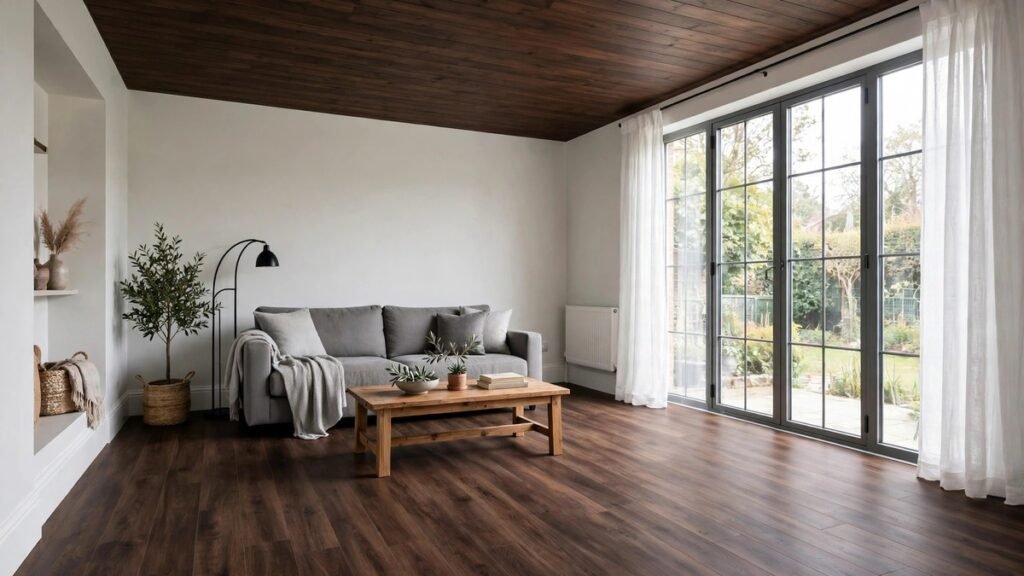
Dark laminate flooring is one of the boldest choices you can make in a home. A dark floor changes the whole room. It grounds the space, makes light walls and pale furniture stand out, and gives an ordinary living room a rich, finished look. It is also one of the choices people worry about most. Will it make the room feel small? Will every speck of dust show? Will it look too dark in a British winter?
This guide answers those questions honestly. It explains what dark laminate flooring is, which dark styles suit which rooms, how dark floors change light and room feel, what they cost in the UK, how to match them with wall colours and furniture, and how to live with one day to day. Everything is in plain English, with UK prices and UK homes in mind. If you are choosing between dark and light laminate, this guide will help you decide with your eyes open.
What Is Dark Laminate Flooring?
Dark laminate flooring is laminate flooring in a dark tone. The board is made in the same way as any other laminate: a printed image of wood grain sealed under a clear protective layer, on a fibreboard core, with a backing layer underneath. The print is what makes it dark. It copies dark oak, walnut, smoked oak, espresso or charcoal wood, with deep brown, near-black or grey-brown tones.
Dark does not mean one colour. A dark oak board is a warm deep brown with visible grain. A walnut board is richer and redder, with bold grain lines. An espresso board is almost black-brown, with little colour variation. A smoked oak board is a grey-brown, made to look as if the wood was aged by smoke. A charcoal board is a cool grey-black that suits modern homes. Each one gives a different feel, so the shade matters as much as the word dark.
What Counts as Dark?
There is no strict line between mid-tone and dark laminate, but a useful rule is this: if the board looks clearly darker than the furniture and walls around it, it is dark. Medium oak, honey oak and natural oak are mid-tones. Dark oak, walnut, espresso, smoked oak and charcoal are dark tones. In a shop, hold the sample next to a mid-tone board. The difference is clear at once, and it is the difference that will shape your room.
How Dark Laminate Is Made
A dark laminate board has four layers, the same as any laminate board. The top layer is a clear wear layer that resists scratches and stains. Below it sits the design layer, a high-resolution printed image of dark wood. The third layer is the core, made from high-density fibreboard, which gives the board its strength. The bottom layer is the backing, which keeps the board flat and protects it from moisture below.
The dark print is the part that matters most to you. A good dark print shows grain that runs the length of the board, with natural variation in tone from board to board. The best products also have a textured surface, where the texture follows the printed grain, so the board looks and feels much more like real wood. A cheap dark print is flat, shiny and repeats the same image too often, and on a dark floor that flat look shows up more than on a light floor.
How Dark Floors Change the Feel of a Room
A dark floor does more than cover the ground. It changes how big the room feels, how warm it feels, and where your eye goes when you walk in. This is the part most buyers get wrong, because they judge a dark floor by a small sample in a bright shop, not by a whole room in their own home.
Light and Room Size
Dark colours absorb light instead of reflecting it. That is the simple physics behind everything else in this guide. A light floor bounces daylight around a room and makes the space feel larger. A dark floor soaks up light, so the room feels smaller, lower and more closed in. In a large room with big windows, that is often a good thing. The floor anchors the space and stops it feeling empty. In a small room with one small window, it can feel like living in a cave.
The good news is that contrast fixes most of the problem. A dark floor with white or pale walls does not feel small in the way people fear. The light walls carry the light, and the dark floor grounds the room. What makes a room feel cramped is dark on dark: a dark floor with dark walls, dark furniture and heavy curtains. If your walls are light, a dark floor can work in a room of almost any size.
Warmth and Mood
Dark floors make a room feel warmer and more intimate. A large living room with a dark walnut floor feels cosy in a way a pale floor rarely does. A bedroom with a dark floor feels calm and settled at night. A dining room with a dark floor feels more formal, which suits evening meals and guests.
That warmth is also why dark floors suit period homes, cottages and rooms with high ceilings. A tall room can feel cold and empty with a pale floor. A dark floor pulls the room together and makes it feel lived in. In a modern flat with low ceilings and little daylight, the same floor can feel heavy, so the room and the light matter more than the floor itself.
Dark Laminate Flooring Styles
Dark laminate comes in more styles than most buyers expect. The style you pick changes the mood of the room, so it is worth knowing the main options before you order samples.
Dark Oak
Dark oak is the most popular dark laminate style in the UK. It is a warm deep brown with visible oak grain, and it suits both modern and traditional homes. It pairs well with cream walls, brass fittings and pale sofas, and it looks right in living rooms, hallways and bedrooms. If you want a dark floor but you are not sure which shade to pick, dark oak is the safe choice. Premium dark oak boards with a matt, lightly brushed finish and a strong wear layer can cost around £36 per m², while mid-range dark oak sits closer to £15 to £22 per m².
Walnut
Walnut is richer and redder than dark oak, with bold grain lines and more colour variation from board to board. It gives a room a luxurious feel and suits formal living rooms, dining rooms and studies. Walnut pairs well with cream, pale grey and sage walls, and with leather and brass. It is a stronger look than dark oak, so it suits rooms where the floor is meant to be noticed. Walnut laminate usually sits in the mid to premium price range, around £15 to £30 per m².
Espresso and Smoked Oak
Espresso is a near-black brown with little colour variation, and it gives the most dramatic look of all. It suits modern homes with white walls, black frames and chrome fittings. Smoked oak is a grey-brown, made to copy wood aged by smoke, and it suits industrial and Scandinavian interiors. Both styles need good light and light walls, because they absorb more light than any other dark style. Espresso and smoked oak usually cost around £14 to £28 per m².
Charcoal and Black
Charcoal and black laminate are the coolest dark tones, with grey or blue undertones instead of warm brown. They suit modern flats, kitchens and open-plan spaces with white walls and pale furniture. They give a sharp, clean look, but they show dust more than any other dark shade, because pale dust stands out clearly on a near-black surface. Charcoal laminate usually costs around £12 to £25 per m².
Rustic Dark
Rustic dark laminate shows knots, grain variation and colour change, and it copies the look of old worn boards. It suits cottages, farmhouses and traditional interiors, and it hides scratches better than any other dark style, because the marks blend in with the knots and grain. If you have children or pets, rustic dark is the most forgiving dark floor you can buy. Rustic dark laminate usually costs around £12 to £22 per m².
Dark Herringbone
Herringbone is the zigzag pattern made from short planks laid at right angles, and in a dark tone it looks striking in hallways, dining rooms and living rooms. It copies the look of traditional dark parquet at a fraction of the cost. Dark herringbone laminate costs more than straight plank, usually £15 to £30 per m² for the boards, and fitting takes longer because the pattern is slower to lay. Expect 10 to 15 percent extra material for cuts and waste. It suits period homes and formal rooms, and it is worth the extra cost if the pattern is the look you want.
Dark Laminate vs Light Laminate: Which Suits Your Home?
Dark and light laminate are the same product in different colours, but they behave very differently in a home. The table below sets out the real differences, so you can judge which one suits your rooms.
| Feature | Dark laminate flooring | Light laminate flooring |
|---|---|---|
| Room feel | Warm, cosy, dramatic, grounded | Bright, airy, open, spacious |
| Light in the room | Absorbs light, needs good daylight | Reflects light, brightens dim rooms |
| Small rooms | Can feel smaller without light walls | Makes small rooms feel larger |
| Dust and light pet hair | Shows clearly, needs frequent sweeping | Hides well, less visible between cleans |
| Scratches | Shows as light lines on dark surface | Hides light scratches well |
| Stains and dark marks | Hides dark stains and mud well | Shows stains, coffee and mud clearly |
| Best rooms | Large living rooms, dining rooms, bedrooms | Small rooms, flats, north-facing rooms |
| Best with | White walls, pale furniture, rugs | Most wall colours and furniture |
Choose dark laminate if your rooms are large, bright and well lit, if you want a warm and dramatic look, and if you do not mind sweeping more often. Choose light laminate if your rooms are small or north-facing, if you want a bright and airy feel, or if you want the lowest cleaning effort. Mid-tone laminate, such as natural oak, sits between the two and hides dust best of all, so if you cannot decide, a mid-tone is the safe middle ground.
The Dust and Scratch Problem, Honestly
Every guide to dark floors mentions dust and scratches, and most of them understate the problem. Here is the honest version, because it is the thing that decides whether people are happy with a dark floor a year after fitting it.
Why Dust Shows on Dark Floors
Dust is pale. On a light floor, pale dust blends in. On a dark floor, it stands out. The same is true of light pet hair, crumbs, lint and footprints in socks. A dark floor that looked perfect when the fitter left will show a fine layer of dust by the next morning, especially in a room with strong sunlight coming through the window. This is not a fault in the floor. It is how dark surfaces work, and it is the same reason a black car shows dust more than a silver one.
The practical answer is routine. A dark floor needs a quick sweep or a dust mop every day, or at least every other day, to keep looking its best. If you are someone who cleans thoroughly once a week and does little in between, a dark floor will look dusty between cleans. If you are happy with a quick daily sweep, it will look fine. A robot vacuum helps a lot, because it keeps the dust down without you thinking about it.
Scratches and the Light Core
Scratches show on dark laminate for a simple reason. The surface is a dark print, and the core underneath is pale fibreboard. A deep scratch cuts through the dark print and shows the pale core below, and that pale line stands out clearly against the dark surface. On a light floor, the same scratch barely shows, because the core and the surface are similar in tone.
The wear layer is what protects you. A board with a strong wear layer resists scratches far better than a cheap board, so the rating matters more on a dark floor than on a light one. Look for a board rated AC4 or higher for living rooms and hallways, and choose a matt or lightly textured finish, because a matt surface hides small marks far better than a shiny one. Embossed texture, where the surface follows the printed grain, also helps, because the texture breaks up the light and hides fine marks.
Matt vs Gloss on Dark Boards
Finish matters more on dark laminate than on any other colour. A gloss dark floor looks stunning in a showroom, because it reflects the lights and looks deep and rich. In a real home, a gloss dark floor shows every footprint, every dust speck and every smear from mopping. A matt dark floor hides far more, and it looks more like real wood. A satin finish sits between the two. If you want a dark floor you can live with, choose matt or satin, and avoid high gloss unless the room is rarely used.
Matching Dark Floors With Wall Colours
Wall colour is the single most important decision after the floor itself. The right walls make a dark floor look rich and deliberate. The wrong walls make the room feel dark and closed in. Here are the combinations that work in UK homes.
White and Cream Walls
White and cream are the safest partners for a dark floor. They reflect the most light, they make the room feel bright, and they let the dark floor stand out as a feature. A warm cream suits dark oak and walnut, because the warm tones work together. A bright white suits espresso and charcoal, because the sharp contrast looks clean and modern. If you are unsure, paint the walls white or cream and add colour with furniture and art instead.
Pale Grey and Greige
Pale grey is the most popular wall colour for dark floors in modern UK homes. A cool pale grey suits charcoal and smoked oak, because the cool tones match. A warm greige, which is grey mixed with beige, suits dark oak and walnut, because it keeps the room warm without looking yellow. Pale grey walls with a dark floor and white skirting give a calm, modern look that suits living rooms and bedrooms.
Bold Colours That Work
Dark floors can also work with bold walls, if the room is large and bright. A deep navy wall with a dark walnut floor and cream furniture looks rich and formal in a dining room. A sage green wall with a dark oak floor looks warm and natural in a living room. A dusty pink wall with a dark floor looks soft and modern in a bedroom. The rule is to keep the bold colour on one or two walls, not all four, and to keep the ceiling white so the room still gets light from above.
Colours to Avoid
Avoid dark walls with dark floors in the same room, unless the room is very large with very good light. Dark green walls with a dark walnut floor can look rich in a large dining room, but in a small living room it will feel like a cave. Avoid warm yellow walls with a dark floor, because the yellow can make the room look dated. Avoid matching the wall colour too closely to the floor colour, because the room loses all contrast and looks flat.
Matching Dark Floors With Furniture and Decor
A dark floor sets the tone for everything that sits on it. The furniture, the rug and the small details either balance the dark floor or fight it. Here is how to get the balance right.
Sofas and Seating
Pale sofas work best with dark floors. A cream, light grey or pale beige sofa stands out against a dark floor and keeps the room bright. A dark sofa on a dark floor disappears into the room and makes the space feel heavy, so if your sofa is dark, add pale cushions and a pale throw to break it up. Leather sofas in tan or cognac look superb on dark oak and walnut floors, because the warm leather and the warm wood work together.
Wood Tones and Metals
Mixing wood tones is fine, but keep them in the same family. A dark walnut floor works with mid-tone oak furniture, because both are warm woods. It clashes with pale ash or whitewashed furniture, because the contrast is too sharp. If your furniture is pale wood, a dark floor can still work, but add a rug and warm accessories to tie the room together. Brass and gold fittings suit dark oak and walnut, because the warm metal matches the warm wood. Chrome and black metal suit charcoal and espresso, because the cool metal matches the cool floor.
Rugs, Curtains and Lighting
A rug is the best friend of a dark floor. It breaks up the dark surface, adds warmth underfoot, and hides dust in the busiest part of the room. A pale rug with a simple pattern works best, because it lightens the room and shows off the dark floor around its edges. A dark rug on a dark floor is a waste of both. Curtains should be pale and light, because heavy dark curtains with a dark floor make a room feel closed in. Lighting matters too. Warm white bulbs suit dark oak and walnut, because they bring out the warm tones. A floor lamp in a dark corner lifts the room and stops the corners looking black.
Best Rooms for Dark Laminate Flooring
Dark laminate suits some rooms far better than others. Here is a room-by-room view, based on light, size and how the room is used.
Living Rooms
Living rooms are the best rooms for dark laminate. They are usually the largest rooms in a UK home, they get the most daylight, and they are where the dramatic look of a dark floor pays off. A dark floor with pale walls, a cream sofa and a rug gives a living room a finished, expensive look. Choose a matt finish and a strong wear layer, because living rooms take the most wear. A doormat at the front door will catch grit and protect the finish.
Dining Rooms
Dining rooms suit dark laminate well, because the formal feel of a dark floor matches evening meals and guests. A dark walnut floor under a pale table and chairs looks rich and welcoming. Dining chairs dragged across the floor can scratch it, so put felt pads on every chair leg, and choose a matt finish that hides small marks. A rug under the table protects the floor and adds warmth.
Bedrooms
Bedrooms suit dark laminate, because the calm, cosy feel of a dark floor helps a bedroom feel restful. A dark floor with pale bedding and light curtains gives a bedroom a calm, hotel-like feel. Bedrooms take less wear than living rooms, so a mid-range board is enough. A rug beside the bed adds comfort without hiding the floor.
Hallways
Hallways are a mixed case for dark laminate. A dark floor in a hallway looks smart and hides mud and dark marks well, which suits a busy entrance. But hallways take more wear than any other room, and they are often narrow with little daylight, so a dark floor can feel tight and show dust quickly. If your hallway is wide and bright, dark laminate works well. If it is narrow and dim, a mid-tone or light floor is a safer choice. If you do choose dark for a hallway, pick a strong wear layer and a matt finish, and keep a doormat at the door.
Rooms to Avoid
Small north-facing rooms are the hardest rooms for dark laminate, because they get little direct sun and the dark floor absorbs what light there is. A small box room, a narrow study or a basement room will feel smaller and darker with a dark floor. Bathrooms and wet rooms are not a good fit for any laminate, dark or light, because regular moisture damages the fibreboard core. Luxury vinyl tile or porcelain tile is a better choice for a bathroom.
Dark Laminate in Small Rooms: Does It Work?
The short answer is yes, but only with the right tricks. A dark floor in a small room is not a mistake on its own. It becomes a mistake when the rest of the room is dark too. If you love dark floors and your room is small, these tricks make it work.
Tricks That Help
Keep the walls white or very pale, and keep the ceiling white. Use mirrors to bounce light around the room, and keep the curtains light and simple. Choose wide planks, because wide boards make a room feel larger than narrow boards. Lay the planks so they run towards the window, because the lines lead the eye to the light. Use a pale rug in the middle of the room to break up the dark surface. Add a floor lamp in the darkest corner. Each of these tricks adds a little light, and together they make a real difference.
When to Choose Light Instead
Sometimes the honest answer is to choose a light floor. If the room is small, north-facing, with one small window and low ceilings, a dark floor will fight the room, and no amount of white paint will fully fix it. If the room is a small flat where every room is dark, a light floor will make the whole flat feel bigger and brighter. A dark floor is a statement, and a statement needs space and light to work. If your room has neither, a mid-tone oak or a light oak will serve you better, and you can still get the rich look with dark furniture and a dark rug.
How Much Does Dark Laminate Flooring Cost in the UK?
Dark laminate costs about the same as other laminate colours, but the best dark boards often sit at the premium end of the price range. The ranges below are typical UK prices seen in 2026, and they are a guide only. Prices vary by supplier, brand and specification, so always get a written quote for your own room.
Price Bands at a Glance
For the boards alone, without fitting, expect these typical ranges:
- Budget dark laminate: around £5 to £12 per m². Usually 7 to 8 mm thick, simple print, few colour variations. Fine for bedrooms and low-traffic rooms.
- Mid-range dark laminate: around £12 to £22 per m². Usually 8 to 10 mm thick, textured surface, good print quality. This is the sweet spot for most homes, and most dark oak and walnut boards sit here.
- Premium dark laminate: around £22 to £36 per m². Usually 12 mm thick, deep texture, water-resistant core, designer styles. Premium dark oak with a matt brushed finish and a top wear rating can reach £36 per m².
Fitting usually costs £10 to £30 per m², depending on the room, the pattern and where you live. Some fitters charge by the day instead, often around £175 per day. London and the South East are usually dearer than the rest of the UK.
What a Typical Room Costs in Total
Take a 20 m² living room at mid-range specification. The boards would cost roughly £360 (20 m² at £18 per m²). Fitting would add roughly £400 (20 m² at £20 per m²). Underlay would add roughly £100 (20 m² at £5 per m²). That gives a total of around £860 before extras, which is a realistic budget for a quality job. The same room in real dark hardwood would cost several times more, which is the main reason dark laminate is so popular.
A smaller room is cheaper in total but dearer per square metre, because set-up time and travel cost the same whatever the room size. A hallway of 10 m² might cost £450 to £700 all in at mid-range specification.
Extra Costs People Forget
The board price is not the whole job. Allow for these extras in your budget: underlay at around £3 to £7 per m², which matters more than most people think, because a good underlay makes the floor feel solid and cuts noise; a waste allowance of 7 to 10 percent extra boards for cuts and mistakes, and 10 to 15 percent for herringbone; beading and thresholds to cover the expansion gap; door trimming, because doors may need trimming to clear the new floor height; old floor removal and disposal; subfloor levelling, because an uneven subfloor needs levelling compound; and delivery, which some suppliers charge for, especially for small orders. A written quote from a fitter should list these items separately, so you can see what is included and what is not.
How to Choose Dark Laminate Flooring
With so many dark products on the market, a short checklist helps. Work through these points before you buy, and you will avoid the most common mistakes.
Samples in Your Own Light
Order large samples and look at them in the room where the floor will go, in daylight and in the evening. A dark sample that looks rich in a bright shop can look almost black in a dim hallway. Lay several boards side by side, because a single board does not show how the pattern repeats across a room. Look at the sample next to your sofa, your curtains and your wall colour. This one step prevents more disappointment than any other.
Finish and Texture
Choose a matt or satin finish, not gloss, because matt hides dust, footprints and small scratches far better on a dark surface. Choose a textured surface that follows the printed grain, often called embossed-in-register, because it looks and feels much more like real wood than a flat shiny surface. Bevelled edges, where each board has a slight groove along the sides, also help the floor look like separate planks rather than one flat sheet, and on a dark floor that definition matters, because it stops the floor looking like one big dark slab.
Plank Width and Length
Most dark laminate boards are 190 to 200 mm wide and 1.2 to 1.4 metres long. Wider boards, 220 to 246 mm, make a room feel larger and show off the dark grain better. They cost more and suit large rooms. Narrow boards suit small rooms and hallways. Longer boards give a calmer look with fewer joints, which suits open-plan spaces. On a dark floor, wider boards also mean fewer joints, and fewer joints mean fewer places for dust to gather and fewer lines breaking up the dark surface.
Water Resistance and Wear Rating
If the floor will go in a kitchen or a hallway near the front door, choose a water-resistant range with a treated core and sealed joints. These products resist swelling for hours after a spill, and they cost more than standard laminate, but they are far cheaper than replacing a swollen floor. No laminate is fully waterproof, so do not fit any laminate in a bathroom or wet room. For the wear rating, choose AC4 at least for living rooms, hallways and kitchens, and AC5 for very busy rooms. On a dark floor, the wear rating matters more than on a light floor, because a worn patch shows up clearly against the dark surface.
Fitting Dark Laminate: What Changes With Dark Boards
Most dark laminate is fitted as a floating floor, with the boards clicking together over an underlay, and the fitting method is the same as for any laminate. But dark boards bring a few fitting details that matter more than they do on a light floor.
Direction and Light
Lay the boards so they run towards the main window, or along the longest wall. On a dark floor, the direction of the boards is more visible than on a light floor, because the joints and the grain show up more clearly. Boards running towards the light look longer and calmer. Boards running across the light can look choppy, because each joint catches the light. In a hallway, run the boards along the length of the hall, not across it.
Gaps and Skirting Contrast
Dark laminate needs the same expansion gap as any laminate, about 10 mm around the edge of the room, hidden by skirting or beading. On a dark floor, white skirting gives a clean, sharp edge that frames the floor and makes it look deliberate. Dark skirting on a dark floor blurs the edge and makes the room look smaller. If your skirting is dark, consider painting it white or pale grey when you fit a dark floor. It is a small job that makes a big difference to how the room looks.
Staggering and Cuts
Joints should be staggered by at least 30 cm from row to row, so the floor looks natural and the joints stay strong. On a dark floor, a regular stagger pattern shows up more than on a light floor, so vary the lengths of the first board in each row. Cut boards with a fine-toothed saw, and wear a mask, because cutting laminate creates fine dust. Dark boards also show chipped edges more than light boards, so use a sharp blade and cut with the finished face down where the saw allows it.
Cleaning and Caring for Dark Laminate Flooring
A dark floor is easy to look after if you follow a simple routine. Most of the work is dust, and dust is easy to prevent and easy to remove if you do it often.
The Daily Routine
Sweep or dust mop every day, or at least every other day, with a dry microfibre mop. This takes two minutes in a living room, and it is the single habit that keeps a dark floor looking good. Vacuum with a hard floor setting, and never use a beater bar that can scratch the finish. Put felt pads under chair and table legs, and use mats at external doors to catch grit. In the kitchen, a washable runner near the sink will protect the busiest spot.
Deeper Cleaning
For a deeper clean, use a well-wrung damp mop with a cleaner made for laminate floors. Never soak the floor, and never use a steam mop, because steam can force moisture into the joints and swell the core. Wipe up spills as soon as they happen, because water left standing on laminate will mark the surface and can seep into the joints. Avoid harsh cleaners, bleach and general household sprays that are not made for laminate, because they can strip the finish and dull the surface. If in doubt, use a cleaner recommended by the flooring manufacturer.
Fixing Marks on Dark Boards
Small scratches can be hidden with a laminate repair kit, which fills the mark with a wax in a matching dark colour. On a dark floor, the match matters more than on a light floor, so test the wax on a spare board first, and pick the darkest shade that matches. A repair kit will not make a deep scratch vanish, but it will make it much less visible from standing height. Deep scratches, chips and swollen boards cannot be repaired properly. The only fix is to replace the damaged board, which is possible with click-lock flooring if the board is near the edge of the room, but much harder if it is in the middle. This is why it pays to keep a few spare boards from the same batch, so a replacement matches the rest of the floor.
How Long Does Dark Laminate Flooring Last?
A good dark laminate floor should last 10 to 20 years in a normal UK home, the same as any laminate floor of the same quality. The lifespan depends on the quality of the board, the wear rating, and how the floor is looked after. A board with a strong wear layer will keep its surface looking new far longer than a cheap board in the same room, and on a dark floor that difference shows up sooner, because wear and fading are more visible on dark surfaces.
Fading in Sunlight
Dark floors fade more visibly than light floors, especially in south-facing rooms that get strong afternoon sun. The wear layer protects the print, and premium dark laminate with a UV-stable wear layer holds its colour well, but over years a sunny patch can look slightly lighter than the shaded parts of the room. You can slow this down by using curtains or blinds in strong sun, and by moving rugs and furniture from time to time so no one patch fades more than the rest. If your room gets strong sun all day, a mid-tone floor will fade less noticeably than a very dark one.
Is Dark Laminate Flooring Worth It?
For the right room, yes. Dark laminate gives you the look of dark hardwood at a price most budgets can handle, it is quick to fit, easy to clean, and it comes in more styles than most buyers expect, from warm dark oak to cool charcoal and dark herringbone. A good board in a large, bright living room will look smart for years, and a whole room can be done for around £860 at mid-range specification.
It is not worth it in every case. If your rooms are small and north-facing, if you hate sweeping, or if you want a floor that hides dust and scratches with no effort, a light or mid-tone floor is the better choice. Dark laminate asks a little more of you: a quick daily sweep, a matt finish, pale walls and good light. Give it those things, and it will reward you with a floor that looks rich, warm and expensive. Buy it for a dim room and forget the sweeping, and you will spend years looking at dust. The choice is yours, and now you know what it really involves.
Quick Takeaways
- Dark laminate flooring is a printed image of dark wood on a fibreboard core, so it looks like dark hardwood at a fraction of the price of real wood.
- Dark floors absorb light, so they make large rooms feel cosy and small dim rooms feel smaller. Pale walls and good daylight fix most of the problem.
- Typical UK material costs are £5 to £12 per m² for budget boards, £12 to £22 for mid-range, and £22 to £36 for premium dark boards.
- Dark floors show pale dust, light pet hair and scratches more clearly than light floors, because the pale core shows through the dark print.
- Choose a matt or satin finish, not gloss, and a strong wear layer, because both hide marks far better on a dark surface.
- White, cream and pale grey walls suit dark floors best. Avoid dark walls with dark floors in the same room.
- Dark laminate suits large living rooms, dining rooms and bedrooms, but not small north-facing rooms, bathrooms or wet rooms.
Frequently Asked Questions
Does dark laminate flooring make a room look smaller?
Yes, it can, because dark colours absorb light instead of reflecting it. A small room with little daylight will feel smaller with a dark floor. But pale walls, a white ceiling, mirrors, light curtains and wide planks running towards the window all help, and together they make a real difference. In a large room with big windows, a dark floor does not make the room feel small at all. It anchors the space and makes it feel cosy. If your room is small and north-facing with one small window, a light or mid-tone floor is the safer choice.
Does dark laminate flooring show dust?
Yes, more than light laminate. Dust is pale, so it stands out clearly on a dark surface. The same is true of light pet hair, crumbs and footprints. A quick sweep or dust mop every day keeps a dark floor looking good, and a robot vacuum helps a lot. Mid-tone laminate hides dust best of all, so if daily sweeping sounds like a chore, a mid-tone floor may suit you better. A matt finish also hides dust better than a gloss finish on a dark floor.
What colour walls go with dark laminate flooring?
White and cream are the safest choices, because they reflect the most light and let the dark floor stand out. Pale grey suits charcoal and smoked oak, and warm greige suits dark oak and walnut. Bold colours can work on one or two walls in a large bright room, such as deep navy in a dining room or sage green in a living room. Avoid dark walls with dark floors in the same room, because the room will feel closed in, and avoid warm yellow walls, which can look dated with a dark floor.
Can dark laminate flooring go in a kitchen?
Yes, with care, if you choose a water-resistant range with a treated core and sealed joints, and wipe up spills at once. Use a mat near the sink and dishwasher, and avoid letting water stand on the floor. Standard laminate is not a good choice for a kitchen, because the fibreboard core swells when it sits in water. Do not fit any laminate, dark or light, in a bathroom or wet room, because regular moisture will damage the core over time.
How much does dark laminate flooring cost in the UK?
For materials only, typical UK prices in 2026 are around £5 to £12 per m² for budget boards, £12 to £22 for mid-range, and £22 to £36 for premium boards. Fitting adds roughly £10 to £30 per m². A 20 m² living room at mid-range specification often costs around £860 in total before extras such as beading, thresholds and waste allowance. Prices vary by supplier, region and specification, so always get a written quote for your own room.
Conclusion
Dark laminate flooring is a bold choice, and it is worth making for the right room. It gives you the rich look of dark hardwood at a price most homes can afford, it fits quickly, it cleans easily, and it comes in styles from warm dark oak to cool charcoal and dark herringbone. In a large, bright living room with pale walls and a cream sofa, a dark floor looks expensive and finished.
The buying decision comes down to a few clear points. Make sure the room has enough light, and keep the walls pale so the dark floor has contrast. Choose a matt finish and a strong wear layer, because both hide dust and scratches far better on a dark surface. Order large samples and check them in your own room in daylight and in the evening before you commit. Budget for underlay, waste and fitting, not just the boards, and keep a few spare boards from the same batch for future repairs.
If your rooms are small and north-facing, or if daily sweeping sounds like a chore, a light or mid-tone floor will serve you better. But if you have the light, the pale walls and the habit of a quick daily sweep, dark laminate is hard to beat. Take your time over the shade and the finish, and you will end up with a floor that suits your home, your budget and the way you live.